 Share:

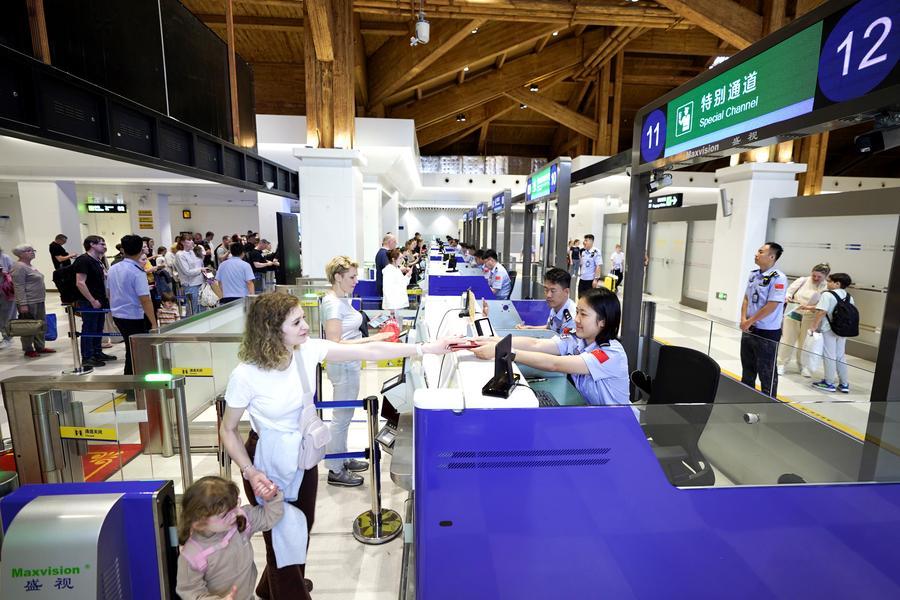
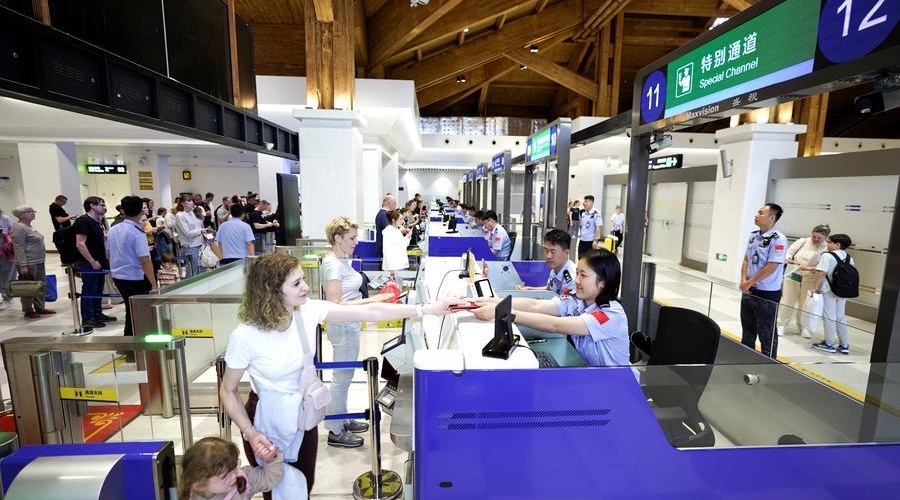
Inbound passengers go through border control at Sanya Phoenix International Airport in Sanya, south China's Hainan Province, March 27, 2026. [Photo/Xinhua]
"I'm gonna let you in on a little secret, OK? Tomorrow you are turning Chinese." That's how Sherry Zhu, a Chinese American creator in her early twenties, kicked off a TikTok video earlier this year.
Her "Becoming Chinese" video series, in which she jokingly laid down rules like drinking hot water, wearing slippers and eating no raw veggies in winter, quickly went viral. Partly inspired by her, millions of overseas users began posting videos showcasing their embrace of typical Chinese daily routines, ranging from drinking warm water and goji berry tea to wearing house slippers and practicing tai chi.
What is remarkable is that this cross-border cultural trend has moved beyond virtual screens and translated into tangible commercial gains worth billions of yuan. According to China's customs data, in the first quarter of 2026, China's exports of thermos flasks reached 5 billion yuan (about 732 million U.S. dollars). Meanwhile, tea exports hit 2.7 billion yuan, while overseas sales of electric kettles reached 200 million yuan.
These surging numbers tell a bigger story -- one where China's evolving industrial strength goes hand-in-hand with its expanding cultural appeal.
Functional vessel to lifestyle icon
Beneath the export surge lies the quiet but unmistakable upgrade of Chinese manufacturing: everyday products are transforming from factory goods to fashion statements, and from functional goods to globally competitive lifestyle brands.
"Chinese wellness culture has definitely played a catalytic role," said Yao Huajun, chairman of Everich And Tomic Housewares Co., Ltd. Founded in 2000, this enterprise has long focused on global markets for drinking utensils and household kettles.
In an interview with China News Service, Yao noted that as more international consumers recognize and adopt Chinese wellness habits such as drinking warm water, global demand for thermos products and traditional tea accessories continues to rise.
"In the past, thermos flasks were seen merely as practical daily tools," Yao added. "But currently in many countries, they have evolved into popular consumer goods that carry lifestyle attitudes, aesthetic pursuits and even social interaction attributes."
China ranks first in the global thermos manufacturing industry, with an annual output of roughly 800 million units, accounting for over 60 percent of the world's total production. Such strong capacity is backed by the Yongkang-Wuyi-Jinyun industrial cluster in east China's Zhejiang Province, a highly developed ecosystem that serves as the core pillar of China's thermos exports.
Industry analysis reveals that this cluster accounts for 70 to 80 percent of China's total thermos exports. Local manufacturers there produce around 80 percent of thermos products for major Western brands. Within an hour's drive, all necessary components are available, enabling rapid prototyping and efficient supply-chain collaboration.
Industry insiders believe that overseas appetite for Chinese thermoses is not a short-lived fad. In the next three to five years, smart cups capable of tracking water consumption and sending hydration reminders are expected to become highly sought-after in Europe and North America. Meanwhile, new materials such as titanium, lighter and safer than conventional options, are poised for wider adoption.
"Chinese thermos exports are not just about 'selling products,' they are about taking Chinese manufacturing, Chinese design and Chinese brand capabilities to the world," said Yao.
Online trend to offline journey
If manufacturing upgrading represents the hard power of goods exports, the spread of a daily lifestyle embodies the soft power of cultural communication.
Unlike previous waves that highlighted grand classical symbols such as Peking opera, ancient poetry and intangible heritage crafts, this "Becoming Chinese" trend is more grounded in the mundane: sipping goji berry tea from a thermos, doing eye exercises between screen breaks, and taking herbal foot baths. These habits are easy to grasp, simple to adopt, and rich in personal experience, making it easier to break down cross-cultural barriers.
"The 'Becoming Chinese' phenomenon on international social media offers a glimpse into the charm of Chinese culture and China's rising global clout," said Zhang Yuqiang, a professor at Communication University of China.
While foreign netizens are keen on "Becoming Chinese" online, a growing number of overseas tourists choose to travel to China to experience authentic local culture in person.
Thanks to China's continuous expansion of opening-up efforts and optimized entry policies, like the 240-hour visa-free transit policy covering 55 countries, cross-border travel has been greatly facilitated. In 2025, the number of inbound foreign tourists reached 150 million, a year-on-year increase of over 17 percent. The number of visa-free entries by foreigners exceeded 30 million, rising by 49.5 percent year on year.
In the first quarter of 2026 alone, the country's customs authorities handled more than 230,000 tax refund verification applications from departing foreign tourists, a fivefold increase compared with the same period last year.
"Many foreign friends are coming to China to immerse themselves in high-speed rail travel, wear hanfu, eat hot pot and experience Chinese lifestyles firsthand," said Wang Jun, deputy head of the General Administration of Customs. Their shopping lists have expanded beyond electronics, like smartphones and VR headsets, to include cultural and creative products and trendy toys.
"China has never tried to push its way of life or culture onto others. Instead, we present them to people overseas with an open and inclusive attitude, and interact with them sincerely. This mindset stems from our growing cultural confidence," said Zhang Yuqiang.


 京公网安备 11010802027341号