Share:

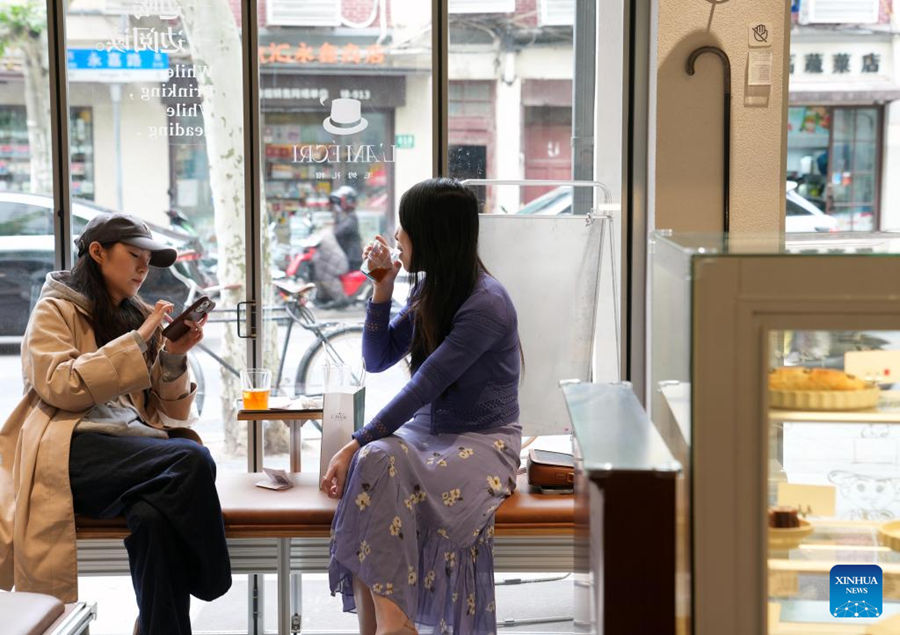
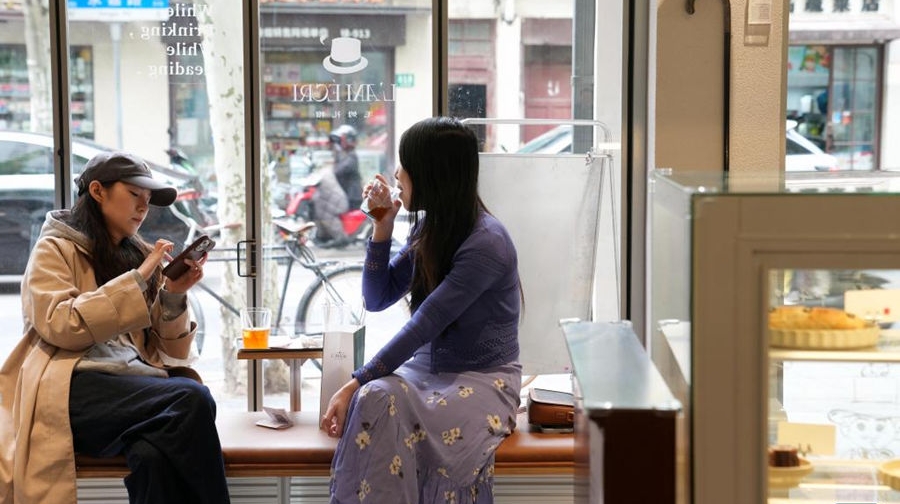
People enjoy the afternoon at LamEcri Cafe Bar in Xuhui District of Shanghai, east China, April 27, 2025. [Photo/Xinhua]
If you scroll through Chinese social media in the early evening, you might come across a light, almost playful phrase: 去去班味 (qùqù bānwèi). It often appears alongside small, familiar rituals. Someone changes out of their work clothes and heads out for a walk. Someone else films a quiet dinner, or a late coffee, or a moment alone on a balcony after a long day. The caption is simple: "去去班味." It is not an announcement or a complaint. It is a gesture, like a small act of self-care put into words.
The phrase itself feels informal and contemporary; part of a growing vocabulary that captures how younger professionals talk about the boundaries between work and life. It might be tempting to think of a familiar English expression like "work-life balance," but that phrase operates at a different level. It speaks to how time and energy are distributed across work and personal life, often in a long-term or structural sense. 去去班味 does something much less grandiose. It does not ask whether life is balanced. It begins at the end of a workday, and focuses on the small, immediate act of stepping out of it. Not by changing schedules or boundaries, but by noticing what remains, and letting it go. It does not dramatize burnout or celebrate productivity. Instead, it sits in a quieter space, acknowledging that work leaves something behind, and that this something needs to be eased away, or "aired out."
去去班味 literally means something like "away with the smell of work," or "off with the odor of the office." The repetition of the verb 去 (qù) softens the tone, making it feel less like a command and more like a gentle nudge. It carries a sense of lightness, even a hint of playfulness. The real weight of the phrase lies in 班味 (bānwèi), or "work smell."
Here, translation becomes less straightforward. There is no actual scent involved, at least not in any literal sense. In Chinese, 味 (wèi) does not always stay within the boundaries of taste or smell. It often extends into the idea of an atmosphere, a trace, or something that lingers after the fact, at times overlapping with what English speakers might call a "vibe." We see this in phrases like 人情味 (rénqíng wèi), which gestures toward the warmth of human connection, or 烟火味 (yānhuǒ wèi), which evokes the grounded, everyday texture of ordinary life. Even 生活味 (shēnghuó wèi) can suggest the sense that a space or moment has a lived-in feel, rather than feeling staged. In each case, 味 points to something intangible, but perceptible.
班味 works in a similar way. It names something that cannot be seen directly, yet is immediately recognizable to anyone who has experienced it.
This is not really about smell, and while it has some overlap with the looser modern uses of the word "vibe," it is different — more grounded, and more a quality that has taken shape over time than a mere "feel." Its lingering effect is an important part of the idea. It is something that can be sensed, even if it is not easily named. It points to something more specific: the residue of work, not just on the body, but on the self. It lingers in posture, in tone of voice, in the way one carries a conversation, or checks a phone, or holds a moment of silence. After a long day, it is possible to still be speaking in the rhythms of meetings, still responding as if one were in the office. To "remove" that is not simply to relax, but to step out of a version of oneself shaped by the workday.
Several English expressions come close, but each captures only part of the meaning.
"Unwind after work" is perhaps the most straightforward. It conveys the idea of releasing tension, of moving from a state of pressure to one of ease. It works well in context, especially in lifestyle writing or casual conversation. But it frames the experience primarily in terms of stress and relief. What it misses is the sense that something more than tension is being shed, something that has settled into the way one inhabits oneself.
"Decompress" offers a similar angle, with a slightly more modern tone. It suggests that the workday has built up pressure that needs to be released. Again, it is functional, and often appropriate. Yet it still treats the problem as mechanical. Pressure goes in, pressure comes out. The idea that work might shape one's presence, one's way of being in the world, remains in the background.
"Shake off the workday" moves closer to the physical metaphor embedded in 班味. There is a sense of something clinging, something that can be brushed away with a small act. This comes nearer to the texture of the original phrase. Even so, it remains focused on the day itself, rather than on the subtle shift in identity that the Chinese expression suggests.
"Get out of work mode" perhaps comes closest to that shift. It recognizes that work is not just a set of tasks, but a state of mind, even a temporary identity. To leave it behind is to transition into a different version of oneself. This captures an important part of the original Chinese, but it loses the sensory and slightly playful quality of the original. The metaphor becomes more abstract, less grounded in lived experience.
There is one phrase that comes so close in many ways, but with a key difference that essentially undoes its place as a serious candidate when selecting the closest translation: "let your hair down after work." The notion of letting one's hair down so neatly mirrors the minor change in the self that signals a change in the mode of being. It perfectly captures one of those mini rituals that shift the mind to a new space, and rid it of the old. However, it is most often used to imply socializing after work, or even partying, which moves it slightly away from the more casual, grounded space of 去去班味.
None of these translations are wrong. Each highlights a different facet of the experience. But taken together, they reveal something more interesting than any single equivalent could.
The feeling itself is universal. People everywhere recognize the need to leave work behind at the end of the day. What 去去班味 offers is a particular way of seeing that transition. It treats work not only as something we do, but as something that leaves a trace. And it recognizes that stepping out of it is not automatic, but something we do, consciously, in small and often quiet ways.
In that sense, the phrase feels both familiar and distinctly shaped by the language that expresses it. It names something many people experience, but gives it a form that invites attention, and perhaps, a little more care in how we move between the roles we inhabit.
Shelly Bryant is a writer and culture & communication consultant living in Singapore and China's Shanghai.
Opinion articles reflect the views of their authors, not necessarily those of China.org.cn.


 京公网安备 11010802027341号