 Share:

China's eradication of extreme poverty, officially announced in 2021, marked one of the most significant poverty-reduction efforts in human history. This achievement is defined not only by its immense scale, but also by the long-term mechanisms put in place to consolidate these gains.
The narrative of this transformation is perhaps most visible in the arid landscapes of northwest China's Ningxia Hui autonomous region. In the 1990s, families in parts of Xihaigu — a region once described as barely fit for human habitation — sometimes relied on a single bowl of water for a whole family's daily washing.
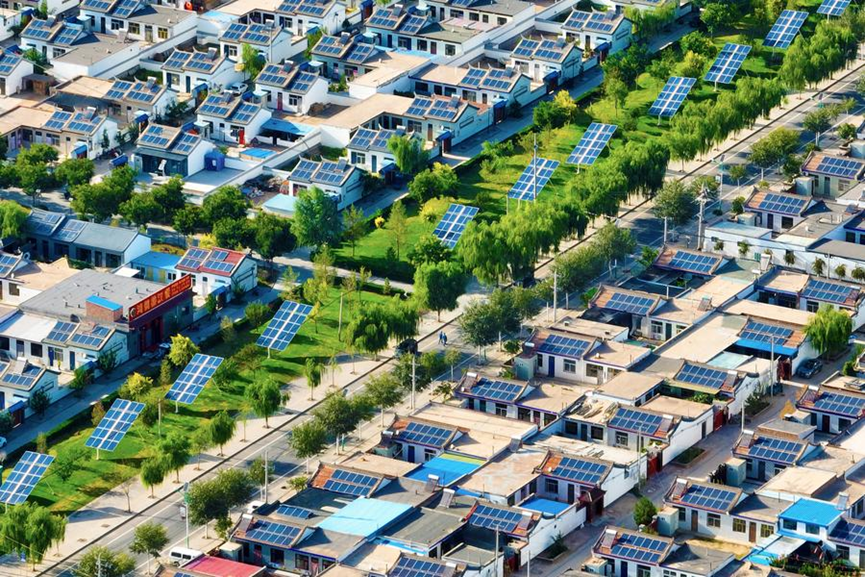
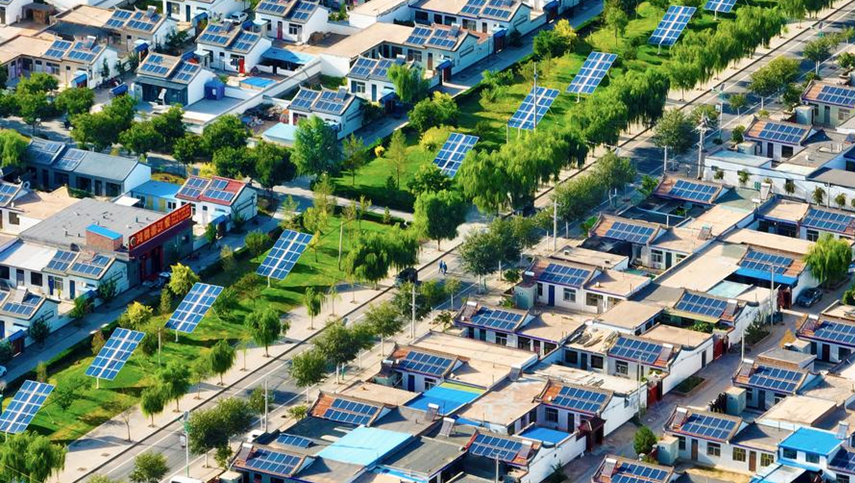
Buildings featuring rooftop solar panels in Yuanlong village of Minning town, Yongning county in Yinchuan, Ningxia Hui autonomous region, Aug. 23, 2024. [Photo/Xinhua]
Three decades later, the transformation of Minning town in Yinchuan city, home to relocated communities from Xihaigu, serves as a living symbol of this progress. Today, clean water flows from household taps, vineyards cover hills, and local industries — from agriculture to tourism and e-commerce — provide increasingly stable incomes.
The transformation is part of a broader national story of development and social change. By 2021, China had lifted the final 98.99 million impoverished rural residents out of absolute poverty, with all 832 impoverished counties removed from the poverty list. According to World Bank statistics, China has been responsible for over 70% of the global reduction in poverty since the late 1970s.
Yet the significance of this achievement lies not only in income growth, but in how poverty was redefined and addressed. Robert Walker, professor emeritus and emeritus fellow of Green Templeton College, University of Oxford, notes that development is not simply about increasing incomes, but about facilitating collective growth and building support systems that allow communities to share in the benefits of development.
In Walker's view, this broader understanding of development was reflected in the structure of China's anti-poverty campaign itself. "You built a situation where you had a partnership between rich cities and poorer cities," he observed. "That sort of putting together collective resources to address a social goal is difficult to replicate, but really interesting to see whether other countries could borrow from that framework."
This large-scale regional coordination was central to the success in places like Ningxia. Beginning in the mid-1990s, eastern prosperous provinces were paired with western regions under a nationwide assistance framework. The partnership between Fujian and Ningxia became one of the most prominent examples. Officials, technicians and enterprises from the coast helped develop industries, improve public services and create employment opportunities for relocated communities emerging from the Xihaigu region.
At the same time, local relocation initiatives known as "diaozhuang" — programs moving residents from ecologically fragile areas to more habitable regions — received stronger policy backing and long-term planning support. Around 8,000 people were gradually relocated to Minning village, which was upgraded to Minning town in 2001. The name Minning denotes the partnership between Fujian and Ningxia, as min refers to Fujian, while ning stands for Ningxia.
Over the past 30 years, Fujian province has invested a total of 7.032 billion yuan in assistance to Ningxia, with nearly 7,000 Fujian-based enterprises and merchants establishing operations there. The once-barren settlement gradually evolved into a functioning town economy. Today, Minning is home to more than 60,000 residents. Per capita income has risen from 500 yuan in 1995 to nearly 20,300 yuan today, exceeding the average level of Ningxia as a whole.
Over 30 years of Fujian-Ningxia cooperation, change has extended far beyond Minning town. More than 600,000 people in Ningxia have moved into new homes, and over 800,000 people have been lifted out of poverty. The growth rate of rural residents' disposable income in Ningxia has for many years remained higher than the national average. Industries such as wine, goji berries and Tan sheep have developed into integrated industrial chains with a total output value exceeding 100 billion yuan.
For older generations who experienced Xihaigu's hardship firsthand, the transformation remains deeply personal. Hai Guobao, a 70-year-old former villager from Guyuan, now lives in Minning town after relocating decades ago. He recalled that in the area where he once lived, many children could not begin primary school until they were 8 or 9 years old because of the harsh conditions. Today, his grandchildren attend university and modern schools, while his son works in vineyards made possible through irrigation and agricultural modernization. "Without these policies and support programs, farming families like ours could never have escaped those mountains," Hai said.
However, policymakers recognized that escaping poverty is not a destination. To prevent a return to deprivation, The government has transitioned from a campaign-style eradication to the long-term management of vulnerability. During the 14th Five-Year Plan period (2021-2025), China allocated 850.5 billion yuan in central government follow-up rural revitalization assistance funding to consolidate poverty alleviation gains.
The results of this transition are already visible. The per capita disposable income of residents in once impoverished rural areas has grown at an average real rate of 7.8% annually, outpacing the national rural average. The number of employed people among those lifted out of poverty remained at over 30 million for five consecutive years. Nearly three-quarters of people lifted out of poverty are now linked to new types of agribusiness, while the combined output of leading industries in 832 counties that had shaken off poverty exceeds 1.7 trillion yuan.
At the same time, basic living conditions have been fundamentally reshaped. Rural tap water coverage has reached 96%, while compulsory education dropout rates among families that had shaken off poverty have been effectively reduced to near zero. Basic medical insurance coverage for those prone to lapse or relapse into poverty remains above 99%. These indicators point to a shift from temporary subsistence relief to system-wide service provision.
Poverty, Walker notes, is not static but dynamic — something that fluctuates with health, employment and life cycles. China's system reflects this understanding through a dynamic monitoring and assistance mechanism designed to identify households at risk of falling back into poverty and intervene before hardship becomes entrenched.
This marks an important shift: from campaign-style eradication to long-term management of vulnerability and risk. During the 15th Five-Year Plan period (2026-2030), China will shift the focus into a phase of regularized and targeted assistance. At present, various support policies and measures are being further refined and improved, while areas that had shaken off poverty are making steady strides toward all-around rural revitalization.
China's eradication of extreme poverty is best understood not as a final destination, but as the foundation for the broader goal of common prosperity and long-term rural revitalization. The challenge now lies in ensuring that growth remains inclusive, sustainable and resilient. In that sense, the story is not finished — it is still being rewritten.


 京公网安备 11010802027341号