

 Share:

From May 8 to 10, the Fusion Conference, the highest-level academic conference in the global field of fibroblast growth factor (FGF) research, was held in St. Julian's, Malta. Originating from the Fusion Conferences, a high-level European academic conference, the event is on par with the Gordon Research Conferences (GRC) and brings together the world's leading professors, founders of disciplines, principal investigators from top international research institutions, R&D executives from multinational pharmaceutical companies, and leading experts in clinical medicine.
Li Xiaokun, an academician of the Chinese Academy of Engineering and president of Wenzhou Medical University (WMU), served as co-chair of the conference. He also participated extensively in academic discussions and led efforts to advance multiple international cooperation initiatives.
As co-chair of the conference, Li actively promoted global academic exchange and industry collaboration in FGF research. During the conference, the WMU team conducted academic exchanges and in-depth discussions with experts worldwide on cutting-edge topics including FGF and metabolic regulation, research and development of long-acting fusion proteins, wound repair, and disease treatment.
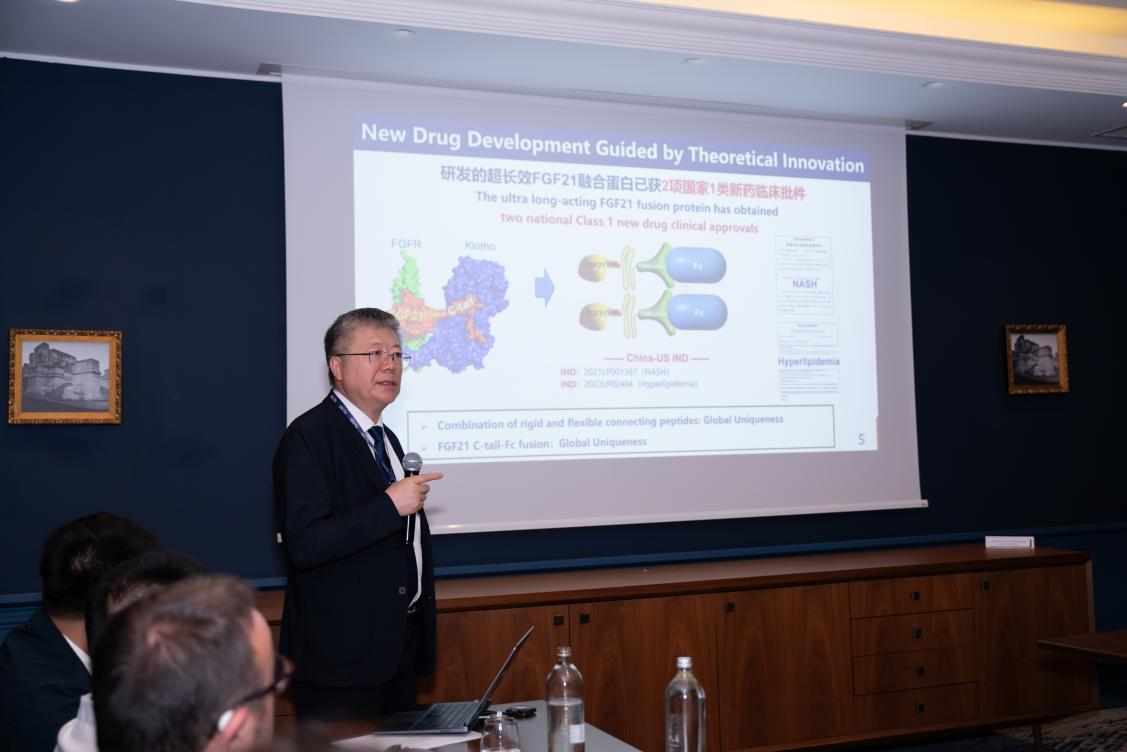
Academician Li Xiaokun delivers a keynote report at the development seminar of the International Cell Growth Factor Alliance on May 8 in St. Julian's, Malta. [Photo courtesy of WMU]
During the conference, Li convened a development seminar of the International Cell Growth Factor Alliance (IGFA). More than 20 internationally renowned professors from countries including the U.S., the U.K., Germany, France, Switzerland, Italy, and the Czech Republic attended the seminar. Li noted that FGF research has entered a critical stage in its transition from basic science to clinical translation, making it imperative to establish an open and sustainable international collaboration platform. Experts held in-depth discussions on issues such as equality and openness, scientific integrity, translational collaboration, and sustainable governance, and reached broad consensus: Looking ahead, the alliance will be open to FGF researchers worldwide, break down barriers related to geography, institutions, and seniority, and strongly support the deep participation of young scientists. At the same time, it will uphold academic ethics and research standards, accelerate the translation of basic research findings into clinical applications and industrial development, and establish new mechanisms for research collaboration across national borders.
David Ornitz, a professor at Washington University, said, "The FGF family comprises numerous members with complex functions, while research efforts across countries have long been relatively dispersed. An organized international alliance will greatly advance collaborative innovation among us."
As another important item on the agenda, the editorial board of Cytokinology, an international English-language academic journal sponsored by WMU, was officially launched. The journal focuses on the full spectrum of cytokine science, covering the entire chain from molecular mechanisms and signaling pathways to disease applications and translational medicine. The launch brought together leading experts from more than 20 countries, including authoritative scholars such as Ornitz, Sabine Werner, and Chiara Francavilla. Sabine Werner, a professor at ETH Zurich in Switzerland, noted that the journal responds to the trend of multidisciplinary integration and is of great significance to the development of the growth factor field. Mohammad K. Hajihosseini, a professor at the University of East Anglia in the U.K., said that by building an open and shared academic platform, the journal will help to draw greater attention from the international academic community to advances in this field.
During the conference, WMU officially released its open research projects for the Cell Growth Factor Peak Discipline to the global community. The initiative supports high-level research teams and outstanding young talents worldwide in conducting joint research on major scientific issues in the field of growth factors, with complementary support for graduate training and international exchange. The projects will focus on areas such as AI-based development of FGF agonists and antagonists, exploration of novel regulatory factors, investigation of new disease mechanisms, and development of new signal transduction technologies. They aim to advance collaborative research among domestic and international teams, promote the translation of research outcomes, and foster joint talent cultivation.
According to reports, drawing on its strengths in disciplines such as pharmaceutical sciences, WMU has long maintained an internationally leading position in basic FGF research and translational applications. Through more than three decades of dedicated work, Li's team has enabled China to become the first country in the world to successfully develop growth factors into clinical drugs. During the visit to Malta, through a series of initiatives including academic presentations and exchanges, alliance development seminars, the launch of an international journal, and the release of open research projects, WMU established an integrated international cooperation network in the global FGF research field that brings together mechanisms, platforms, and resources. Looking ahead, the university will continue to advance frontier research in biomedicine and make greater contributions to promoting scientific and technological progress in life and health and serving the country's overarching strategic priorities.


 京公网安备 11010802027341号