 Share:

While the Chinese and United States leaders met amicably in Beijing last week, the way forward is not clear. The Chinese side consistently has proposed constructive ideas to stabilize and improve relations, but before President Trump's China trip, the U.S. side had yet to respond in a substantial way. Meanwhile, the world is changing, and the international situation is volatile and increasingly dangerous.
Back in 2013, President Xi Jinping and President Barack Obama met in California for an important informal summit. President Xi proposed a "new type of major power relations" on a win-win basis. Washington did not take this offer up directly, but it did lead to broader engagement and to a diplomatic process that involved over 80 working groups in different fields of mutual interest. We must see a return to such engagement.
President Xi explained to the United States that constructive strategic stability is possible. The foundation is, of course, constructive engagement on the basis of the principles of peaceful coexistence. International law must be respected, and that includes the principle of state sovereignty.
Washington's China policy not consistent
American presidents beginning with Richard Nixon, a Republican, and later President Jimmy Carter, a Democrat, sought to manage relations with China constructively, but there were obstacles such as the Taiwan question, which was exploited by hawks in the U.S. with a Cold War mentality. During the George W. Bush Administration, a major revision of Washington's foreign policy began to be implemented under the succeeding Obama Administration.
This was the "pivot to Asia" policy. The United States had been bogged down in the Middle East in Iraq and Afghanistan, and at the same time, China was rising. Thus, the geopolitical concept was to pivot away from the quagmire in the Middle East and swing military assets to the Pacific in order to "contain" China. The concept involved bringing Japan, India, and Australia into alignment with Washington to contain China. This was the so-called "Quad" concept.
The first Trump Administration, beginning in 2017, followed this general policy but took a more pronounced turn against China in the economic area with its negative trade and technology policies. Trump also took harsh economic measures with sanctions and tariffs against other countries as well. The European economy had already been slowing, so the Trump economic warfare policies, combined with the black swan Covid crisis, further hurt the world economy and economic development.
The succeeding Biden Administration continued Trump's economic policy line, and the second Trump Administration, not surprisingly, continued the policy. Added to this negative impact on the world economy and global development, the Israeli-American war against Iran today is very sharply and seriously impacting the world economy and the international community.
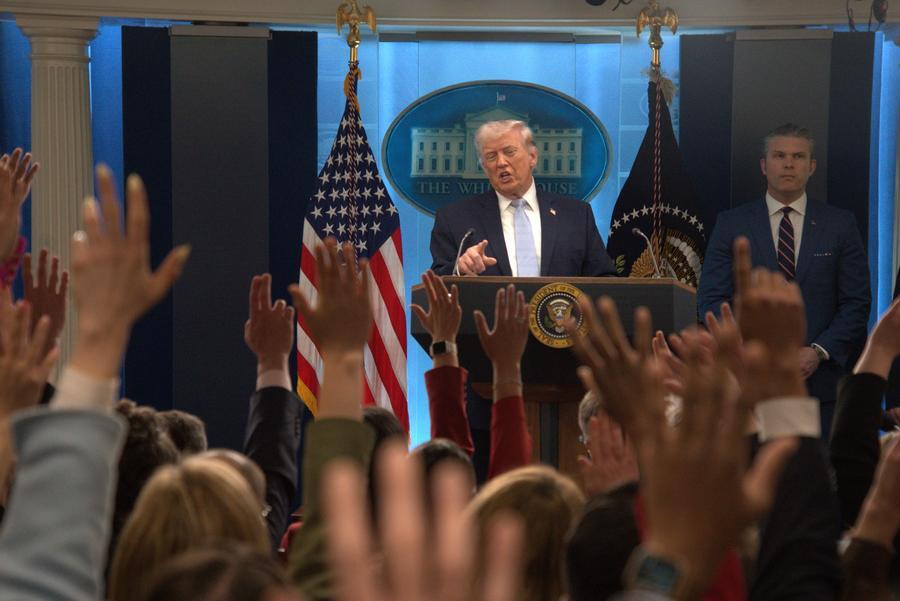
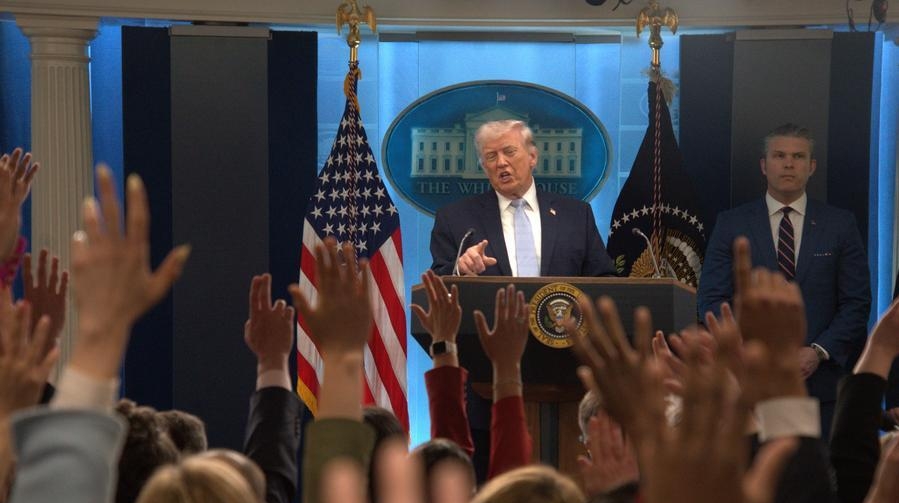
U.S. President Donald Trump speaks during a press conference at the White House in Washington, D.C., the United States, Apr. 6, 2026. [Photo/Xinhua]
The world has changed
The world has changed, and has changed dramatically, over the past quarter century. China has made great strides in its national rejuvenation objective and is now the largest economy in the world by PPP, and is also a formidable modern technological and military world power. At the same time, Russia has returned as a major world power.
The United States, however, is in relative decline economically, militarily, and culturally. The greatest arguable strategic mistake in U.S. history was the failed Iraq and Afghanistan military adventure. Today, Washington's Iran War, spurred by the Israel Lobby in the U.S., is yet another historic strategic mistake. It may well have more profound and long-lasting military, diplomatic, and economic consequences and thus become the greatest strategic mistake in U.S. history.
Washington's support for Israeli genocide in Gaza, the West Bank, and Jerusalem, combined with the Israeli-American war against Iran has severely damaged America's reputation and has alienated a majority of the world's population. Polling data shows that this is true in the United States itself. A majority of the American population, particularly the youth, but also a majority of the under-50 age group generally, is alienated from Washington's reckless and shameful foreign policy. There is increasing political volatility in the United States.
Washington must rethink and reappraise
Within the context of a changing world and international situation, Washington must undertake what would be an agonizing reappraisal of its national strategy, foreign policy, and military posture. Over the past quarter century, Washington has engaged in reckless wars, covert actions, and the like, which jeopardize the future of the United States.
The world is moving on, and the familiar post-World War II world is fading. A new world is emerging as the international situation changes and shifts power from the West, the United States and Europe, to the East, Eurasia. New international institutions and alignments are emerging. The United States has acted to disrupt the United Nations and international law and this further isolates the United States and impairs its reputation and influence.
The United States, for the sake of its own future generations, must come to its senses and abandon the follies of empire. The national strategy of global hegemony must be ended and be replaced by a policy of peace and cooperation. Instead of a futile and reckless attempt to maintain world hegemony, Washington must scale back from its current unsustainable path. Washington must think in terms of a national future as a responsible republic, not as a hegemonic empire, within the world community, which desires peace and development.
With such a responsible vision in Washington, relations between the United States and China can not only be repaired but also flourish in a condition of constructive strategic stability.
Dr. Clifford A Kiracofe is President of the Washington Institute for Peace and Development and former senior professional staff member of the US Senate Committee on Foreign Relations.


 京公网安备 11010802027341号