 Share:

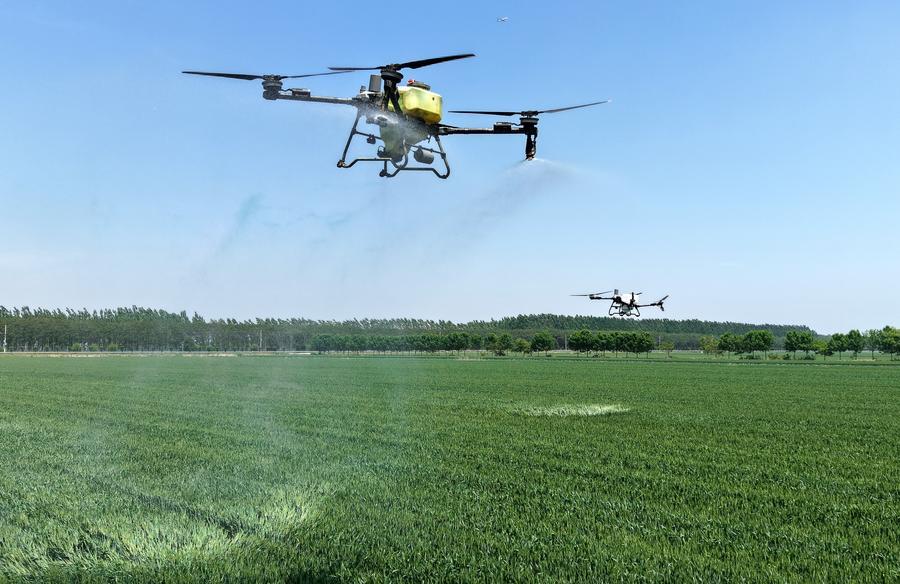
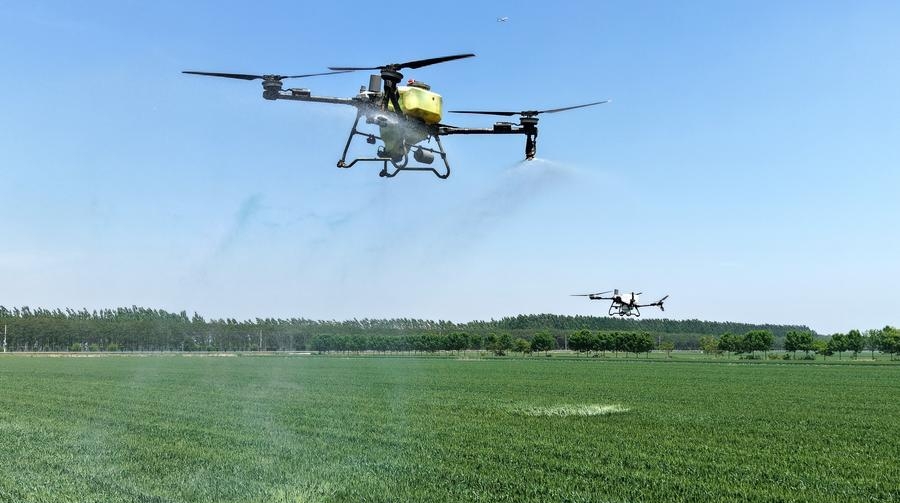
A drone photo shows plant protection drones conducting spraying operations in the wheat fields of Houshuangqiu Village of Qingdao, east China's Shandong province, May 6, 2026. [Photo/Xinhua]
The High-Quality Development Conference of the Low-Altitude Economy Industry convened in Beijing on Wednesday under the theme "Empowering Airspace, Converging for Strength." Policymakers, industry leaders and financial institutions gathered here to chart the trajectory of a sector now firmly embedded in China's national economic blueprint.
The gathering follows a series of policy developments that have positioned the low-altitude economy as an increasingly important part of China's national strategy. The 15th Five-Year Plan (2026–2030), unveiled earlier this year, explicitly calls for "promoting the healthy and orderly development of the low-altitude economy." As the opening year of the Plan, this year also saw the Government Work Report formally designate the low-altitude economy as an emerging pillar industry, alongside integrated circuits, aviation and aerospace, biomedicine, new types of energy storage, and intelligent robots. This marks the third consecutive year the sector has appeared in the Government Work Report, with a clear shift in its positioning, going from a "new growth engine" in 2024, to an "emerging industry" in 2025, and now to an "emerging pillar industry" in 2026.
Chen Yanbin, Deputy Party Secretary and Director of the Institute of Industrial Economics at the Chinese Academy of Social Sciences (CASS), noted during the conference, "The low-altitude economy represents a new arena for national competitiveness, a new dimension for urban development, and a new horizon for people's well-being," Chen said, adding that China is uniquely positioned with "steadfast policy support, a complete industrial system, a dynamic innovation ecosystem, and an enormous domestic market."
According to estimates released by the National Development and Reform Commission (NDRC) during this year's "Two Sessions," the emerging pillar industries — including the low-altitude economy — generated a combined output of nearly 6 trillion yuan ($885.3 billion) in 2025, a figure projected to double to over 10 trillion yuan by 2030. The Civil Aviation Administration of China (CAAC) estimates that the low-altitude economy market alone reached 1.5 trillion yuan in 2025 and is expected to exceed 3.5 trillion yuan by 2035.
Deng Zhou, Director of Industrial Development Research at CASS's Institute of Industrial Economics, presented the Low-Altitude Economy Development Report (2026) during the conference. He noted that China's drone R&D and manufacturing capabilities now rank among the global top tier, with eVTOL aircraft poised for rapid growth. He said that China's revealed comparative advantage index for low-altitude products stands at 3.13, and its trade competitiveness index at 0.83 — both indicating world-class export strength. Deng also mentioned the low-altitude economy is moving from pilot projects toward full industrial synergy, with growing applications in logistics, urban governance, and emergency response,.
The policy architecture supporting this growth has been reinforced on multiple fronts. The newly revised Civil Aviation Law, effective July 1, 2026, requires relevant state departments and provincial governments to formulate low-altitude economy development plans, improve supporting policies, and encourage technological innovation and application expansion. In April, the State-owned Assets Supervision and Administration Commission (SASAC) convened a special meeting directing central enterprises to serve as "long-term capital, strategic capital and patient capital" in building internationally competitive low-altitude industry clusters.
On the ground, commercialization is accelerating. Danfeng county in Shaanxi province, home to a CASS low-altitude economy research base, saw its low-altitude output value surpass 1.5 billion yuan in 2025, deploying drone-based intelligent inspection systems for geological hazard sites, while training over 5,000 drone professionals annually.


 京公网安备 11010802027341号