 Share:

Young politicians from China and Europe called for stronger cooperation and greater mutual understanding at the China-Europe Young Politicians Forum, held on May 28 at the Yanjing Eight Imperial Handicrafts Museum in Beijing.
Held under the theme "Bridging Differences and Advancing China-Europe Cooperation: Responsibilities of Young Politicians in Our Times," the forum brought together more than 20 young politicians from 12 countries, including Germany, France, Spain and Switzerland.
Participants exchanged views on China-Europe relations, global governance, cultural exchanges and the role of younger generations in promoting peace and cooperation in a rapidly changing world.
Ma Hui, deputy head of the International Department of the CPC Central Committee (IDCPC), highlighted the steady growth of China-Europe ties over the past five decades.
"As 2025 marks the 50th anniversary of diplomatic relations between China and the European Union, bilateral trade has expanded from $2.4 billion at the beginning of diplomatic ties to more than $820 billion last year," Ma said.
He added that people-to-people exchanges have also flourished. In 2025, more than 2 million European tourists visited China visa-free, while nearly 10 million trips were made by Chinese tourists to Europe.
Ma noted that 2025 marks the first year of China's 15th Five-Year Plan period (2026-2030) and said the development of China-Europe relations tests the political wisdom of both sides. Building a healthy, stable and mature relationship, he added, is a responsibility young politicians cannot shirk.
Davide Aiello, a member of the Italian Chamber of Deputies and head of the European young politician delegation, emphasized the role of younger generations in strengthening exchanges.
Aiello said being young politicians gives participants a unique advantage, adding that dialogue between Europe and China requires openness, energy and a willingness to learn from one another. He encouraged participants to make full use of the visit to deepen understanding and build genuine friendships.
"We can overcome our differences if we work together and look at the same goals," he said. "Let's prove that Europe and China can cooperate for a world that is cleaner, tighter and safer for everyone."
The Beijing Eight Imperial Handicrafts are Jingtailan (Cloisonne), carved lacquer, jade carving, palace carpet, gold lacquer inlay, filigree inlaid metal art, ivory carving and Beijing embroidery.
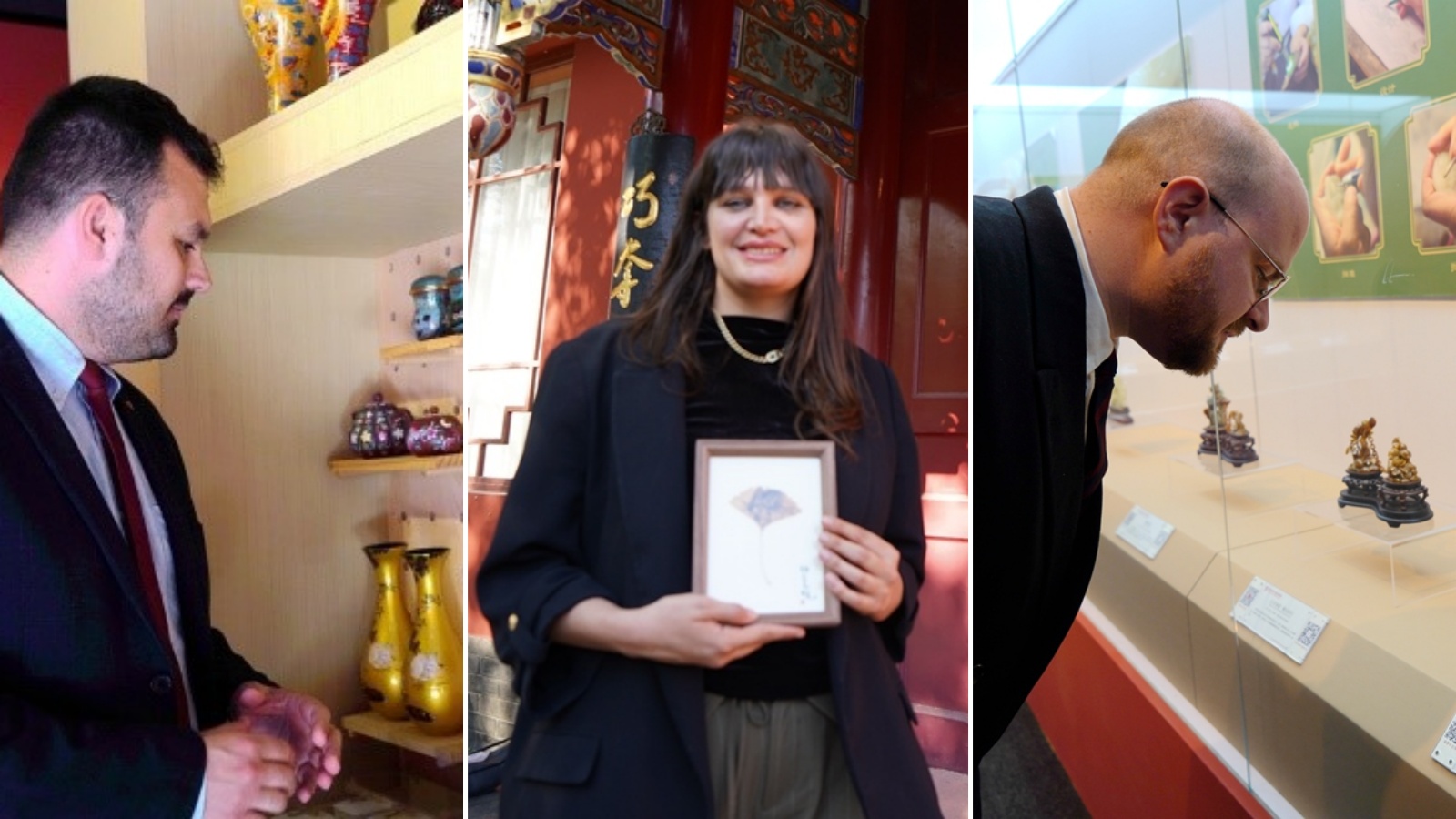
On the sidelines of the event, the delegation toured museum exhibits and watched a Wing Chun martial arts performance, gaining firsthand experience of traditional Chinese culture.
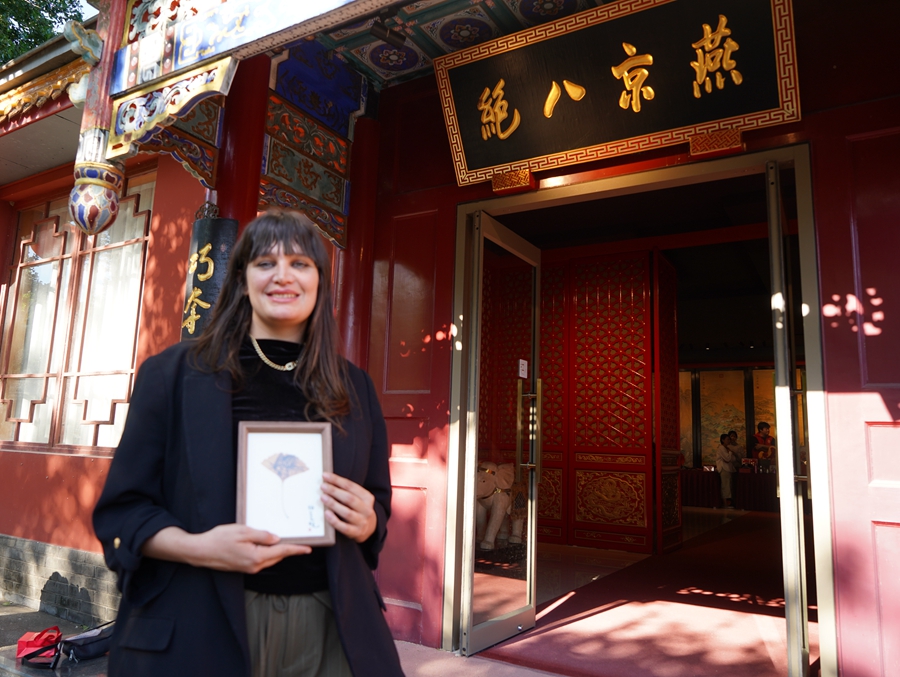
Alma Dufour, a member of the French National Assembly, poses for a photo outside the Yanjing Eight Imperial Handicrafts Museum in Beijing, holding a piece of leaf carving artwork, May 28, 2026. [Photo by Xu Xiaoxuan/China.org.cn]
In an interview with China.org.cn, Alma Dufour, a member of the French National Assembly, said the traditional handicrafts displayed at the museum reflected values that deserve wider appreciation.
"The artworks we saw in the museum need a lot of delicacy and a lot of patience," Dufour said. "This is sometimes a value that we don't nurture enough in Western countries."
She added that Europe and China should expand exchanges, as deeper mutual understanding would make political and economic cooperation easier.
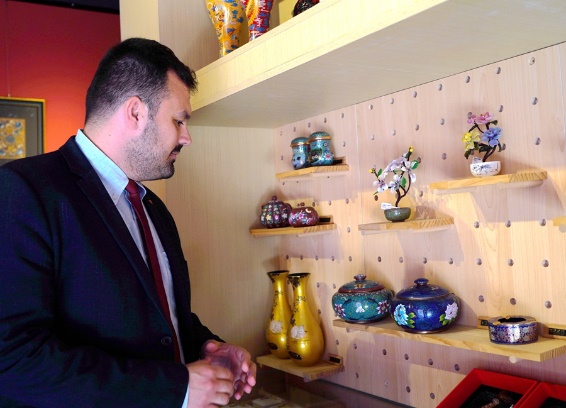
Foivos Tsiklias, deputy spokesperson and member of the Central Committee of Syriza in Greece, views exhibits at the Yanjing Eight Imperial Handicrafts Museum in Beijing, May 28, 2026. [Photo by Xu Xiaoxuan/China.org.cn]
Foivos Tsiklias, deputy spokesperson and member of the Central Committee of Syriza in Greece, said young leaders bear a responsibility to safeguard international law, transnational cooperation and peace amid global turbulence.
"Cooperation between Europe and China is very important and is fundamental to keeping stability in the world," Tsiklias said.
He described the Global Civilization Initiative as an important proposal, saying countries should preserve their own identities while engaging in open dialogue among civilizations in pursuit of a shared future.
"We should also discuss how cultural and civilizational endeavors would help break barriers, bridge differences and foster understanding," he said. "Because culture and civilization are the best means to accomplish friendship and unity."
Tsiklias added that stronger two-way investment between China and Europe could help strengthen both economies, revitalize growth and create greater opportunities for younger generations.
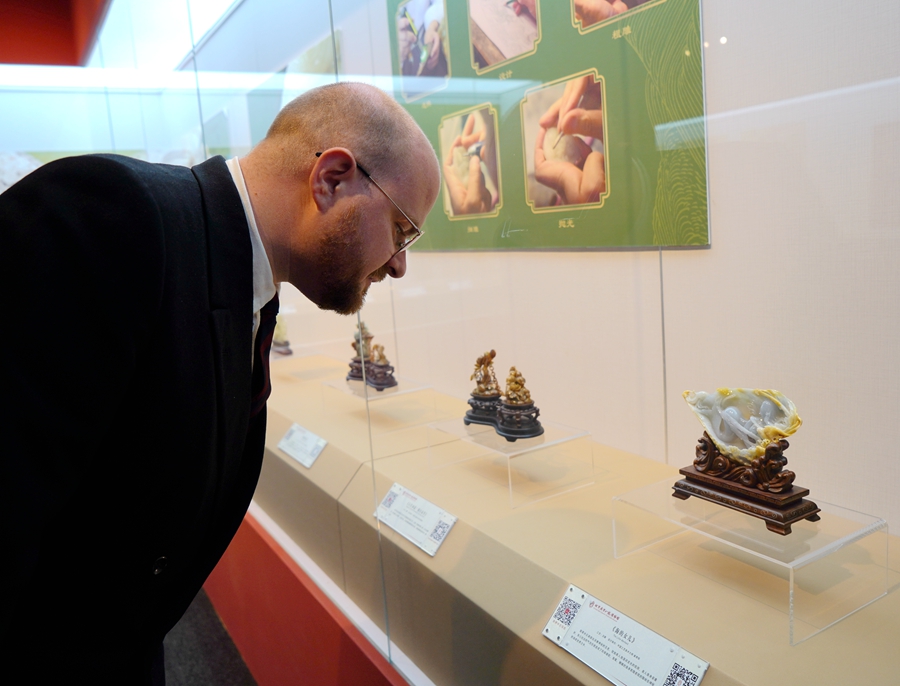
Markus Pohle, a member of the Executive Board of Germany's Die Linke party, views a jade carving at the Yanjing Eight Imperial Handicrafts Museum in Beijing, May 28, 2026. [Photo by Xu Xiaoxuan/China.org.cn]
Markus Pohle, a member of the Executive Board of Germany's Die Linke party, said both China and Europe share a common interest in maintaining a stable international system and can play an important role in promoting global stability.
"I think that both China and Europe have at the core of their interest a stable international system," Pohle said.
He said the current global order is characterized by multiple modernities, arguing that it is no longer shaped solely by a Western-dominated system. Different civilizations, he said, should engage in dialogue to better understand how societies resolve internal differences and foster mutual acceptance of diverse models of modernity.


 京公网安备 11010802027341号