 Share:

More than 200 representatives from 18 international organizations and 35 countries and regions gathered in Huangshan, Anhui province, on May 31 to examine how digital technologies can help safeguard UNESCO-designated sites and advance sustainable development.
The discussions took place at the 5th Huangshan Dialogue on UNESCO-designated Sites and Sustainable Development, a two-day forum that brought together heritage experts, policymakers, researchers and technology specialists from around the world.
This year's dialogue marks an "important milestone," according to Guo Huadong, director of the International Centre on Space Technologies for Natural and Cultural Heritage (HIST) under the auspices of UNESCO, as it has been included in the framework of the International Decade of Sciences for Sustainable Development (2024-2033), a United Nations initiative aimed at harnessing science to advance sustainable development worldwide.
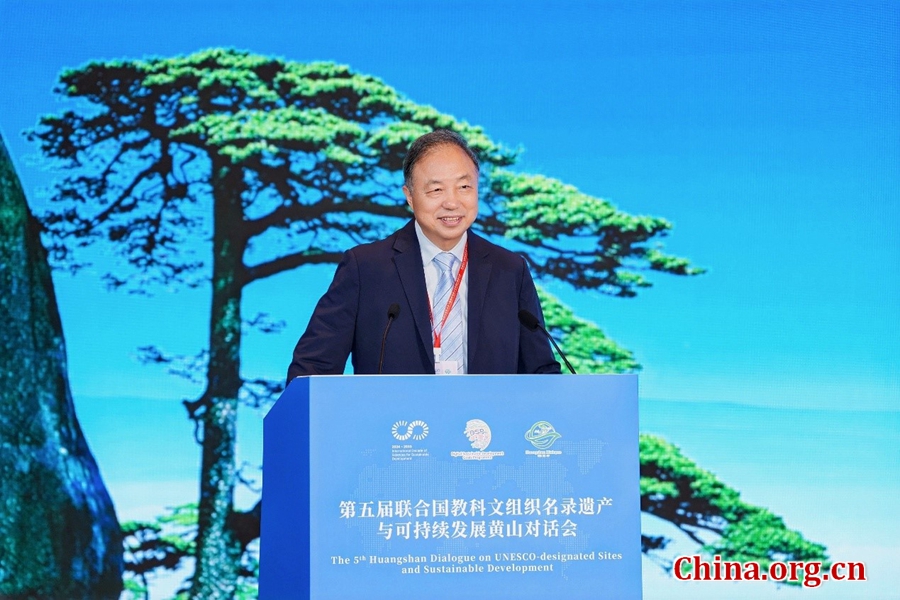
Guo Huadong, director of the International Centre on Space Technologies for Natural and Cultural Heritage under the auspices of UNESCO, speaks at the opening ceremony of the 5th Huangshan Dialogue in Huangshan, Anhui province, May 31, 2026. [Photo provided to China.org.cn]
Guo said the international community increasingly recognizes the role of digital tools, including space technologies, in the identification, monitoring, assessment, presentation and management of heritage sites.
To support the implementation of the World Heritage Convention and the U.N. 2030 Agenda for Sustainable Development, he proposed strengthening interdisciplinary research on heritage conservation, enhancing education and talent cultivation, and expanding the innovative application of digital technologies to improve heritage monitoring, risk prevention, and site management.
At the opening ceremony, Lazare Eloundou Assomo, director of the World Heritage Centre, highlighted the first global assessment of over 2,260 World Heritage Sites, Biosphere Reserves and Global Geoparks recently undertaken by UNESCO and HIST.
The assessment, he said, "was only possible thanks to advances in digital technologies, including earth observation data, spatial analysis and large-scale environmental monitoring tools."
"These technologies are not only helping us generate new global knowledge to better understand the state, contribution and resilience of UNESCO-designated sites," Assomo said. "They are also providing increasingly powerful tools to improve management on the ground through stronger monitoring systems, better risk detection and more informed decision-making."
He stressed that digital technologies should be used responsibly and ethically in ways that remain human-centered, transparent, and grounded in science, international cooperation and the needs of local communities.
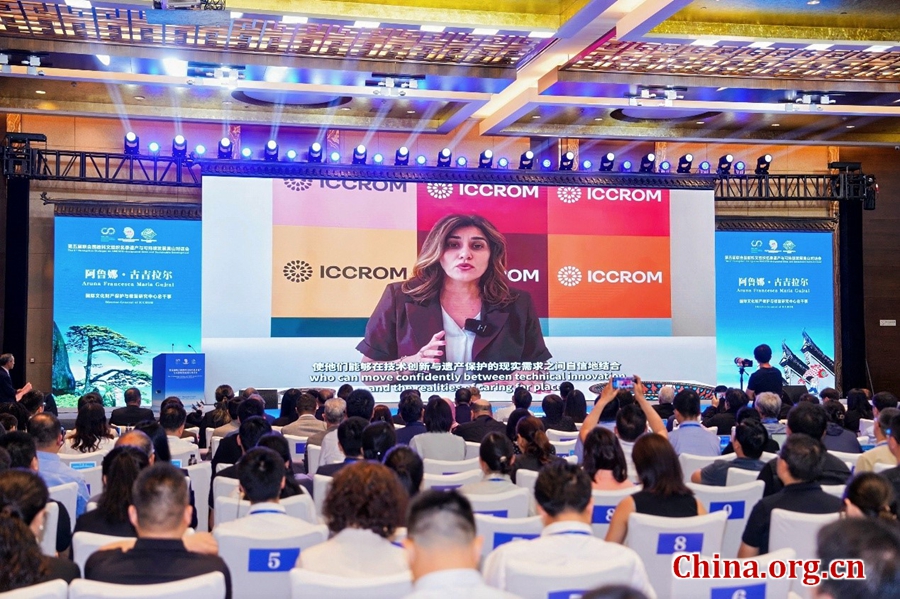
Aruna Francesca Maria Gujral, director general of the International Centre for the Study of the Preservation and Restoration of Cultural Property, addresses the opening ceremony of the 5th Huangshan Dialogue via video link, May 31, 2026. [Photo provided to China.org.cn]
Speaking via video link, Aruna Francesca Maria Gujral, director general of the International Centre for the Study of the Preservation and Restoration of Cultural Property (ICCROM), echoed the importance of placing people at the heart of heritage conservation.
Gujral said ICCROM's Strategic Plan 2026-2031 emphasizes conserving, activating and recognizing heritage in all its forms, with communities and institutions playing a central role.
"Digital technologies can amplify this work substantially, provided they remain guided by human expertise in conservation, local knowledge and the ethical responsibility that heritage carries," she said.
According to Gujral, big data, digital twins, remote sensing and artificial intelligence are no longer peripheral tools: "These technologies are reshaping how we identify values, anticipate risk, monitor change and support decision-making at sites increasingly affected by climate change, urbanization, disasters and conflict."
The integration of digital tools with conservation practice, she added, includes risk monitoring, documentation and the training of new generations of professionals who can move confidently between technical innovation and the realities of caring for places.
"They require sustained cooperation across the international heritage system, with research institutes, site managers, governments and youth working together," she said.
Gujral highlighted that the Huangshan Dialogue, over the course of its previous four editions, has become an important international platform where conservation, science and technology converge in meaningful and forward-looking ways.
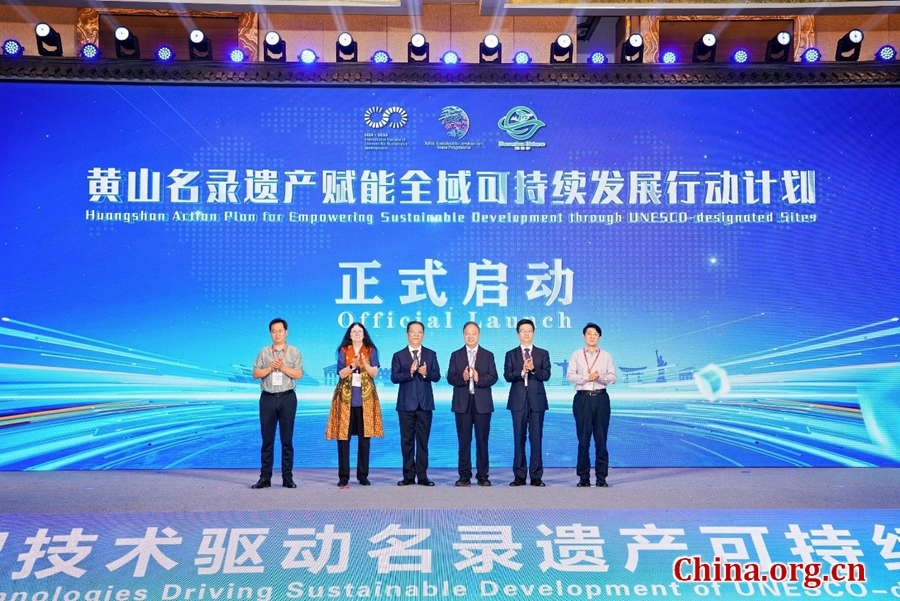
Officials attend the launch of the Huangshan Action Plan for Empowering Sustainable Development through UNESCO-designated Sites at the opening ceremony of the 5th Huangshan Dialogue in Huangshan, Anhui province, May 31, 2026. [Photo provided to China.org.cn]
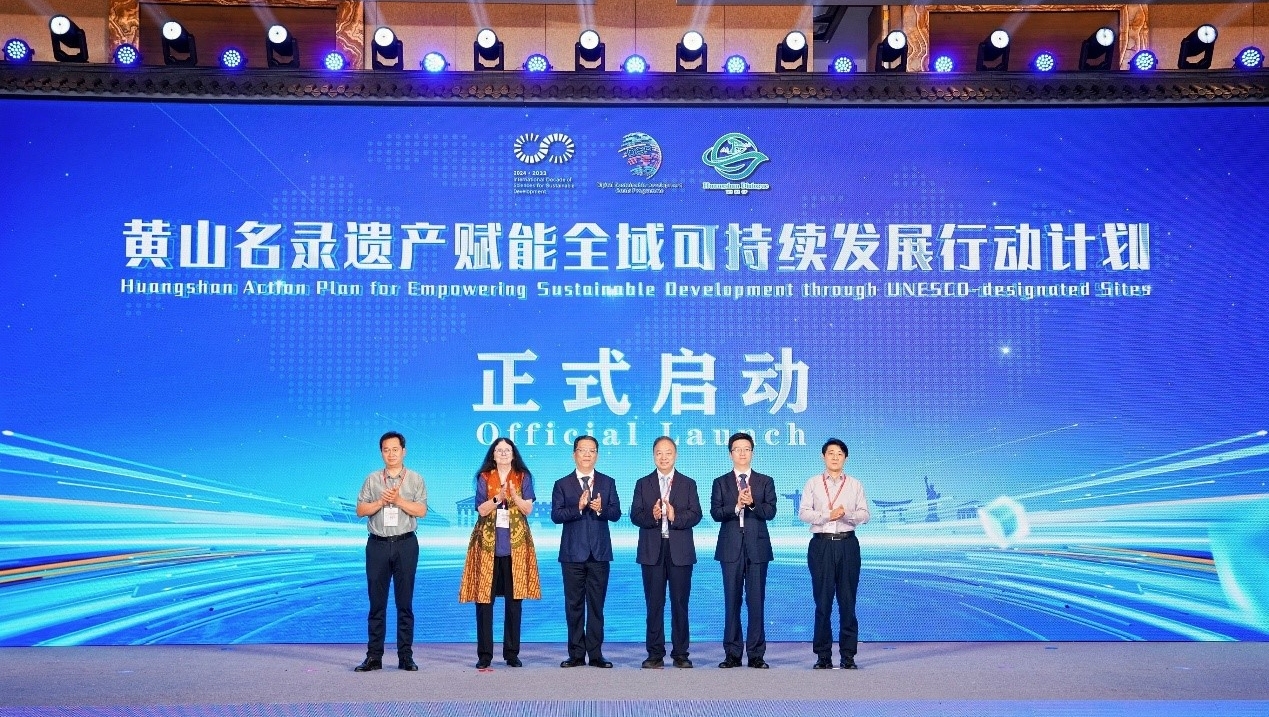
This year's dialogue also saw the launch of the Huangshan Action Plan for Empowering Sustainable Development through UNESCO-designated Sites and the release of the Remote Sensing Dynamic Monitoring Atlas of Global World Cultural Heritage (2020-2025), among other achievements.
Wu Xuguang, deputy director of the Mt. Huangshan Scenic Area Administrative Committee, said that the dialogue aims to foster collaboration among heritage policymakers, researchers, managers, practitioners and technology experts in addressing common challenges facing heritage sites worldwide.
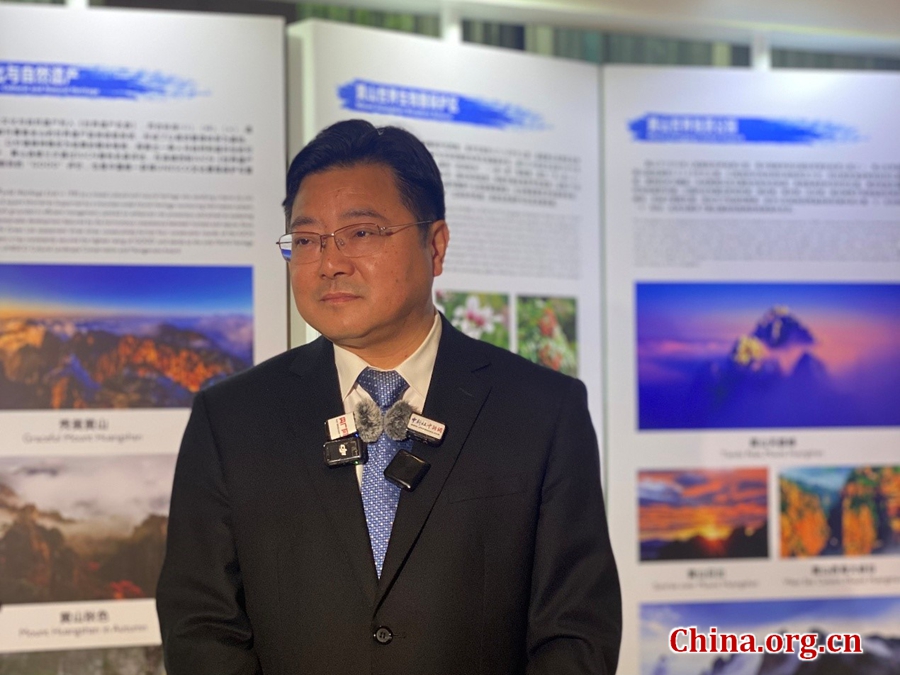
Wu Xuguang, deputy director of the Mt. Huangshan Scenic Area Administrative Committee, gives an interview during the 5th Huangshan Dialogue in Huangshan, Anhui province, May 31, 2026. [Photo by Wang Wei/China.org.cn]
He expressed hope that the consensus and initiatives reached at the dialogue will be translated into concrete actions, generating more replicable Huangshan practices to support the sustainable development of heritage sites around the world and advance harmonious coexistence between humanity and nature.
The 5th Huangshan Dialogue was co-hosted by HIST, the International Research Center of Big Data for Sustainable Development Goals, the Aerospace Information Research Institute of the Chinese Academy of Sciences, the Department of Culture and Tourism of Anhui Province, and the Huangshan Municipal People's Government.


 京公网安备 11010802027341号