


 Share:

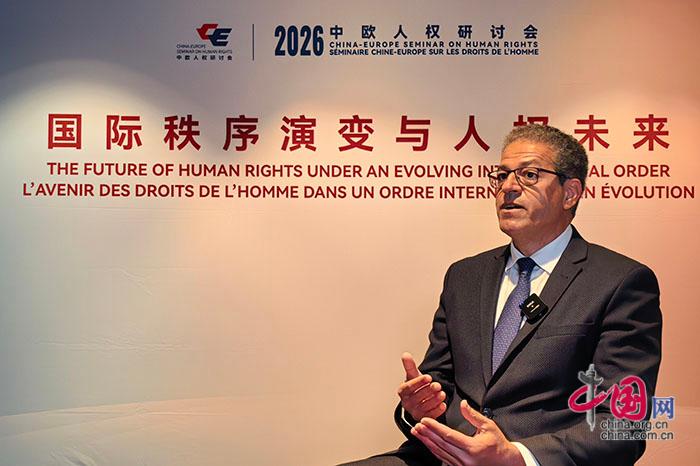
Hussein Askary, vice chairman of the Sweden-based Belt and Road Institute, gives an exclusive interview to China.org.cn. [Photo/China.org.cn]
The right to development is the foundation of human rights, without which other rights cannot breathe, claimed by Hussein Askary, vice chairman of the Sweden-based Belt and Road Institute in an interview with China.org.cn during the 2026 China-Europe Seminar on Human Rights.
International human rights law has never been only about ballots and courtrooms. The Universal Declaration of Human Rights links rights to social security, work, education and an adequate standard of living, while later instruments—most notably the 1986 UN Declaration on the Right to Development—frame development as an inalienable human right.
Askary praised China's achievement in lifting 800 million people out of poverty as evidence that prioritizing subsistence and development creates the conditions for broader human flourishing. "Hundreds of millions gaining, for the first time, a stable roof, running water and power, schooling for children, basic medical cover, and the capacity to plan a life rather than merely survive a day."
"In Western Europe and the United States, we take basic survival for granted—until recently," he noted, pointing to a resurgence of homelessness and rising poverty even inside wealthy societies. "That is why the discourse drifts: it assumes the floor is already there. It isn't everywhere. And pretending it is, makes human rights lose credibility in the Global South."
"China also shares its achievements of development with the rest of the world through the Belt and Road Initiative (BRI)." Askary, who has authored several books on the BRI, argued that development is not merely an economic objective but a prerequisite for all other human rights.
"The BRI provides the basics—infrastructure, transport, power, water, sanitation, digital connectivity—plus the technological tools so that nations can produce, not only consume," Askary said. He also stressed a rarely discussed diplomatic point of view: BRI cooperation is designed based on mutual consultation and respect for sovereignty, allowing partner nations to determine their own development priorities. "Kenya, Zambia, Tanzania, Nigeria... China does not tell them what to build," Askary said. "They agree on needs. It is mutual. That is why, ironically, the more BRI is criticized in western think-tanks, the more nations join it."
He also challenged the notion of universally applicable human rights models, stressing the importance of balancing individual rights with social harmony.
On China-Europe cooperation, Askary urged both sides to focus on shared goals rather than ideological divides. "Europe stands to benefit enormously from engaging with the BRI—not only by addressing its own infrastructural and social deficits but also by tackling root causes of migration through joint development." He cautioned against zero-sum thinking, advocating instead for a multi-polar order where diverse approaches to human rights are respected.
The expert concluded by highlighting the urgency of revitalizing international law and multilateralism. "Initiatives like China's Global Security Initiative and Global Governance Initiative are vital to preventing a descent into the Law of the Jungle," he said. "True progress lies in building an environment where all nations can pursue dignity and development through peaceful collaboration."
The seminar has brought together over 150 officials and human rights scholars from China and European countries on May 21, providing a platform for in-depth exchanges and cooperation on human rights development between China and Europe.


 京公网安备 11010802027341号