Share:

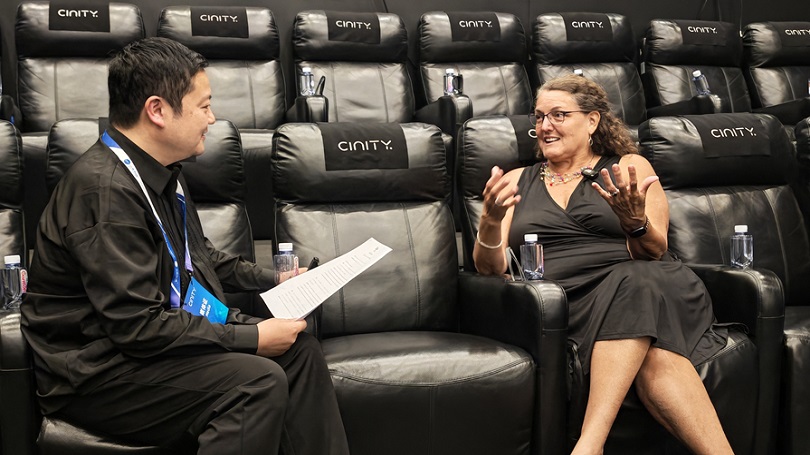
Tammy Barrett, executive director of the Giant Screen Cinema Association (GSCA), which represents nearly 200 institutions worldwide, spoke to China.org.cn in Beijing on May 26 about the future of the giant-screen industry and China's homegrown CINITY technologies.
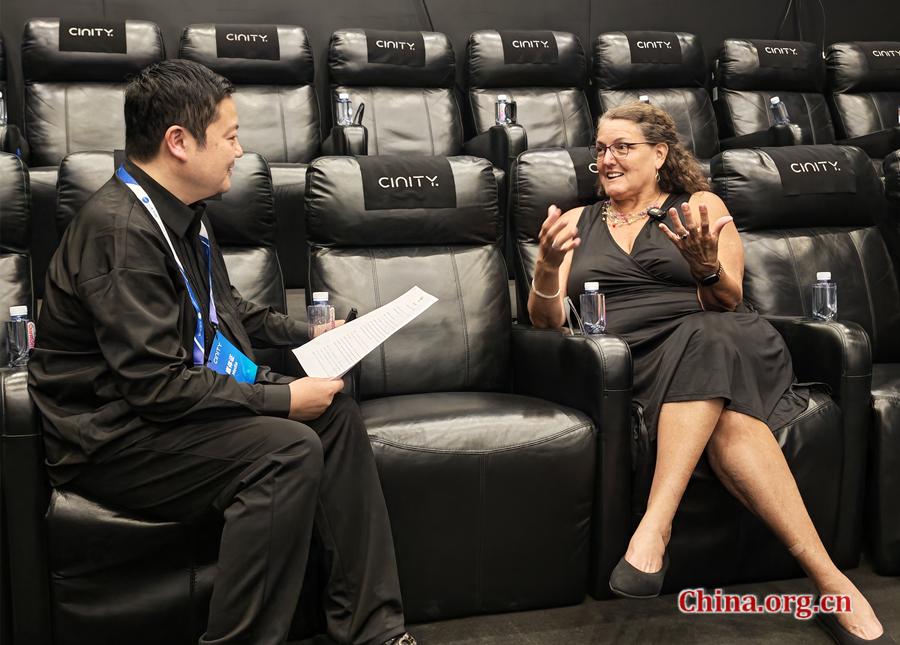
Tammy Barrett, executive director of the Giant Screen Cinema Association (GSCA), speaks to China.org.cn reporter Zhang Rui during an exclusive interview in Beijing, May 26, 2026. [Photo/China.org.cn]
Barrett and her colleagues toured the headquarters of China Film Group and its China Film Technology after attending the opening of the GSCA Science Film Special Expo on May 24. The expo was co-organized with the Shanghai Science and Technology Museum, one of China's leading science museums.
Fu Ruoqing, founder of CINITY, said he was pleased the technology had gained wide recognition, including from international peers."CINITY will continue to iterate its technology, optimize the viewing experience, and enrich its content ecosystem, so that the fertile ground of light and shadow can nourish more hearts passionate about science," Fu said at the event's opening.
Barrett said the expo collaboration was intended to showcase giant-screen films on the new CINITY LED (CLED) screen, with up to 9 GSCA member titles selected for presentation. The films were shown to Chinese science museum directors and industry leaders, and will also screen during the Shanghai International Film Festival from June 12 to 21.
GSCA is the global trade body for the giant-screen film industry, representing museums, science centers, specialty theaters, distributors, producers and technology developers across international markets.
The giant-screen theater at the Shanghai Science and Technology Museum debuted a new "CINITY science" system following a 13-month renovation completed earlier this year. The centerpiece is a CINITY 3D LED direct-view screen measuring 23.68 meters wide and 18 meters high, one of the largest museum-scale LED installations in the world and the first to use perforated LED technology. Barrett called the experience "amazing."
Barrett said she hoped the event would signal to the global giant-screen cinema industry that new technology like CLED is "an investment in the future."
"We want to have the best quality images on the best screens and give people a good reason to come outside of their home, to watch fabulous films on the best screens possible," she said.
LED direct-view display technology is still new to the giant-screen sector, but Barrett said its continuing evolution is good for the industry, with CINITY playing a significant role. "We're very pleased to have this new investment in the technology," Barrett noted.
Asked whether LED could become the mainstream technology for the next generation of cinemas, Barrett said: "For now, LED direct-view display is the highest quality technical presentation, and we're glad to see CINITY leading that charge."
Barrett described CINITY as a complete ecosystem, supporting filmmakers at every stage, from development and production to marketing and cameras. "They are a one-stop shop," she said.
CINITY is a high-format cinema technology platform offering high brightness, high frame rate, high dynamic range, immersive 3D and advanced sound integration, with a portfolio spanning premium projection systems and museum-scale LED direct-view installations.
CINITY science is a screening brand for science venues built on CINITY and CLED technologies. Re-mastering centers in Beijing and Los Angeles provide CLED-exclusive services for domestic and imported films, with the Los Angeles facility, opened in December 2024, the only one globally capable of LED re-mastering for Hollywood productions.
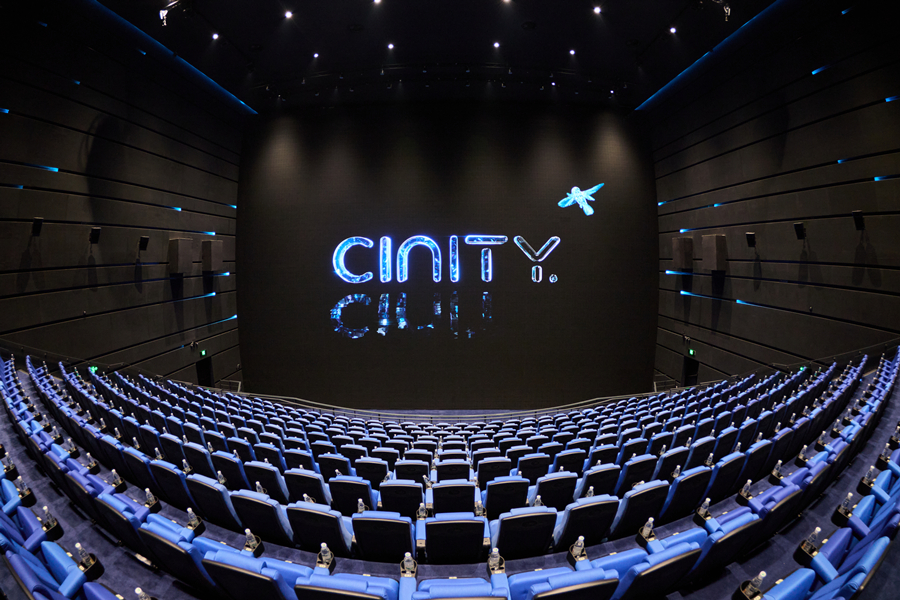
A giant CLED screen installed at the Shanghai Science and Technology Museum's newly renovated giant screen theater is unveiled in Shanghai, Jan. 9, 2026. [Photo courtesy of China Film Group]
Looking ahead, Barrett said CINITY could help bring educational content to museum and science center screens around the world.
"Hopefully, what it does is it continues to bring children and their families to the science centers, eager to see these new films, eager to see the educational opportunities, and gives them a good reason to get outside their home," she said. "Being in a beautiful cinema, watching a film with a group of people — there's nothing better."


 京公网安备 11010802027341号