Share:

A range of administrators, experts and scholars spent the weekend discussing efforts to revitalize soccer in China at thec 2026 Modern Football Science Conferene in Beijing.
The conference, the first to be hosted by the newly-founded Football Branch of the China Sport Science Society (CSSS), drew nearly 400 governing body officials, sports scientists, training experts and researchers from over 120 organizations, including the University of Chinese Academy of Social Sciences, the World Congress on Science and Football and the World Association for Sport Management.
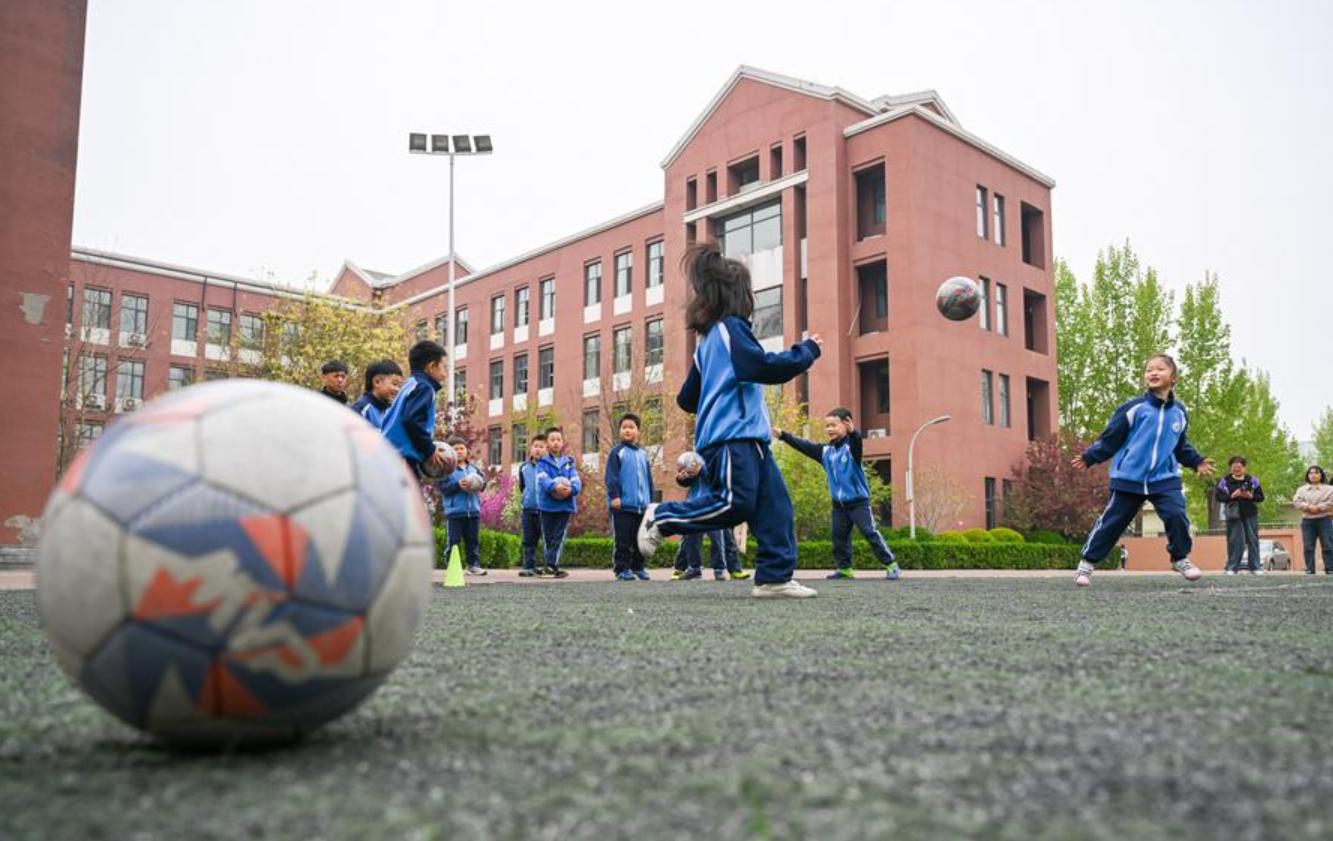
Young football players attend a training session under the instructions by foreign coach at Tianjin Foreign Languages School Nanpu Primary School in Tianjin Municipality, north China, on April 10, 2024. (Xinhua/Sun Fanyue)
Held at Beijing Sports University, topics up for debate included sports physiology, youth cultivation, injury prevention and new-tech training programs, and the general reform and development of Chinese soccer from the grassroots up.
Zhou Jinqiang, the vice-president of the Chinese Olympic Committee, called for stronger support from academia for the development of soccer in China.
"China's soccer revitalization is gaining steady momentum, but the lack of theoretical support and scientific research, especially in youth development, remain a pressing issue restricting the high-quality development of the sport," Zhou, also a member of the National Committee of the Chinese People's Political Consultative Conference, said in his opening remarks at the conference.
"To advance the revitalization of the game for the new era, we must stay committed to scientific guidance, make up for the lack of theoretical support in development and make concerted efforts for progress."
Cao Jingwei, vice-president and secretary-general of the CSSS, also stressed the need for practical measures in his speech.
"The conference addresses prevailing industry challenges and responds to practical needs, demonstrating a clear commitment to scientific guidance and pragmatic action," said Cao, who is also director of the China Institute of Sport Science.
"Research findings should be brought out of the lab and implemented onto the pitch," he added
Fan Zhanbei, chairperson of the Council of Beijing Sport University, insisted that the foundations of China's soccer revitalization lie in youth development with scientific support.
"Only by taking science as the foundation and integrating academic research into the practice of grassroots training can we achieve steady and long-term development," he said.
A number of noted scholars and experts from home and abroad shared their research findings at the conference and explored future development paths from the perspectives of digital-intelligent integration, scientific training, management innovation and consolidated foundation for youth development.
At the end of the conference, the consensus among industry insiders was that, in future, soccer development should be focused on shifting experience-driven training to science-led development to boost the sustainable competitiveness of the sport in the long run.


 京公网安备 11010802027341号