Share:

Supported by strong partners such as China, the World Anti-Doping Agency has reiterated its confidence in the concerted global fight against doping, while urging authorities in the United States to keep up with international practice and standards.
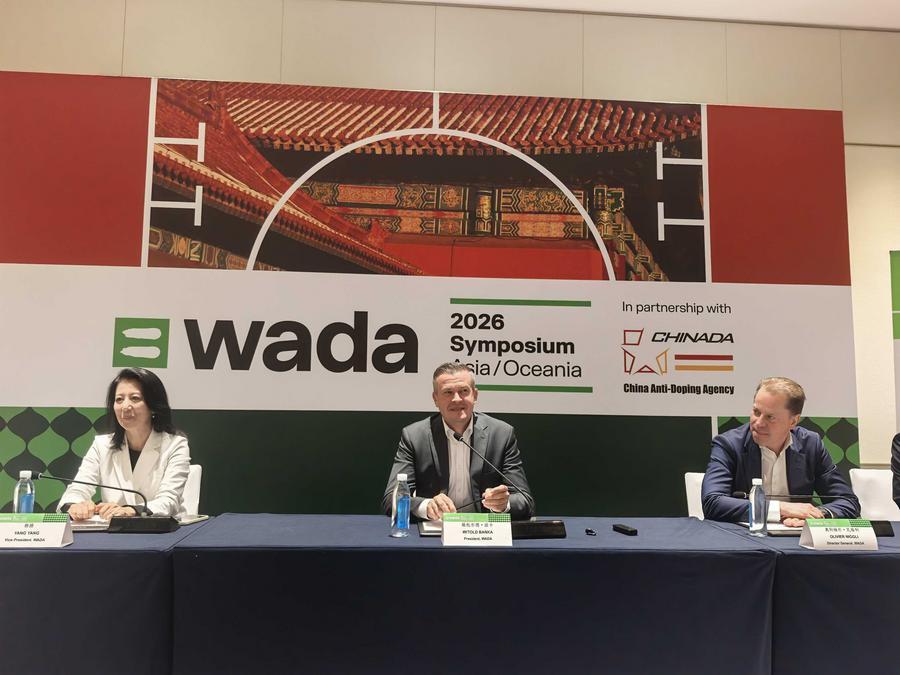
WADA president Witold Banka (C) speaks at a press conference after the opening day sessions of the Asia and Oceania Symposium in Beijing, China, on June 2, 2026. (Handout via Xinhua)
With the 2027 World Anti-Doping Code and International Standards set to be implemented in six months, WADA highlighted the importance of a well-informed and well-connected global anti-doping community as it called on governments, national anti-doping organizations, and relevant parties across the Asia and Oceania region to update and optimize their own doping-control systems to stay in line with the new code.
WADA president Witold Banka, while addressing participants at the 2026 Regional Symposium for Asia and Oceania on Tuesday in Beijing, accentuated the important role each code signatory must play for the smooth implementation of the new standards, citing its strong partnership with host China as an example of productive international cooperation.
China's "zero-tolerance" stance against doping echos WADA's mission, said Banka, who expects to expand collaboration with the China Anti-Doping Agency and Chinese government with the new code and international standards coming into force soon.
"In many areas we can work closely with CHINADA and the Chinese government, such as science and research, education, investment in new technologies and new detecting methods, so this is definitely how we can work together to better contribute to the global anti-doping initiative," Banka said from the sidelines of the symposium at Beijing's National Convention Center on Tuesday.
China's sports governing body has pledged full support to the global anti-doping fight under WADA's leadership.
"China is willing to continue strengthening exchanges and practical cooperation with WADA and all parties in areas such as code implementation, talent development and education resource sharing," said Tong Lixin, deputy director of the General Administration of Sport of China.
Stronger legal support, such as approving a law amendment at the end of 2020 to criminalize doping, expanded anti-doping education covering juveniles at the grassroots level, and more advanced scientific research are among effective measures safeguarding sports integrity and clean athletes in China, according to Tong, who addressed participants at WADA's Asia and Oceania Intergovernmental Ministerial Meeting on Monday.
According to CHINADA, a total of 1,259 pre-event anti-doping education sessions were organized in 2025, involving about 50,000 athletes on provincial teams and 135,000 sports school students. Only those who passed the exams were eligible to compete in relevant domestic and international competitions.
As part of its efforts to align the country's domestic framework to the updated international rules, CHINADA has been rolling out nationwide training and education on the new code, pushing ahead with systemic revision of China's own anti-doping rules, and ramping up efforts to better educate and protect athletes, especially minors.
China will keep sharing its domestic practices through tailored training workshops, international seminars and exchange programs to facilitate the worldwide anti-doping cause, said Li Zhiquan, director general of CHINADA.
The two-day regional symposium brought together nearly 400 participants from anti-doping authorities, sports governing bodies, and governmental departments from across Asia and Oceania, to align regional preparations for the 2027 code enforcement.
While highlighting the critical need for harmonization and worldwide coordination at the symposium, Banka zeroed in on longstanding loopholes within the US domestic anti-doping framework and brought up the fact that some privately owned professional sports leagues and the US collegiate sports system remain outside the global doping-control regulations overseen by WADA.
"There are private leagues, for instance, from the US, which are not a code signatory," Banka said.
"They have their own programs, which are quite weak when it comes to doping, and there is the NCAA — the academic sport (governing body) — and this is not a mystery that they are not code signatories either."
The WADA president stressed that the onus falls squarely on the US Anti-Doping Agency, or USADA, to bridge this regulatory gap and integrate these fragmented domestic systems into the unified global anti-doping network.
"So, that's more of a question for the US Anti-Doping Agency. What have they done to encourage them and to convince these private leagues and the academic sport to be code signatories?" asked Banka, a former track athlete, who used to represent Poland in 400m.
"I think it should be a mission of USADA to convince all the stakeholders (in the US) to be part of the system. And they are not part of the system now."
Banka emphasized WADA's years-long advocacy for the USADA to prioritize rectifying its domestic regulatory loopholes rather than shifting focus to other countries' anti-doping practices.
"For many years, we have encouraged our colleagues from USADA to focus more on their backyard, rather than focusing on other countries," Banka said.
WADA director general Olivier Niggli highlighted better protection of human rights, particularly for underage athletes, increased responsibility of athlete entourages, and more prudent handling of positive tests caused by contamination, such as strictly protecting the private information of no-fault athletes involved in contamination cases, among key updates of the new code and standards, which will be implemented on Jan 1.
He also warned against the politicization of anti-doping and stressed that the system must remain fair, neutral and independent.
"Anti-doping should not be politicized. Anti-doping should not be weaponized," Niggli said during his speech at the intergovernmental ministerial meeting in Beijing.


 京公网安备 11010802027341号