Share:

Digital technologies are increasingly being used not only to monitor changes at heritage sites, but also to identify patterns, assess risks and support predictive modeling for disaster prevention and climate adaptation, experts said at the 5th Huangshan Dialogue, held in Huangshan, Anhui province, on May 31 and June 1.
Guo Huadong, director of the International Centre on Space Technologies for Natural and Cultural Heritage (HIST) under the auspices of UNESCO, noted that this year marks the fifth edition of the dialogue since it was launched in 2014, adding that the past 12 years have seen China's evolving role in global heritage governance — from a participant and contributor to an increasingly influential leader.
A key outcome of this year's dialogue was the signing of cooperation agreements between HIST and several international partners, including the African World Heritage Fund and UNESCO Category II centers in Latin America.

Guo Huadong, director of the International Centre on Space Technologies for Natural and Cultural Heritage (HIST) under the auspices of UNESCO, speaks during an interview at the 5th Huangshan Dialogue in Huangshan, Anhui province, May 31, 2026. [Photo by Wang Wei/China.org.cn]
As the world's only UNESCO-established research center dedicated to applying space technologies to heritage conservation, HIST serves as a bridge between China's technological capabilities and the practical needs of heritage-rich regions around the world, Guo said.
"Through collaboration, we can jointly carry out heritage monitoring and assessment, talent cultivation and technology transfer," he said. "This is also a concrete step toward implementing the Global Civilization Initiative and advancing South South cooperation."
Another highlight of the dialogue was the release of the Remote Sensing Dynamic Monitoring Atlas of Global World Cultural Heritage (2020-2025). Covering major cultural heritage sites worldwide, the atlas uses satellite-based observations to visualize environmental changes, development trends and potential disturbance risks affecting heritage sites.
HIST Deputy Director Chen Fulong called the atlas a landmark scientific contribution that China has offered to the international community in the field of space technology for heritage conservation.
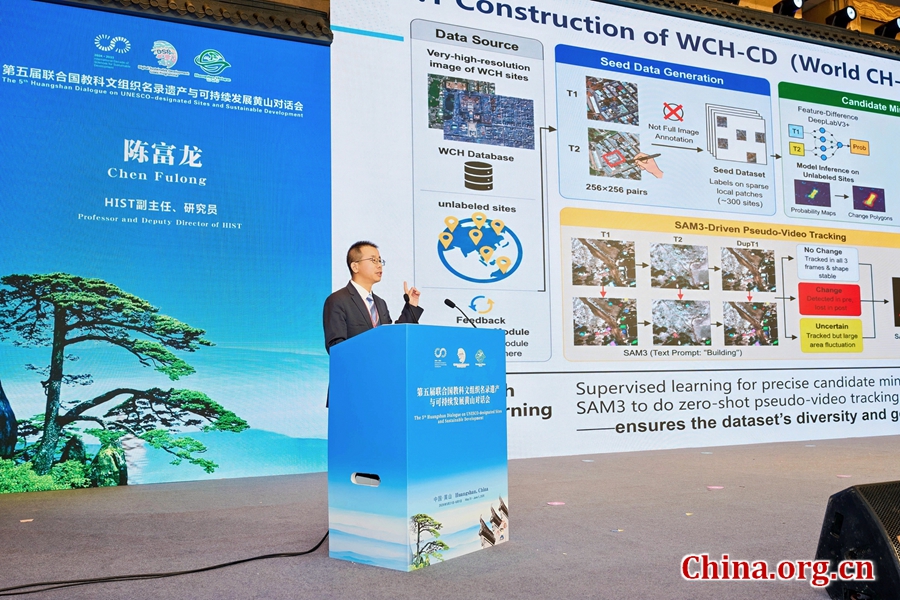
Chen Fulong, deputy director of HIST, speaks at the opening ceremony of the 5th Huangshan Dialogue in Huangshan, Anhui province, May 31, 2026. [Photo provided to China.org.cn]
"It provides site managers with a quantifiable and dynamic monitoring tool," he explained. "While offering developing countries a low-cost, high-efficiency solution for heritage monitoring, it demonstrates China's commitment to applying space technology for the public good."
According to Chen, the atlas will be made freely available worldwide through UNESCO channels, with a particular focus on supporting developing countries.
Experts at the dialogue also emphasized the growing role of digital tools in managing tourism pressures at heritage sites.
Heba Aziz, UNESCO chair for world heritage and sustainable tourism management in the Arab region, said new technologies can help optimize visitor flows and improve the management of peak travel periods, making them valuable tools for sustainable heritage management.

Heba Aziz, UNESCO chair for world heritage and sustainable tourism management in the Arab region, gives an interview during the 5th Huangshan Dialogue in Huangshan, Anhui province, May 31, 2026. [Photo by Wang Wei/China.org.cn]
She expressed hope for closer cooperation between China and Arab countries, particularly in joint research, staff training, and academic and student exchanges related to heritage conservation.
Antonio Abreu, director of the Division of Ecological and Earth Sciences at UNESCO, echoed similar views, saying that "digital innovation helps democratize access to knowledge. It enables local communities, researchers, young people and decision-makers to collaborate across borders and disciplines."
"The protection of UNESCO sites is a shared global responsibility," he added. "International cooperation is therefore essential not only in financing and policy, but also in data sharing, scientific collaboration, technology transfer and joint capacity development."
Capacity building has long been a core component of HIST's mission, according to Wang Xinyuan, another deputy director of the center.

Wang Xinyuan, deputy director of HIST, speaks during an interview at the 5th Huangshan Dialogue in Huangshan, Anhui province, May 31, 2026. [Photo by Wang Wei/China.org.cn]
"We have trained more than 600 heritage management, technical and research professionals from developing countries, as well as dozens of postgraduate students," Wang said. "Our space technologies have benefited over 30 countries along the Belt and Road."
Looking ahead to HIST's third development phase (2025-2033), Wang said the center will focus on two major priorities: establishing a disciplinary framework for spatial archaeology and developing a full-chain governance system for UNESCO-designated sites, covering identification, monitoring, assessment, management and planning.
"Technology is helping us move from passive conservation to preventive conservation," he said. "By anticipating risks before disasters occur, we can build a more science-based approach to heritage governance — one that protects our shared heritage not only as a legacy of the past, but also as a foundation for sustainable development."


 京公网安备 11010802027341号