 Share:

New tensions came afloat in recent China-EU business relations. The European Parliament adopted, with an overwhelming majority of 606:16, a new steel import act, effective from July 1, 2026. It drastically reduced the tariff-free steel import quota by 47 percent, to 18.3 million tons annually, and raised the tariff on above-quota imports from the current 25 percent to 50 percent. China sued the EU at the WTO, claiming the bill violated WTO rules.
Meanwhile, the EU Commission has proposed a sweeping new bill, the Industry Acceleration Act (IAA), imposing a 49.5 percent ownership ceiling and compulsory tech transfer for new investments from a country that accounts for 40 percent of global output in the said industry. Meanwhile, five EU member countries, led by France, pressed the EU Commission to adopt more severe protection measures against imports from China, including measures similar to the U.S.' Section 301 unilateral tariffs.
To a large extent, the latest moves are directed at China. The spokesperson for MOFCOM has expressed firm opposition and the right of retaliation.
Tensions and cooperation are rising simultaneously
Parallel to the rising tensions, business cooperation between the EU and China continues to gain momentum. In recent months, leaders from France, the UK, Germany, Italy, Ireland, and Spain have visited China with large groups of business leaders.
From May 26 to 29, German Federal Minister for Economic Affairs and Energy Katherina Reiche visited China with 40 German multinational corporations, including BASF and Siemens. The German minister praised the Chinese economy and Germany-China economic cooperation.
The European Chamber of Commerce in China has issued a statement claiming that "de-risking" is not the prevailing trend in EU-China policy, and 68 percent of EU businesses in China will remain and grow.
Taken together, these developments reveal two opposite trends in China-EU relations. However, cooperation and win-win is definitely the main trend, as stated by a Chinese Foreign Ministry spokesperson.
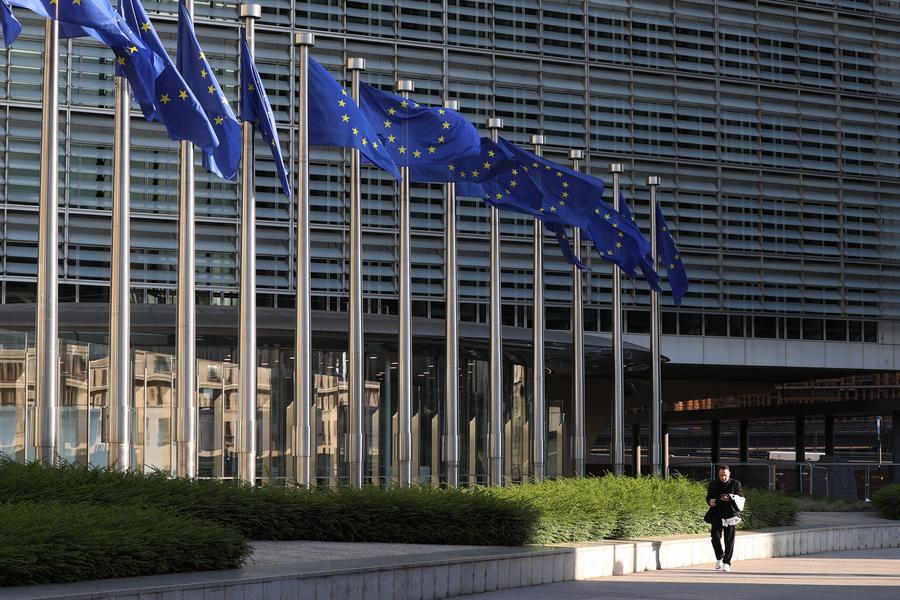
Photo taken on May 23, 2025 shows European Union flags at the European Commission headquarters in Brussels, Belgium. [Photo/Xinhua]
Factors behind the growing restrictive tendency
The growing EU trade hawks on China are not accidental or a personal phenomenon, but reflect profound changes in the EU economy and the latest tensions in the world.
First, the EU economy's stagnation, especially the decline in industrial competitiveness. The EU composite PMI index fell to 47.5 in May, down from 48.8 in April, the lowest in 31 months. EU GDP is estimated to have fallen 0.2 percent in Q2 2026.
Second, the U.S.-Israel-Iran war and the subsequent blockade of the Strait of Hormuz disrupted the global energy supply chain, thereby driving up EU energy prices and raising industrial production costs, on top of already high energy costs from the Ukraine Crisis.
The combined factors mentioned above have resulted in a comparative disadvantage in EU production costs. The production labor cost of an automobile in 2025 was $ 3300 in Germany, compared to $ 1300 in the U.S. and $585 in China. The disadvantage, in turn, has caused the steady fall of the manufacturing sector's share in GDP, from 19.7 percent in 1991 to 17 percent in 2000 and to 14.3 percent today.
Thirdly, the U.S. trade restrictions have created new difficulties in EU exports, especially in steel and automobiles, which are subject to a 15 percent tariff.
Fourth, the overwhelmingly strong competitiveness of Chinese products contributed to the growing trade deficit with China. China's official trade statistics show that over the past 7 years, Chinese exports to the EU increased by 52.6 percent while its imports from the EU fell by 1.1 percent. The EU data show that its trade deficit with China broke 300 billion euros in 2025.
Fundamentals of China-EU business cooperation and win-win
All the above-mentioned negative factors have not, and will not, change the fundamentals in the China-EU business relationship—cooperation and win-win.
EU statistics show that China is the second largest trading partner of the EU after the U.S., accounting for 14.6 percent of the EU's trade. China's official data show that two-way trade with the EU hit $ 828.12 billion in 2025, making it the second largest trading partner after ASEAN. The EU accounted for 13 percent of China's global trade. Total EU direct investment stock in China reached $ 174.6 billion by the end of 2024, with over 20,000 European enterprises operating in China, including almost all European multinationals. Likewise, over 8,000 Chinese businesses are operating in the EU, with direct investment stock of over $ 110 billion.
China and EU cooperation covers almost all sectors, ranging from trade and investment in agriculture, automobiles, machinery, iron and steel, electronics, nuclear, solar and photovoltaic power, high-speed railway, chemicals, pharmaceuticals, aerospace, banking, insurance, telecom, education, and health care. China and the EU are highly complementary in the global supply chain, with tremendous benefits for both over the past decades.
The growing trade imbalance between China and the EU deserves serious attention by both sides. China is actually making efforts to increase imports from the EU. Nonetheless, the trade imbalance narrative should not be a reason to enhance trade restrictions. First, the total EU worldwide trade balance was in surplus (133.5 billion euros in 2025). Second, the unilateral restrictions have been less effective than consultation, as seen with the EU's imposition of countervailing tariffs on Chinese EVs in October 2024. Nonetheless, Chinese EV exports in the EU doubled in 2025. Both sides reached a compromise earlier this year on the floor export price of Chinese EVs to the EU, a constructive solution no doubt.
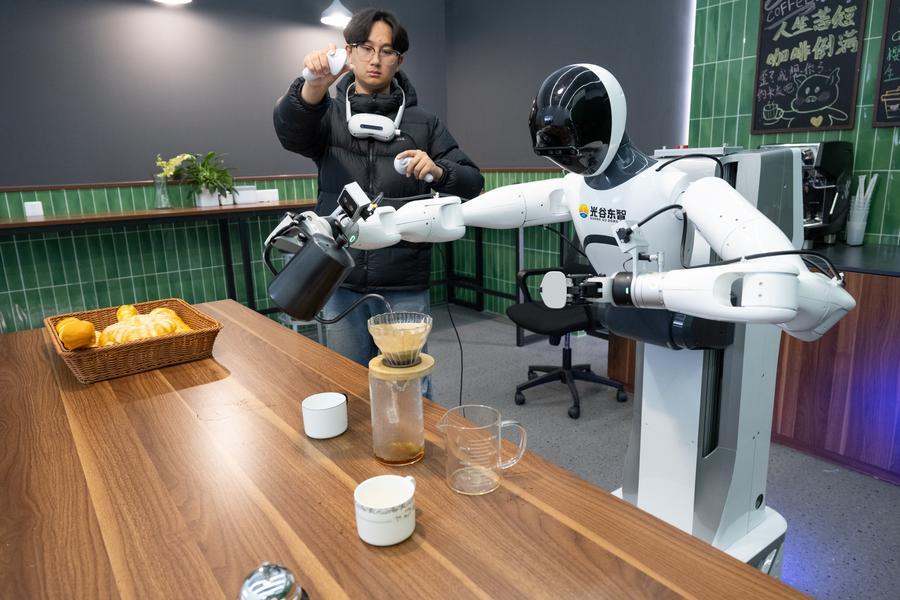
A staff member operates a robot to collect data in a cafe scenario at a humanoid robot innovation center in Wuhan East Lake High-tech Development Zone, also known as the optics valley of China, in Wuhan, central China's Hubei Province, Dec. 4, 2025. [Photo/Xinhua]
The future hinges on the cooperation of future industries
While making joint efforts to stabilize the current bilateral business relationship, both China and the EU need to find new room for creating a much larger pie that benefits both in the future. The world is entering a historic period of the fourth industrial revolution, marked by AI, big data, quantum computing, and the green transition, all of which promise profound impacts on future generations.
The size of the global digital economy was estimated at $ 26.7 trillion in 2025, and it will contribute $ 22.3 trillion to world economic growth by 2030. Each dollar input is estimated to generate $ 9.55 in output.
A 2025 Hurun report showed there were 1523 unicorn companies, with roughly two-thirds of them less than 6 years old. The U.S. accounted for roughly half of all unicorn companies with 758. China had 343, representing about a quarter of the total and three times the EU's (112).
EU countries, the cradle of industrial civilization and leaders of the world’s first and second industrial revolutions, must catch up in the current fourth industrial revolution. China, as the world’s largest manufacturing and trading power, is also faced with the historical challenge of developing new productive forces to attain a medium developed economy by 2035.
According to the 15th Five-Year Plan, China will focus on 4 strategic industries: new energy, new materials, aerospace, and the low latitude economy. 3 new emerging industries: smart manufacturing, high-end equipment manufacturing and biomedicals. Along with 3 frontier or future industries: quantum technology, brain-machine interface and 6G. The EU remains a global leader in most strategic and emerging industries, with comprehensive strategies for future sectors. This positions the EU to seize vast opportunities in China and achieve shared growth.
Likewise, the EU announced the Competitiveness Compass Report on January 29, 2025, putting forward 3 key areas: innovation, decarbonization and security, along with five key horizontal pillars. The EU has also put forward a series of strategies for future industries, including initiatives on AI Gigafactories and Apply AI, thereby accelerating AI development and industrial application in key areas. The EU is also making action plans on advanced materials, quantum technologies, biotechnology, and space technology. This is where China can help. China now holds 60 percent of the world's AI patents and is extremely strong in industries that involve new energy vehicles, batteries, and industrial robots. It also has abundant experience in manufacturing upgrading, something the EU desperately needs.
China and the EU should increase mutual investment on an unprecedented scale. By the end of 2024, EU direct investment stock in China was $ 174.6 billion, or 1.3 percent of the EU's global direct investment stock ($ 13 trillion). China's direct investment stock in the EU was $ 110 billion, 3.5 percent of China’s global direct investment stock ($ 3.1 trillion). However, China accounts for one-sixth of world GDP, and the EU accounts for one-fifth. The room for growth is infinite. It will be desirable that the direct investment stock hit $400 billion each way by 2035. Large numbers of innovation centers, labs or R&D centers and manufacturing hubs could be set up by the EU in China and vice versa. It is also expected that two-way trade increases in a more balanced way from $ 818 billion in 2025 to $ 1.5 trillion in 2035.
In that eventuality, China and the EU will both be leaders in future global industries, closely complementing each other in the global supply chain, and grow and prosper together, thus benefiting our two peoples and contributing to global development.


 京公网安备 11010802027341号