

 Share:

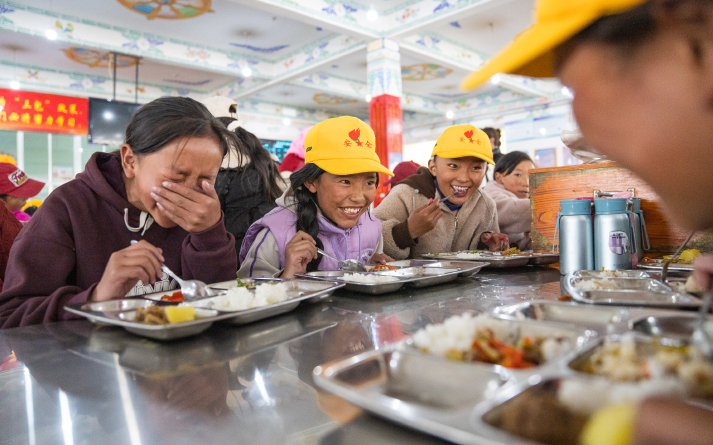
Students at the Sinopec Primary School in Baingoin County, Nagqu City, Xizang Autonomous Region, have a meal in the school cafeteria on June 22, 2024. [Photo/Xinhua]
In the southern foothills of the Nyenchen Tanglha Mountains in Lhasa, Xizang Autonomous Region, meltwater from ancient glaciers slowly seeps through layers of rock at an altitude of 3,700 meters. After years of natural filtration, a rare water source characterized by low deuterium, low sodium and a naturally mild alkalinity, was formed, known as the Drolma Spring. Drolma is one of the most beloved deities in Tibetan Buddhism, and local residents believe the water is a gift bestowed by the sacred mountains.
In the 1980s, Xizang's first local mineral water brand, Drolma Spring was established there. However, this pristine gift remained largely confined to the plateau for more than three decades, remaining a small regional product with annual revenues of less than 20 million yuan ($2.9 million).
Xizang is often described as the Water Tower of Asia, widely recognized as one of the world's best sources of fresh water. Yet its bottled water industry long remained small, fragmented and underdeveloped as high logistics costs, distance from major markets, and limited marketing capacity blocked Xizang's water from reaching consumers.
Teaming up
The turning point came in August 2014, when China's largest oil refiner China Petrochemical Corp., also known as Sinopec Group, was invited by the regional government to jointly develop the Drolma Spring brand and began facilitating its sales through its nationwide network. More than a decade later, Drolma Spring has grown into a leading brand in Xizang's natural drinking water industry and now reaches the global market.
Unlike traditional charitable aid, characterized by direct funding, Sinopec Group introduced a clear commercial strategy implemented in three stages: distribution, co-branding and investment.
In October 2014, Sinopec Group partnered with Drolma Spring's parent company—Xizang Water Resources Ltd., and its bottled water products were first introduced into one of China's largest retail networks: Sinopec Group's over 28,000 Easy Joy stores at its gas stations.
Almost overnight, Drolma Spring gained a high-speed "commercial highway" connecting the Qinghai-Xizang Plateau directly to urban communities across China. The product was soon rebranded as Easy Joy Drolma Spring.
That same month, Sinopec Sales Co. Ltd. invested 40 million yuan ($5.9 million) to acquire a 40-percent stake in Xizang Water Resources Ltd. In just three months, the three-step strategy was complete, transforming Drolma Spring from a small regional product into a nationwide brand backed by a major state-owned enterprise. In December 2016, Sinopec Group further increased its holdings by purchasing an additional 11-percent stake at market price, becoming the controlling shareholder.
The market response was immediate. In 2016 alone, Easy Joy Drolma Spring sold 300 million bottles, generating more than 700 million yuan ($103 million) in revenue—an increase of 97 percent year on year.
The brand also gained international visibility when it became the official water supplier for the 2015 IAAF World Athletics Championships in Beijing. Images of Jamaican sprinter Usain Bolt, one of the fastest men in the world, holding a bottle of Drolma Spring further boosted its global recognition.
Before Sinopec Group's investment, the water plant had just over 60 employees. Today, the company has created more than 800 jobs, with over 90 percent of employees coming from local farming and herding families.
One of them is Lhachung, who grew up in a remote village in Ngamring County in Xigaze City. She joined the factory in August 2013. At the time, she could hardly have imagined how much her life would change. "Now I have settled in Lhasa, with my own apartment and car. My child is studying in a school here," Lhachung told newspaper China Petrochemical News. "These are things I never dared to imagine before."
The company has recruited young people from impoverished pastoral areas around Xigaze, with annual incomes reaching around 80,000 yuan ($11,810) per person, more than twice the per-capita disposable income of Xizang residents in 2025, which stood at 33,600 yuan ($4,961).
Yan Haibo, Deputy General Manager of Xizang Water Resources Ltd., said that with Sinopec Group's support, the company now operates six advanced production lines and has built a production base capable of producing up to 1 million tons of drinking water annually.
By May 2025, Xizang Water Resources Ltd. had sold a cumulative 1.585 million tons of bottled water, generating total revenue of 4.05 billion yuan ($589 million) and contributing about 350 million yuan ($51.7 million) in tax payments.
Now, the water sells not only across China but also in international markets. Since 2015, it has been exported to Singapore, Kuwait, Saudi Arabia, Venezuela, the Philippines, Laos and Thailand.
Behind the numbers
From a remote spring high on the plateau to bottled water distributed nationwide, and from a local factory struggling to break into the national market to a modern enterprise generating billions of yuan (hundreds of millions of U.S. dollars) in revenue and employing hundreds of people, Easy Joy Drolma Spring tells not only a business success story built around water. It is also a story about people.
In 1994, the Central Government of China introduced a new policy to provide greater support to Xizang. The core idea behind the program is to create sustainable development opportunities for local communities. Some developed provinces were asked to pair up with specific cities and counties in Xizang and provide assistance in areas such as infrastructure development, agriculture, healthcare and education.
Eight years later, 17 leading state-owned enterprises (SOEs) joined the program. Sinopec Group is one of them and it paired with Baingoin County in Nagqu, a remote pastoral region with an average altitude of 4,750 meters. It was once one of the harshest and least developed areas in Xizang.
In 2002, Sinopec Group began providing targeted assistance to Baingoin County. Over more than two decades, Sinopec Group has invested about 680 million yuan (about $100 million) in Xizang and implemented more than 230 development projects. Through these efforts, the company has developed a distinctive approach that combines immediate support with long-term economic capacity building.
Alongside Drolma Spring, Sinopec Group has also helped develop other specialty products, including yak meat products under the brand "Little Yak Benben" and powder made from medicinal Ganoderma mushrooms, selling them nationwide through the Easy Joy retail network.
It also invested nearly 100 million yuan ($14.8 million) to build the Sinopec Primary School, a free full-time school with modern teaching facilities, in Baingoin County.
Sinopec Group also sponsored the "Health Express" medical train's visit to Xizang in 2007, funding 872 cataract surgeries. It has also installed community medicine cabinets in remote villages and built an oxygen supply station in western Nagqu, improving living conditions for residents at extreme altitudes.
According to the Sinopec Group's 2025 corporate social responsibility report, the company's assistance has helped Baingoin County achieve average annual GDP growth of over 12 percent.
As the bottle of glacier water that travels thousands of kilometers suggests, the most effective form of aid is not simply giving—it is about empowering and growing together.


 京公网安备 11010802027341号