 Share:

Artificial intelligence is transforming China's sports sector, overhauling traditional patterns of fitness training, venue operations and event organization.
AI POWERS PERSONALIZED FITNESS SOLUTIONS
AI-driven personalized fitness has become a mainstream trend in China's gym market. Shuhua Sports, a supplier of fitness equipment to the Chinese Olympic Committee, has launched an AI gym solution to meet demand for science-based training, company vice president Shi Yong told Xinhua.
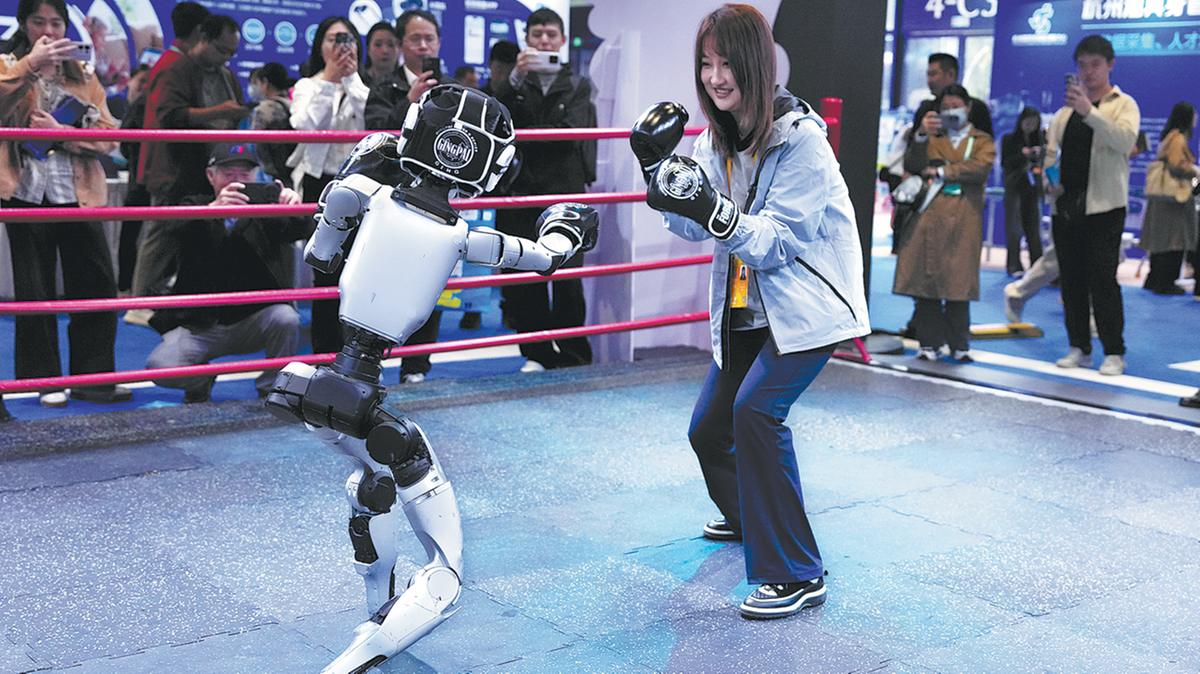
A participant boxes with a humanoid robot from Unitree Robotics during the 2025 World Internet Conference Wuzhen Summit in Wuzhen, Zhejiang province, on Nov 6. HUANG ZONGZHI/XINHUA
The system collects users' cardiopulmonary data via smart treadmills and measures muscular strength through digital testing devices. Real-time feedback is provided through mobile mini-programs, offering pre-workout assessments, AI-generated workout plans, guided on-site exercise and performance-based adjustments.
"Our AI solution acts as an affordable digital personal trainer, delivering different plans for different users," Shi said. "Meanwhile, fitness operators can adjust their strategies flexibly."
Several domestic manufacturers have introduced AI-powered gear for diverse user groups. Impulse Fitness, based in Qingdao, has developed smart stair climbers for professional training. Hangzhou's Ease Future has built massage robots to ease post-exercise soreness. Suzhou Qiber's fitness bikes combine physical exercise with interactive gaming.
SMART TECH UPGRADES VENUE OPERATIONS
AI has become integral to the development and daily management of sports venues, fueling small-scale upgrades of public sports facilities across China.
The air dome company Metaspace has created an AI management framework for sports venues. Its algorithm-driven system adjusts indoor environmental conditions in real time, automates equipment maintenance and cuts energy use. A smart platform enables passenger flow analysis, refined customer services and consumption management.
Chen Liangfeng, a senior engineer at the Hefei Institutes of Physical Science under the Chinese Academy of Sciences, said the core shift for stadiums is moving from leasing space to managing users' sports life.
"The most competitive future venues are not those with the most advanced hardware, but those that truly understand the customers," Chen said.
DIGITAL INNOVATION REDEFINES EVENT ORGANIZATION
AI-powered digitalization is also bringing revolutionary changes to the planning and execution of sports competitions.
Li Chungang, deputy director of the sports tourism committee at the China Association of National Parks and Scenic Sites, introduced an intelligent event system that works for road running, cycling and orienteering. Equipped with distributed real-time timing modules, the digital platform lowers costs and entry barriers for hosting races.
"The Old Town of Lijiang has adopted this system to support offline check-ins and real-time online rankings, allowing organizers to hold small-scale sporting events all year round," Li said.
Cui Yixiong, an assistant professor at the School of Sports Engineering at Beijing Sport University, cited global examples such as bullet-time filming technology used at the 2024 Paris Olympics and the 2026 Milan-Cortina Winter Olympics, as well as AI-driven multilingual TV advertisements during the UEFA Euro 2024, to show how AI is used in large-scale events.
According to Cui, sports tournaments can build self-evolving digital ecosystems through deep cross-industry collaboration between organizers, tech vendors, broadcasters and sports data providers.
Luo Jie, vice chairman and secretary-general of the China Sporting Goods Federation, said AI has penetrated every layer of China's sports industry, shifting from an optional direction to a mandatory engine for boosting sports consumption and reshaping the domestic sports landscape.


 京公网安备 11010802027341号