 Share:


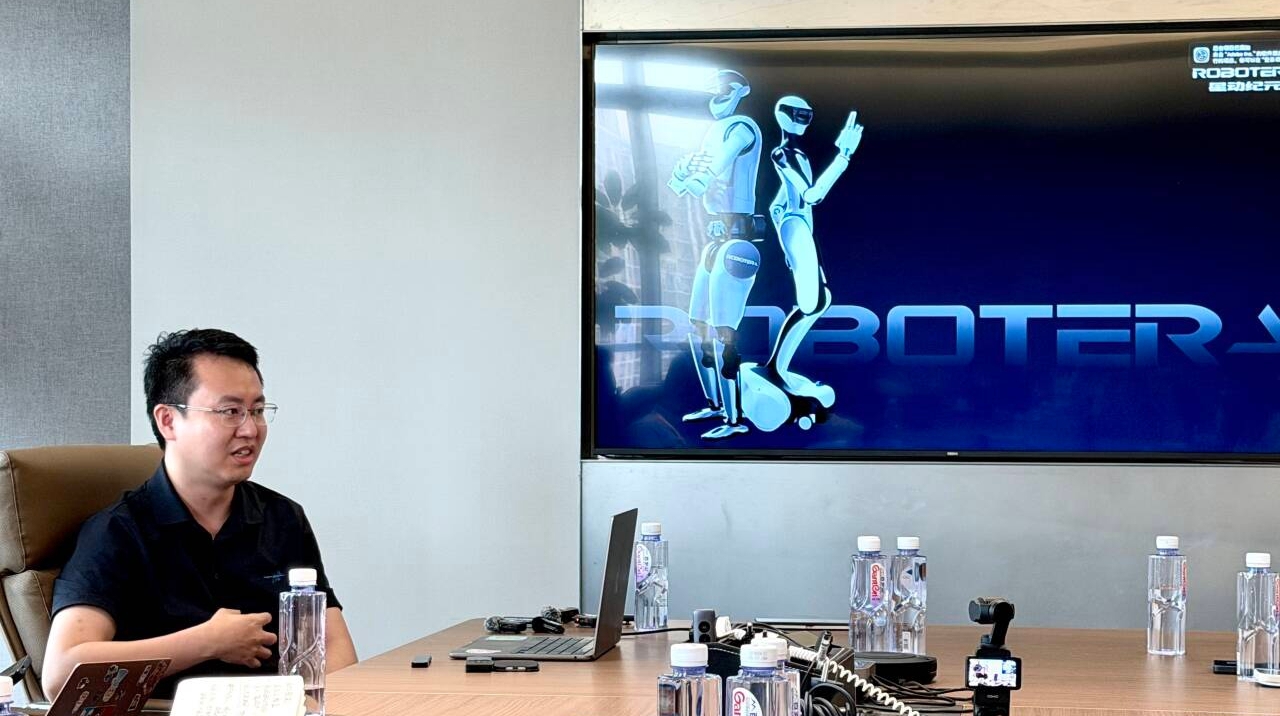
Chen Jianyu, founder of Chinese humanoid-robot startup Robot Era and assistant professor at Tsinghua University, attends a group interview during the 2026 Vibrant China research and visit tour, Beijing, June 10, 2026. [Photo by Liu Caiyi/China.org.cn]
Teaching robots to better understand the physical world will be key to the future of embodied artificial intelligence, Chen Jianyu, founder of Chinese humanoid-robot startup Robot Era and assistant professor at Tsinghua University, said Wednesday.
Speaking during the 2026 Vibrant China research and visit tour in Beijing, Chen said world models — AI systems trained on video and visual data to understand and predict physical interactions — could offer robots a more intuitive way to learn and operate in real-world environments.
He noted that conventional embodied AI systems are largely built on large language models, which rely primarily on linguistic information for reasoning and decision-making. World models, by contrast, place greater emphasis on visual input.
"Video contains much richer information about physical interactions," Chen said. "Compared with language, it is more closely aligned with how robots perceive and interact with the physical world."
Founded in 2023 and incubated by Tsinghua University, Robot Era focuses on embodied AI systems that integrate robotic hardware, motion control and AI models. The company's work spans robot bodies, dexterous hands, embodied AI models and real-world deployment.
Chen identified data scarcity, particularly the lack of high-quality data from real-world robot operations, as one of the major challenges facing the industry. He said the company is addressing this by collecting data through commercial deployments rather than relying solely on dedicated data collection environments.
As robots are deployed in logistics and industrial settings, operational data can be continuously collected and fed back into model training, helping reduce costs while improving system performance, he said.
The company is already deploying robots in logistics, where real-world operations provide commercial opportunities and valuable training data. Chen said this creates a feedback loop in which larger-scale deployments generate more data, leading to improved models and broader adoption.
Looking ahead, Chen said embodied AI still faces significant technical barriers before humanoid robots can be widely deployed in households. For now, logistics and industrial applications remain the most promising path toward commercialization, he said.
As global competition in embodied AI intensifies, Chen said advances in world models combined with large-scale deployment could help accelerate the transition of humanoid robots from research labs to practical applications.


 京公网安备 11010802027341号