Share:

A dense mist blanketed the mountains of northern Sichuan Province on a day in June. On a steep slope within the Tangjiahe Area of the Giant Panda National Park, an Asian black bear led her cub up a cluster of boulders flanking a rushing stream, and then vanished into the dense forest. This rare scene was captured on a smartphone by a patrolling forest ranger.
"Today we also encountered tufted deer, macaque, Sichuan takin and Chinese serow," said Chen Shiying, an official at the Tangjiahe Administration Bureau, her excitement palpable. In Tangjiahe, casual encounters between humans and wild animals have long ceased to be news. Black bears appearing outside windows, takins strolling on highways and golden snub-nosed monkeys leaping through the canopy—this region has become a global hotspot for low-altitude wildlife sightings.
This vibrant landscape sits within the Minshan Mountains in Qingchuan County, Sichuan. Characterized by precipitous slopes and deep valleys, the topography features a massive relative relief of 2,864 meters, nurturing a forest coverage rate of 96.15 percent. Deep within these mountains lies a rich variety of wildlife, serving as a sanctuary for over 3,800 species, including 24 species under top class national protection.
The ecological vitality found here is a microcosm of the broader Giant Panda National Park. Established in 2021 as one of China's first five national parks, it spans three provinces--Sichuan, Shaanxi and Gansu--covering 22,000 square km. Winding through the eastern margin of the Qinghai-Xizang Plateau, the park shelters approximately 1,900 wild giant pandas and safeguards over 8,000 rare species.
However, a decade ago, this habitat was fragmented by administrative boundaries into 33 ecological islands managed by different government departments. The establishment of the national park marked a profound transition from fragmented management to integrated governance, and from passive protection to systematic restoration, embracing the philosophy that lucid waters and lush mountains are invaluable assets.
A chessboard
In the past, the dilemma facing the giant panda habitat reflected a systemic issue shared by many natural protected areas across China. Overlapping administrative barriers isolated local sub-populations of wild giant pandas, creating management blind spots. Cross-provincial patrols required multi-layered approvals, and joint law enforcement frequently stalled due to jurisdictional limitations.
Chen Limin, Vice President of the Sichuan Academy of Giant Panda Sciences, has witnessed this transition firsthand over his 45-year career. "In the 1980s, conducting conservation outreach was difficult," he told Beijing Review. At that time, the livelihoods of local villagers depended heavily on traditional forestry and farming. Logging restrictions directly impacted traditional survival methods, leading to tense relationships between the reserve and local communities. "Even more challenging was that the three provinces operated under different protection standards," Chen added. "A panda crossing provincial borders could slip out of its original protection strategy."
The formal establishment of the park in 2021 was the catalyst to break this deadlock. Sichuan, Shaanxi and Gansu pioneered a collaborative legislative model to unify protection standards and law enforcement criteria across the entire park area.
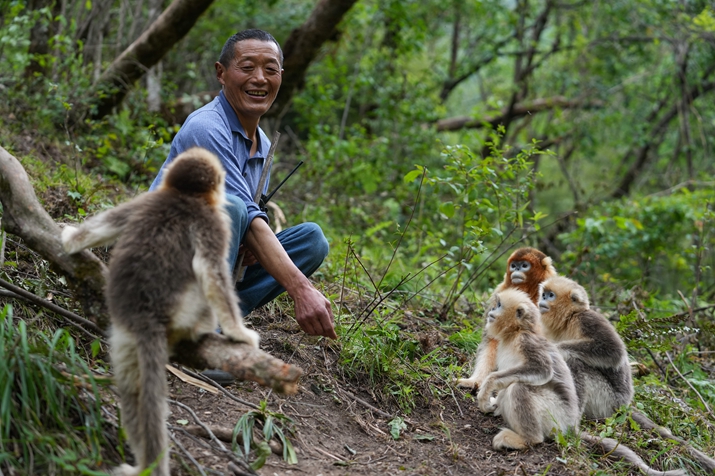
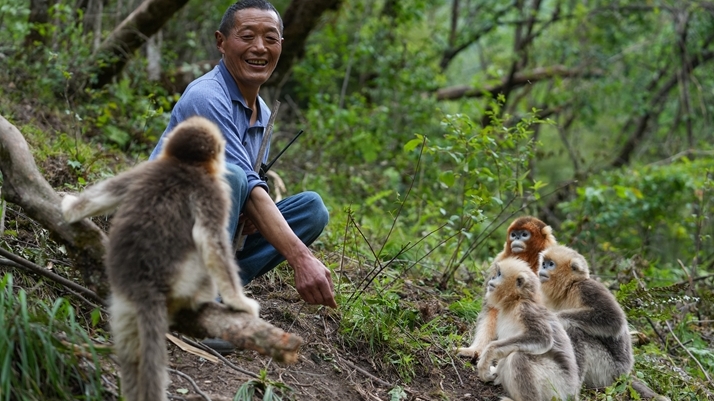
A ranger who has worked with golden snub-nosed monkeys for years interacts with four of them at a conservation and science education base in Pingwu County, Sichuan Province, on May 22, 2025. [Photo/Xinhua]
Institutional innovation extended beyond legislation. The park implemented a management system shared by the National Forestry and Grassland Administration and the three provincial governments. The provinces jointly issued a master plan, established a joint meeting system and initiated cross-regional judicial cooperation. Notably, the Sichuan Higher People's Court created the National Park Ecological Tribunal, implementing a unified adjudication model for environmental resource cases to ensure consistent legal enforcement across borders.
To further bridge jurisdictional gaps, environmental prosecutors from all three provinces launched an integrated information-sharing platform. This network enables real-time tracking of illegal poaching and habitat encroachment along provincial borders, preventing violators from exploiting legal gray zones between different administrative territories.
Furthermore, local frontier police stations have integrated their emergency response communication lines with the park's network. This allows rapid response units to deploy within minutes if any unauthorized human activity or potential ecological risk is detected along the high-altitude boundaries, creating an uninterrupted shield of regional security.
Jin Jijun, a forest ranger in Gansu with 36 years of experience, has felt these changes directly. "In the past, border areas were prone to becoming management blind spots," Jin noted. Today, he regularly forms joint teams with colleagues from Sichuan and Shaanxi to venture deep into border zones to eliminate human interference and collect monitoring samples. With the implementation of the National Park Law in 2025, the Giant Panda National Park introduced a modernized management framework. Cross-provincial coordination now provides a replicable model for regional conservation throughout China.
Connected corridors
Once institutional pathways were cleared, the ecological landscape recovered its vitality. In Baoxing County, Sichuan, a core area of the Giant Panda National Park, the local government has completed the ecological restoration of about 2,313 hectares of habitat, constructed six major ecological corridors, closed 16 mines, and phased out 27 small hydropower stations.
These ecological corridors serve as vital lifelines. Previously, infrastructure and human settlements sliced giant panda habitats into fragments, raising concerns over inbreeding and genetic decline. Today, these green bridges allow 13 previously isolated local panda groups to achieve regular genetic exchange. With nearly 88 percent of the park's total area under its jurisdiction, Sichuan has invested 2.885 billion yuan ($401 million) to restore over 22,667 hectares of habitat, bringing its wild panda population to 1,227.
Concurrently, Sichuan has established an integrated space-air-ground monitoring system. The province utilizes giant panda facial recognition algorithms and ultra-shortwave data transmission to achieve real-time transmission of field imagery, increasing the annual number of wild panda encounters from 135 to 185. This advanced network ensures that any environmental disruption is flagged instantly, transforming passive patrolling into precision management.
To enhance habitat connectivity, restoration teams have also replanted indigenous arrow bamboo species while gradually removing invasive plants along historic migratory routes. This specialized botanical restoration mirrors the natural dietary preferences of pandas, encouraging younger generations of wildlife to explore beyond their traditional home ranges.
To assess the success of these corridors, field research teams regularly conduct non-invasive DNA tracking by analyzing scat samples collected along the restored pathways. This genetic monitoring provides absolute proof of inter-population breeding, ensuring that biological data illuminates future conservation investments.
Parallel progress has been achieved in Shaanxi and Gansu. Thanks to Shaanxi's Yangxian County's conservation work, the global wild population of the crested ibis has risen from just seven individuals in 1981 to over 12,000. The Gansu portion of the Giant Panda National Park has shut down all mining rights, expanding the activity range of its wild pandas by 30 percent.
Through systematic restoration, the fragmented habitats have been linked into a contiguous ecological corridor. This integration has triggered the umbrella species effect, where protecting the panda effectively safeguards co-existing rare flora and fauna like the golden snub-nosed monkey and the takin. Nationwide, the wild giant panda population has recovered from around 1,100 in the 1980s to approximately 1,900 today.
Turning green into gold
Conservation and economic development were once viewed as contradictory priorities. However, the park's development has integrated the interests of traditional communities into the conservation framework, proving that environmental protection can directly feed local development.
Luoyigou Village, situated at the entrance of the Tangjiahe Area, illustrates this ecological transition. Pu Youhai, a 72-year-old villager, admitted that during his youth, residents routinely logged timber and hunted wildlife to sustain their livelihoods. When the reserve was first established, the sudden loss of traditional income streams led to friction.
The turning point occurred with the implementation of a co-construction and co-management strategy. The reserve administration assisted the village with infrastructural improvements and agricultural irrigation while holding face-to-face dialogues to address grievances. Recognizing the long-term benefits, villagers voluntarily integrated conservation rules into their village codes.
Today, Luoyigou operates 72 boutique homestays, receiving 150,000 tourists annually and generating over 30 million yuan ($4.17 million) in tourism revenue. The village has also developed an eco-beekeeping industry where the organic honey fetches up to 100 yuan ($15) per kg. Pu told Beijing Review, "Now, by protecting the ecology at our doorstep, our lives have become sweeter."
The transformation of Luoyigou Village is part of a broader trend. Over the past five years, the three provinces have explored pathways to realize the value of ecological products. Sichuan has established 81 co-management committees, employing 3,162 local residents as ecological rangers, which has increased per-capita income by 24,000 yuan ($3,300). To secure livelihoods, local governments have also introduced innovative commercial insurance mechanisms for wildlife damage, ensuring that villagers are fairly compensated if wild boars or black bears damage their crops.
Furthermore, community cooperatives have established green brand certifications for local agricultural goods, such as organic walnuts and mountain tea, allowing sustainable farm products to be sold at premium prices in high-end urban markets.
Hardcore protection
Deep within the uninhabited zone of Tangjiahe sits the Baixiongping Protection Station. Situated at an altitude of 1,800 meters, it is completely devoid of cellular signals. Yang Bangfu, the fourth-generation station chief, has stood guard here for a decade, conducting grueling field research alongside his team. Each carrying a 25-kg backpack, rangers trek over 20 km a day through pathless mountains.
Today, advanced technology is reshaping this ancient wilderness. Frontiers are monitored via drones and AI-powered infrared cameras. Rangers utilize specialized tracking applications that run in offline mode to log wildlife data, which automatically generates detailed digital patrol logs once they return to network coverage. Leveraging this technology, Tangjiahe has introduced live wildlife streaming services, connecting urban populations directly with the wilderness.
The park's cultural impact has also gone global. In Dengchigou, Baoxing County, the historical site where the giant panda was first scientifically discovered in 1869, the region now hosts an international origin camp offering immersive natural education courses for thousands of students annually. Furthermore, a café named after French naturalist Armand David nestles in the lush greenery.
Chen Yi, the barista, is a native of Baoxing. He used to work in the beverage industry in Chengdu. After the Giant Panda National Park was established, he quit his city job and returned to his hometown. "The park has created many jobs--science educators, study tour guides, homestay managers--attracting quite a few young people to come back," he told Beijing Review. While pouring latte art, he tells visitors the story of how the giant panda made its way to the world.
Meanwhile, Shaanxi's Caochiguan Village has successfully developed a crested ibis-rice-fish symbiotic ecosystem, drawing international tourists and increasing agricultural yields by $10,417 per hectare.
In Shaanxi, ecological culture is also transforming ancient villages. In Caochiwan, Shiquan County, Ankang City, 79yearold villager Zhou Fakui's eyes light up when he talks about wildlife. In 2008, a pair of rare crested ibises landed in the paddy fields of Caochiwan. Zhou, who had traveled far from home in his early years, immediately recognized them as extremely precious "birds of good fortune." Since then, Caochiwan has written "no pesticides, no chemical fertilizers, no setting off firecrackers" into its village regulations. The villagers guard the birds as if they were family members.
Today, the original pair of crested ibises has multiplied into a large family of 72 individuals. Caochiwan's unique "ibisricefish" integrated symbiosis system not only protects the ecology but also has led to the development of products such as rice tea, rice wine and rice candy. The average output value per hectare of land has increased by more than 75,000 yuan ($11,064) compared to traditional farming.
Caochiwan's approach integrates production, living and ecology. Without demolishing old houses, flattening rice fields, or cutting down ancient trees, the village has carried out microrenovations. Since its trial operation in 2023, it has received more than 70,000 visitors annually, generating 3.5 million yuan ($486,000) in tourism revenue.
In Tangjiahe, the rangers and villagers use no grand rhetoric. When speaking about the floppy-eared panda, Yang simply said, "It's back, it's alive. That's wonderful." Reflecting on the crested ibis, Zhou noted, "I protect the ibis, and the ibis brings blessings to my home."
It is their quiet footsteps in the silent wilderness that allow black bears to roam, giant pandas to thrive, and the crested ibis to return from the brink. Their dedication proves a profound truth: when humanity treasures nature, nature endlessly rewards humanity. The Giant Panda National Park is more than a vast sanctuary; it is China's living answer to a world where mankind and nature thrive together.


 京公网安备 11010802027341号