 Share:

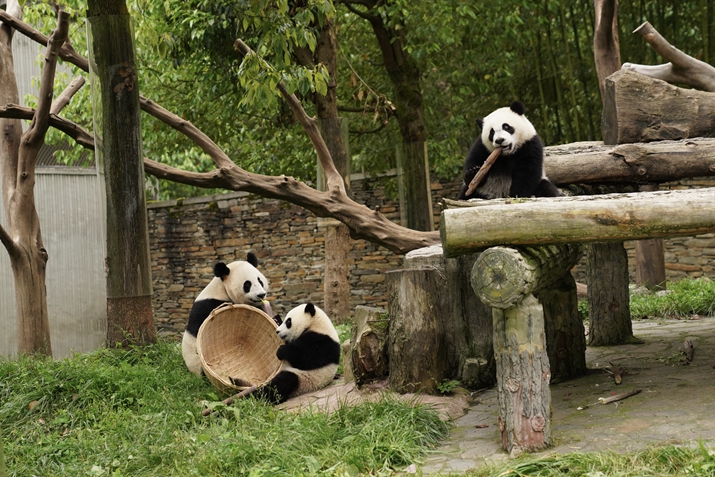
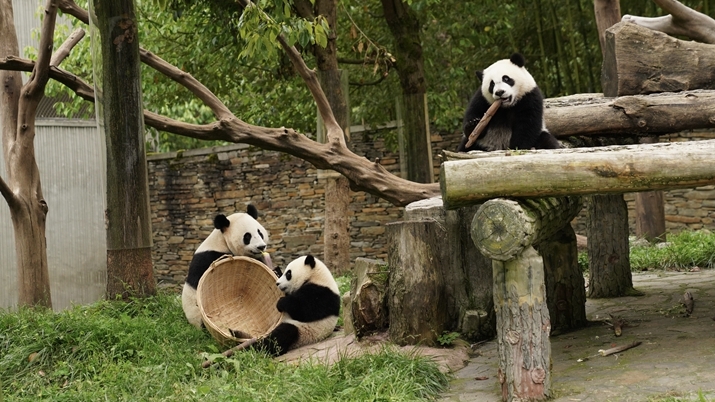
Giant panda Nan Xiaoyue (left) and her two cubs are pictured at the Shenshuping Base of the China Conservation and Research Center for the Giant Panda (CCRCGP) in Wolong on June 3. Located in Gengda Town, Wenchuan County, Sichuan Province, the Wolong Shenshuping Base is one of the four major bases of the CCRCGP. [Photo/Xinhua]
On a wall in the Giant Panda Origin Museum in Baoxing, a county administered by Ya'an City in the southwestern province of Sichuan, hangs an old photograph from the 1980s. It captures keeper Li Kewu sitting inside a rustic log cabin in a bitter winter, cradling a rescued wild panda cub while another rests on his lap. In an era without incubators or specialized formulas, Li used his own body heat to warm the shivering creatures, gently feeding them drop by drop from a glass bottle. One of those cubs grew up to be Panpan. At the time of his death in 2016, Panpan's robust wild genes had produced more than 130 descendants, accounting for one quarter of the global captive panda population then.
That photograph records the humble and grueling beginnings of China's panda conservation. While the outside world was infatuated with these enigmatic black-and-white bears, the early panda keepers and researchers deep in the mountains were driven by pure instinct, wrestling fragile lives from the jaws of death.
Over the past five decades, the giant panda has been downgraded from "endangered" to "vulnerable" on the International Union for Conservation of Nature Red List, and the Giant Panda National Park--spanning Sichuan, Shaanxi and Gansu provinces--has been established. Today, millions of people watch the antics of its pandas on their smartphone screens, generating massive online attention. Yet, few are aware of the generations of researchers who have quietly trudged through signal-blind primeval forests for half a century.
From the pioneering masters who measured the wilderness on foot to today's researchers using AI-powered tracking systems, Chinese scientists have poured their youth, sweat and sometimes their lives into this sea of bamboo.
The 51 steps of Wuyipeng
To understand the foundation of Chinese panda conservation, one must return to the summer of 1974. Hu Jinchu, then a 45-year-old wildlife expert, was tasked with a seemingly impossible mission: Leading a team into the forests of the Wolong Nature Reserve in Wenchuan County, Sichuan, to conduct China's first comprehensive wild panda survey. The nature reserve is China's first protection area for giant pandas, established in 1963.
At the time, data on the wild panda population, its distribution and habits were practically non-existent. Devoid of roads, maps and even proper rainboots, Hu and his team trekked through knee-deep mud and dense bamboo forests, armed with nothing but basic rations.
Pandas are solitary creatures with an acute sense of smell; often, researchers only heard the rustle of bamboo leaves without ever catching a glimpse of the animal. At an altitude of 2,500 meters, Hu noticed frequent panda activity and built a few simple thatched huts for long-term observation. This site later became known as Wuyipeng (Station 51), the world's first field observation station for giant pandas. It was named simply because it took exactly 51 slippery mud steps to fetch water from the stream.
Inside this drafty shelter, Hu spent his days analyzing panda feces. Lacking sophisticated instruments, he used a vernier caliper to meticulously measure bamboo fragments in their droppings. He also examined bite marks on discarded bamboo stalks, which helped identify individual pandas.
Through this painstaking routine, he discovered a pattern: Different pandas left distinct bite marks based on their chewing habits. By mapping the location, freshness and distribution of the droppings, the team could estimate the number of pandas and their movement trajectories.
This empirical method was later coined the Hu Method by the international academic community. It remains a foundational technique used in China's national panda surveys (four to date).
Wuyipeng soon propelled China's conservation efforts onto the global stage. In the early 1980s, George Schaller, a renowned zoologist from the World Wildlife Fund, joined Hu at the station. Together, they tracked wild pandas using radio collars. Every day at 4:00 a.m. in sub-zero temperatures, they climbed cliffs, holding up antennas to catch the faint "beeps" of the transmitters. Through these signals, scientists mapped out the giant panda's daily routine for the very first time. In 1985, Hu and Schaller co-authored The Giant Pandas of Wolong, laying the cornerstone for wild panda behavioral ecology.
Unboxing the wilderness
As the torch passed on to the third generation of researchers in the 2000s, radio waves evolved into satellite positioning, but the wilderness remained unyielding.
Professor Zhang Jindong, Vice Dean of the School of Environmental Science and Engineering at China West Normal University in Nanchong, Sichuan, has spent over 20 years in the field. In public presentations, he humorously describes the panda as a picky eater. Behind the humor, however, lie decades of hardship.
In 2008, before embarking on his doctoral fieldwork, Zhang visited the then 79-year-old Hu. The veteran scholar advised him: "To do this work, you must sweat more than your predecessors, walk harder paths and take risks that others shy away from," Zhang told Beijing Review in an exclusive interview.
Zhang carried these words into the mountains of Wolong, which were then still reeling from the 8.0-magnitude Wenchuan earthquake that claimed more than 80,000 lives in May that year. "People watch videos online and think encountering a wild panda is easy," Zhang noted with a wry smile. "In reality, it took our team five years just to successfully collar five wild pandas."
For over 1,800 days at Wuyipeng, where clean drinking water had to be carried on foot from several kilometers away, Zhang and his team monitored traps. Field tracking was like opening a blind box. To avoid alerting the pandas, Zhang and his American colleague, Vanessa Hull, spent days crouching in makeshift snow shelters. Hull even shaved her head before traveling from the U.S. to save water and time in the mountains.
The psychological toll was immense. "You never knew if a panda would show up, or if it had abandoned the valley entirely," Zhang recalled. Their only company was the midnight wind and the wild eyes staring from outside their tents.
Persistence paid off in 2010 when they first successfully fitted a healthy wild panda with a high-precision satellite collar.
The data harvested from those five collared pandas revolutionized basic panda knowledge. Scientists discovered that pandas do not just mindlessly munch on bamboo; they are highly selective, eating only the most nutritious middle sections.
Furthermore, despite their sluggish appearance, pandas can traverse multiple rugged ridges over 3,000 meters high in a single night during mating season. These data provided the scientific framework for the ecological corridors of today's Giant Panda National Park.
The next generation
Today, a fourth generation of conservationists has taken up the mantle. In the Tangjiahe segment of the Giant Panda National Park, mountain patrolling is a rite of passage. Jia Feide, a local young man and deputy head of the Baixiongping Protection Station in Qingchuan County, Sichuan, underwent his own transformation here. His station oversees 40,000 hectares of primeval forest, an area roughly the size of the U.S. city of Chicago, divided into 65 fixed patrol routes that must be covered every month.
"To avoid the scorching midday sun and toxic insects in summer, we set out at 6:00 a.m. in pairs, carrying over 20 kg of gear, including telephoto cameras, satellite phones and infrared monitors," Jia told Beijing Review.
Initially, Jia struggled with vertigo on trackless cliffs and got severe blisters. Yet, watching veteran rangers silently pack their bags each morning, he learned to lance his blisters, wipe away the fluid, slip back into his damp boots and head out anyway. Some routes required round trips of up to 20 km. Encounters with black bears or Tibetan takins, large, muscular goat-antelopes, were common. But Jia learned the code of the wild: respect their space, detour quietly and coexistence follows.
"Pandas have poor eyesight but excellent hearing and smell; they vanish long before you approach. Finding even a fresh footprint makes us as ecstatic as winning the lottery," Jia said.
Occasionally, direct encounters do happen. Ranger Shao Chunlin once stumbled upon a wild panda in a bamboo grove just five meters away. "We locked eyes. Both of us froze," Shao recalled. No one spoke or reached for a camera. Shao and his partner held their breath and slowly backed away to a safe distance. The panda relaxed and resumed chewing its bamboo. "Watching from afar without disturbing them is the ultimate form of protection," Shao said.
Where technology meets the wild
In 2024, the information center at Tangjiahe launched an integrated "space-air-ground" smart monitoring platform. On her monitor, Xiao Mei, head of the monitoring section, displayed a series of maps tracing panda sightings from August 2020 to February 2026. Over 11 maps, the red dots representing these spottings gradually multiplied, spreading across the northern foothills of the Minshan Mountains until they formed a dense tapestry.
"Behind every red dot is a path carved out by our rangers or captured by infrared cameras," Xiao said.
Panda conservation no longer relies solely on traditional human surveys. Today, over 400 infrared cameras keep watch along animal trails 24/7. Drones scan inaccessible cliffs. And high-precision DNA analysis of collected feces and fur identifies individual pandas, preventing double-counting in surveys.
"The giant panda serves as an umbrella species," Zhang explained. This is an ecological phenomenon where protecting one species--in this case, the giant panda--inadvertently protects an entire ecosystem. By restoring the mosaic of forests and bamboo groves that pandas call home, generations of scientists have extended a protective canopy over golden monkeys, takins, rare birds and thousands of unique insect and plant species.
"Protecting pandas is not about nurturing a cute pet," he added. "It is about preserving an entire interconnected ecosystem. Ultimately, it is about saving our human selves."
The ultimate goal
The ongoing relay of panda research at China West Normal University has now crossed the half-century mark. Yin Huakang, who studied under Zhang, spent five consecutive years at the remote Mabian Dafengding Panda Observation Station. During a dung collection trip in 2023, a wild panda sleeping above him fell when the branch snapped, landing right on top of him. The startled panda scrambled away, but Yin, knocked into the mud, barely noticed the pain--he was simply overjoyed. After five years of searching, he had finally seen a wild panda up close. Upon graduating, Yin joined the China Conservation and Research Center for the Giant Panda as a keeper.
This dedication resonates globally. Every year, Zhang's research group conducts academic exchanges with students from the University of Florida, led by Hull. Seeing the decades of sacrifice made by Chinese researchers in remote, off-the-grid mountains, the young researchers from the U.S. delegation are invariably moved to profound respect.
Looking ahead, Zhang advocates for translating complex scientific research into popular science. He and his graduate students are turning dense academic papers into Chinese comic strips, short videos and animations tailored for social media.
"We want the public to understand that a wild panda is not a captive darling; it is a highly intelligent, wild and ancient survivor that has triumphed over millions of years of evolution. True understanding is the first step toward true conservation," he explained.
When asked what the ideal future looks like for the giant panda, Zhang paused before answering.
"From a human perspective, freedom is the highest form of wellbeing. The same applies to pandas. That rugged, hazardous yet dynamic wilderness without cell service is their true home. Foraging, mating and raising cubs in the wild is their most natural and joyful state," Zhang said. "The ultimate goal of our breeding, research and tracking is not to keep them permanently within human sight, but to one day step back and return their homeland to them entirely."


 京公网安备 11010802027341号