Share:

"We are small, yes. But our hope is as vast as the sea."
The words, written in Portuguese on a hand-held placard, rose above a crowd in Praia on Monday night as Cabo Verdeans celebrated a result that already felt larger than football.
Around the woman holding the sign, fans in blue national team jerseys waved Cabo Verdean flags, cheered, clapped and sang in the streets of the capital.
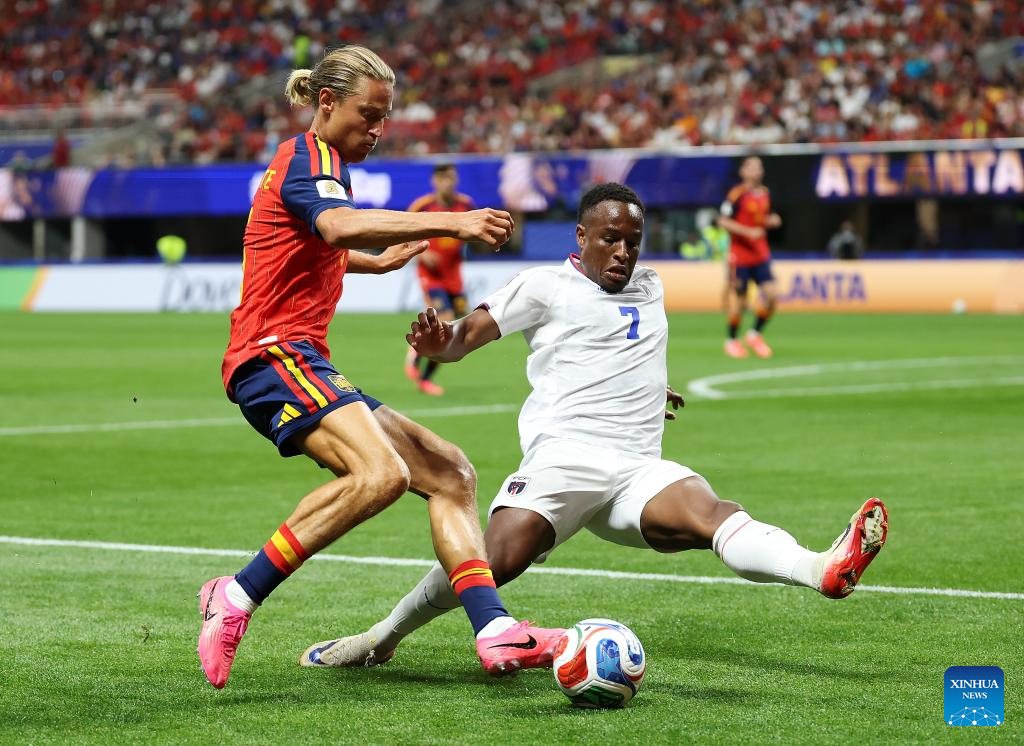
Jovane Cabral (R) of Cape Verde vies with Marcos Llorente of Spain during the group H match between Spain and Cape Verde at the 2026 FIFA World Cup at Atlanta Stadium in Atlanta, the United States, June 15, 2026. (Xinhua/Wang Kaiyan)
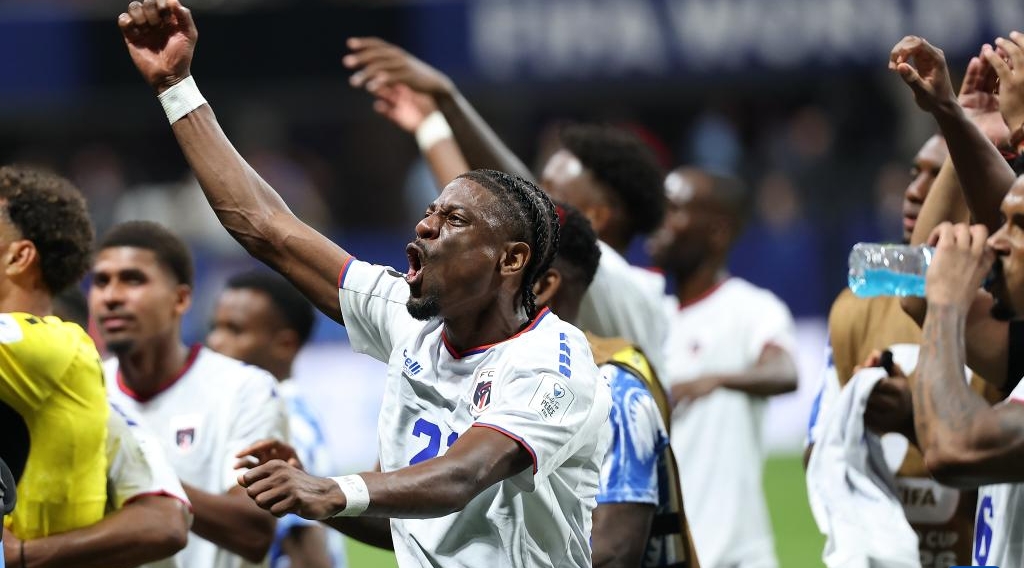
Hours earlier, Cabo Verde, a small Atlantic island country with a population of just over half a million, had held former world champion Spain to a 0-0 draw in its first-ever FIFA World Cup match. The draw earned Cabo Verde its first point at the tournament.
For Cabo Verdeans, it produced something more enduring: belief. Facing one of world football's traditional powers, the Blue Sharks withstood pressure and left the pitch with a result that many described as historic.
"The feeling after the match is indescribable," said Oscar Rodrigues, sports councilor of the Praia City Council. "Cabo Verde played very well for a team going to the World Cup for the first time, especially against Spain, a former world champion with some of the best players."
Rodrigues said the result should give the team confidence, but not arrogance.
"What Cabo Verde did today is historic," he said. "Now we must continue with the same humility and look ahead to the next two matches. Everything is possible, and we can go further."
Among those watching the celebrations was Jose de Pina, a former Cabo Verde national team player between 1975 and 1988. For him, the result carried the weight of decades of footballing struggle.
"It was a draw that felt like a victory," he said. "Spain was the clear favorite, but football is played until the final whistle. There is no winner before the match begins."
De Pina said Cabo Verde's performance showed how far the national team had come.
"Before, we took part in matches. Now, we compete," he said. "I feel proud and very happy. My message to the team is to keep going. They are on the right path."
On the pitch, goalkeeper Vozinha became one of the faces of Cabo Verde's debut. Under sustained pressure from Spain, he remained composed in front of goal and made a series of important saves to help preserve the clean sheet. His performance earned him the player-of-the-match award and made him one of the most talked-about Cabo Verdean players after the final whistle.
Yet the night in Praia was not only about one player. It was about a country seeing itself on football's biggest stage and refusing to be intimidated.
"We entered the field with humility, respecting a team that has already been world champion, but without fear," said artist Tutu Sousa. "We came to the World Cup to compete, not just to take part. Today, the team proved that."
Sousa's words carried added meaning. He is also the designer of Cabo Verde's commemorative World Cup stamps, issued on June 8 by the Cabo Verdean postal company and the Cabo Verdean Football Federation to mark the country's first qualification for the World Cup finals.
At the launch ceremony, Cabo Verdean Football Federation president Mario Semedo said the stamps would travel around the world with the country's mail, carrying the World Cup dreams of the island country. After the draw with Spain, that dream felt less distant.
Cabo Verdean President Jose Maria Neves also attended the game and later posted on social media that he had visited the dressing room to congratulate the "brave Blue Sharks" on their brilliant World Cup debut.
"We are making history every day," the president wrote.
On the streets of Praia, that sense of history was shared by ordinary supporters.
"We are a strong, united and resilient people," said Alcides Cabral. "To draw with Spain in our first World Cup makes us believe in ourselves even more."
Cabo Verde will next face Uruguay and Saudi Arabia in Group H.
As night fell over Praia, the celebrations had not faded. Flags were still waving, car horns still sounded, and fans in blue still filled the streets.
For a small island country, one point had opened a sea of hope.


 京公网安备 11010802027341号