


 Share:

Turning scientific discoveries into market-ready products remains one of the most challenging steps in the innovation chain. At Tianjin's Tiankai Higher Education Innovation Park, an integrated ecosystem links researchers, entrepreneurs, capital and industrial resources to shepherd university technologies from the laboratory to the market.
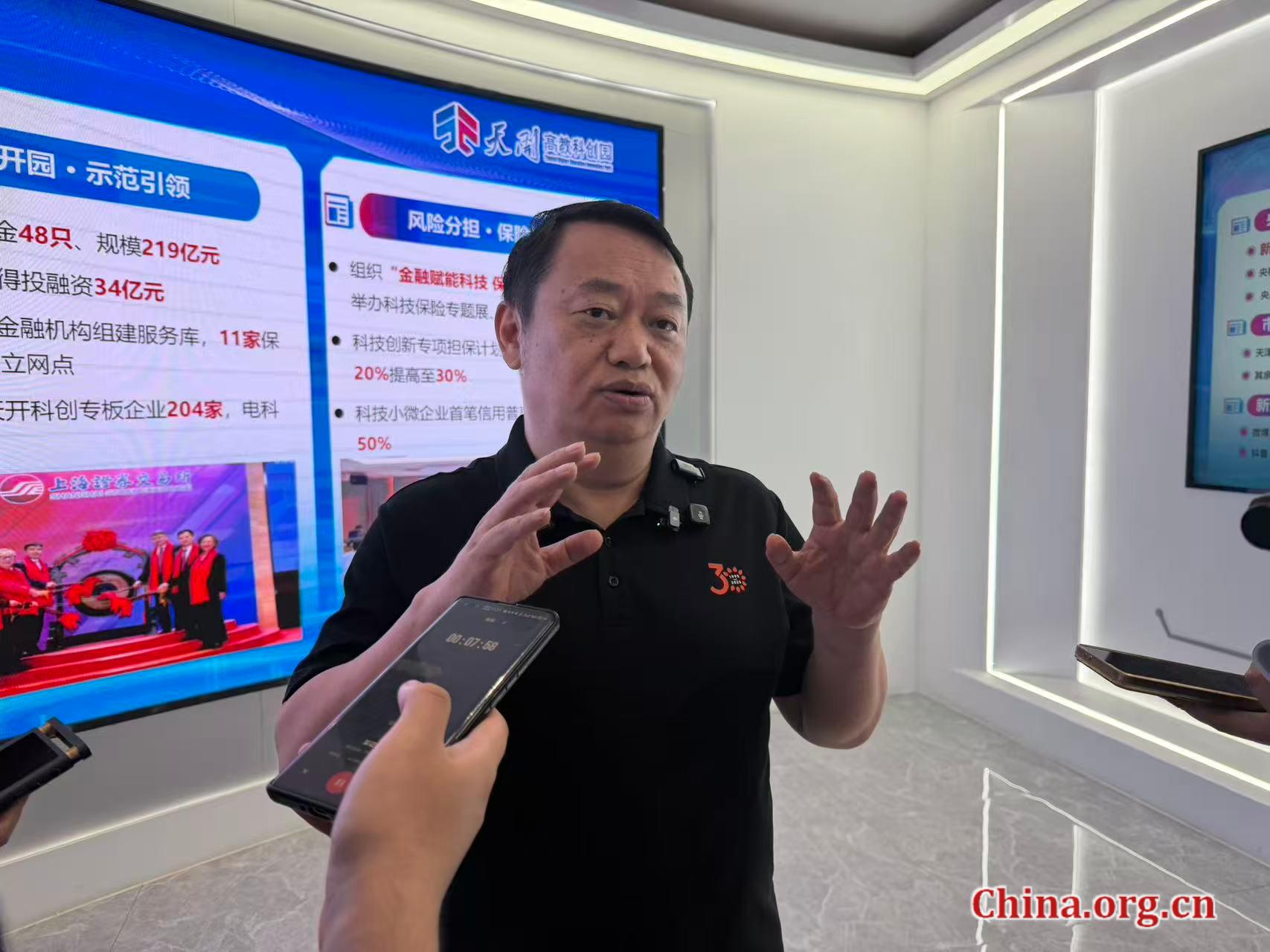
Liu Yi, founding partner of Beiyang Haitang Fund, dean of Xuanhuai College at Tianjin University and chairman of Andon Health Co., Ltd., attends a group interview during the 2026 Vibrant China Research and Visit Tour in Tianjin, June 15, 2026. [Photo by Liu Caiyi/China.org.cn]
The biggest challenge in technology commercialization is not the technology itself but the gap between scientists and entrepreneurs, according to Liu Yi, founding partner of Beiyang Haitang Fund and dean of Xuanhuai College at Tianjin University.
"Scientists focus on innovation, while entrepreneurs focus on turning technologies into products that meet market demand," Liu told reporters during the 2026 Vibrant China Research and Visit Tour.
He said successful commercialization requires a full support system spanning investment, entrepreneurial talent, incubation space and professional mentoring. Tiankai Higher Education Innovation Park plays a key role by identifying promising projects, mobilizing capital and providing startup services.
The fund was jointly initiated by Tianjin University alumni entrepreneurs, focusing on early-stage, small-scale and hard-tech investments. It has built a comprehensive investment system combining direct investment and fund-of-funds mechanisms to support technology startups.
The fund currently manages nearly 10 billion yuan ($1.4 billion) in assets, including a flagship 5-billion-yuan science and innovation fund.
It began investing in startups founded by students, faculty members and alumni in 2019, aiming to support early-stage innovators facing constraints in funding, talent and resources.
One of its most notable success stories is Yunyao Aerospace, a meteorological satellite startup that won top honors in Tianjin University's entrepreneurship competition in 2019. The company has since launched more than 40 satellites and reached a valuation of around 2.5 billion yuan.
Liu said many emerging projects at Tianjin University are concentrated in fields aligned with the university's academic strengths, including precision instruments, automation, electronics, chemical engineering, synthetic biology and advanced materials.
When assessing investment opportunities, the fund focuses on two factors: technological competitiveness and the path to industrialization. "We look at the uniqueness of the technology, its competitive barriers and the time required to reach the market," he said.
By integrating university research strengths with entrepreneurial support and capital investment, Liu said more scientific discoveries are expected to translate into new industries and drivers of economic growth.


 京公网安备 11010802027341号