Share:

When people think of virtual reality (VR), they often imagine gamers wearing headsets or futuristic digital worlds from science fiction films. Yet in China, the technology is increasingly viewed not as entertainment but as a platform that could transform how people learn, work, communicate and innovate.
"Virtual reality is essentially a new way of human-computer interaction," said Yu Wenjiang, secretary of the China Virtual Reality Technology and Industry Innovation Platform, in a recent interview with China.org.cn. "It allows the digital world to appear in a more natural and immersive form."
Zhao Qinping, an academician of the Chinese Academy of Engineering and a leading Chinese virtual reality researcher, said the next phase of VR development can be described as "VR 2.0," moving from a "3I" model — immersion, interaction and imagination — to a "6I" framework that adds intelligence, interconnection and iteration.
Industry coordination is becoming increasingly important as these developments accelerate. In November 2025, the launch of the Zhongguancun Alliance for Virtual Reality and Metaverse Industries in Beijing reflected a broader shift in China's approach to immersive technologies, said Yu, who also serves as the alliance's legal representative.
Initiated by Beihang University alongside industry partners, the alliance brings together universities, research institutes and leading enterprises to promote related policies, advance academic research and develop technical standards in the VR and metaverse sectors.
Its formation comes as the global digital economy enters a new phase shaped by AI, spatial computing, digital twins and next-generation internet systems associated with Web 3.0 and the metaverse, Yu said.
A VR system allows users to enter a computer-generated environment, interact with it naturally and receive real-time feedback. Increasingly, VR is merging with augmented reality (AR) and mixed reality (MR) into a broader ecosystem known as XR. In 2025, the XR industry experienced rapid growth in AI-powered smart glasses and immersive computing devices, with technologies such as multimodal interaction, world modeling and spatial intelligence converging in what many analysts see as a tipping point for XR adoption.
Backed by advances in AI, digital twins, spatial computing and XR devices, China's VR industry is entering a phase where practical applications matter more than futuristic hype, and the impact is becoming visible across a growing range of real-world scenarios.
Education is one of the clearest examples. Chinese schools and universities are increasingly experimenting with virtual laboratories, immersive science education and historical simulations.
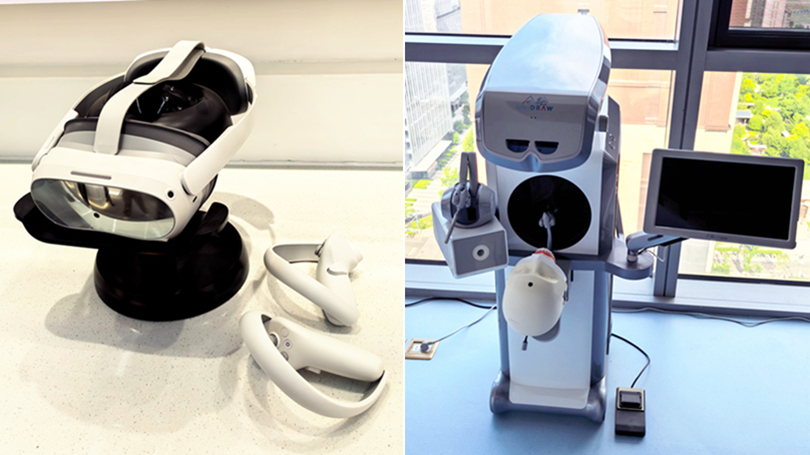
Companies are also developing specialized XR teaching systems. China IOT Telecommunication Technology Co., Ltd. has developed XR-based teaching systems for vocational logistics education, integrating AR interactive teaching, digital twins, 3D simulation, MR collaborative training and VR panoramic instruction.
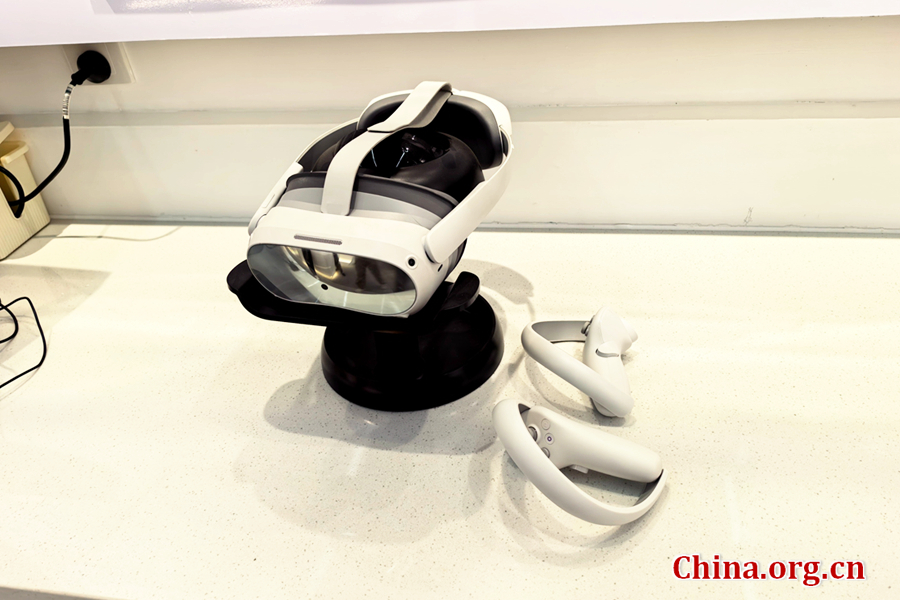
An XR headset for vocational logistics education developed by China IOT Telecommunication Technology Co., Ltd. is on display at the company's premises in Beijing. [Photo by Mi Xingang/China.org.cn]
Vice President Wei Jia said the company has already partnered with multiple vocational schools across China, reflecting growing demand for immersive education tools that combine hardware, software and practical training scenarios.
In medicine, VR is becoming a tool for surgical training, rehabilitation and psychological treatment.
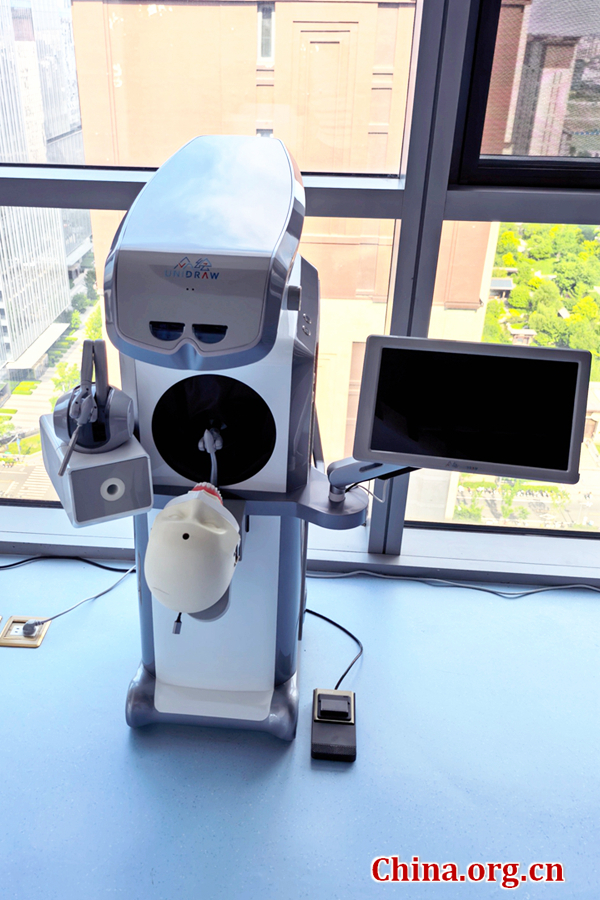
A dental simulator for education, surgical skills training and operational assessment is on display at the State Key Laboratory of Virtual Reality Technology and Systems, Beijing. [Photo by Mi Xingang/China.org.cn]
Virtual human simulation has a long history in medical education, but modern VR systems now allow far more realistic and interactive training environments, with doctors able to practice procedures repeatedly in safe virtual settings. Some hospitals are also exploring VR-assisted rehabilitation programs for stroke patients and immersive therapies for anxiety-related disorders.
This reflects a broader Chinese approach to linking universities, research institutions and companies into integrated innovation networks, with the goal of moving VR from isolated technical breakthroughs toward scalable real-world applications. Museums, cultural institutions and tourism projects are also increasingly adopting AI and XR technologies to let visitors experience virtual exhibitions.
Many Chinese researchers believe the future of VR may look less like a fully separate virtual universe and more like a seamless blend of digital and physical reality — a world where information, collaboration and simulation are embedded into ordinary life.


 京公网安备 11010802027341号