 Share:

The group stage of the 2026 FIFA World Cup concluded on Saturday, leaving behind a collection of remarkable numbers that tell the story of records broken, tactical trends revealed and stars shining on football's biggest stage.
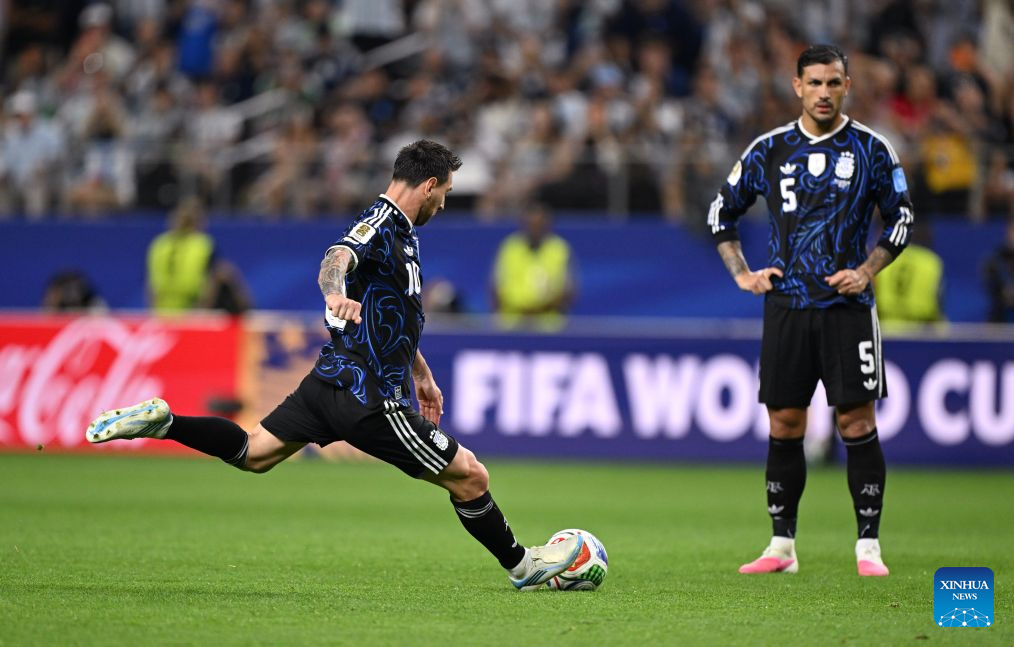
Lionel Messi (L) of Argentina scores their third goal from a free kick during the group J match between Jordan and Argentina at the 2026 FIFA World Cup at Dallas Stadium in Dallas, the United States, on June 27, 2026. (Xinhua/Cheng Min)
RECORDS IN NUMBERS
3
This is the first World Cup jointly hosted by three countries. Mexico is hosting the tournament for a third time after staging the 1970 and 1986 editions.
Mexico City's iconic stadium, formerly known as the Azteca Stadium, has become the first venue to host three World Cup opening matches.
215
A total of 215 goals were scored in the 72 group-stage matches.
The previous World Cup record of 172 goals, set across 64 matches in Qatar in 2022, was broken when United States forward Auston Trusty scored the tournament's 173rd goal during Match 59.
The average goals per game has increased from 2.69 in Qatar to 2.99 at the 2026 tournament.
19
Lionel Messi entered the tournament with 13 World Cup goals.
The Argentine captain scored a hat trick in the opening round, becoming the oldest player to record a World Cup hat trick at 38 years and 357 days. He then surpassed Miroslav Klose's record of 16 goals before adding another strike as a substitute in Argentina's final group match, taking his all-time World Cup tally to 19.
6
Cristiano Ronaldo also made history.
The Portuguese star scored twice in the second round of the group stage to become the first player to score in six consecutive World Cups. His 10 World Cup goals are also a Portugal national team record.
At 41, Ronaldo became the oldest player to score twice in a World Cup match and the second-oldest goalscorer in tournament history, behind only Cameroon's Roger Milla.
Ronaldo, Messi and Mexico goalkeeper Guillermo Ochoa are now the only three players to have appeared at six men's World Cups.
1
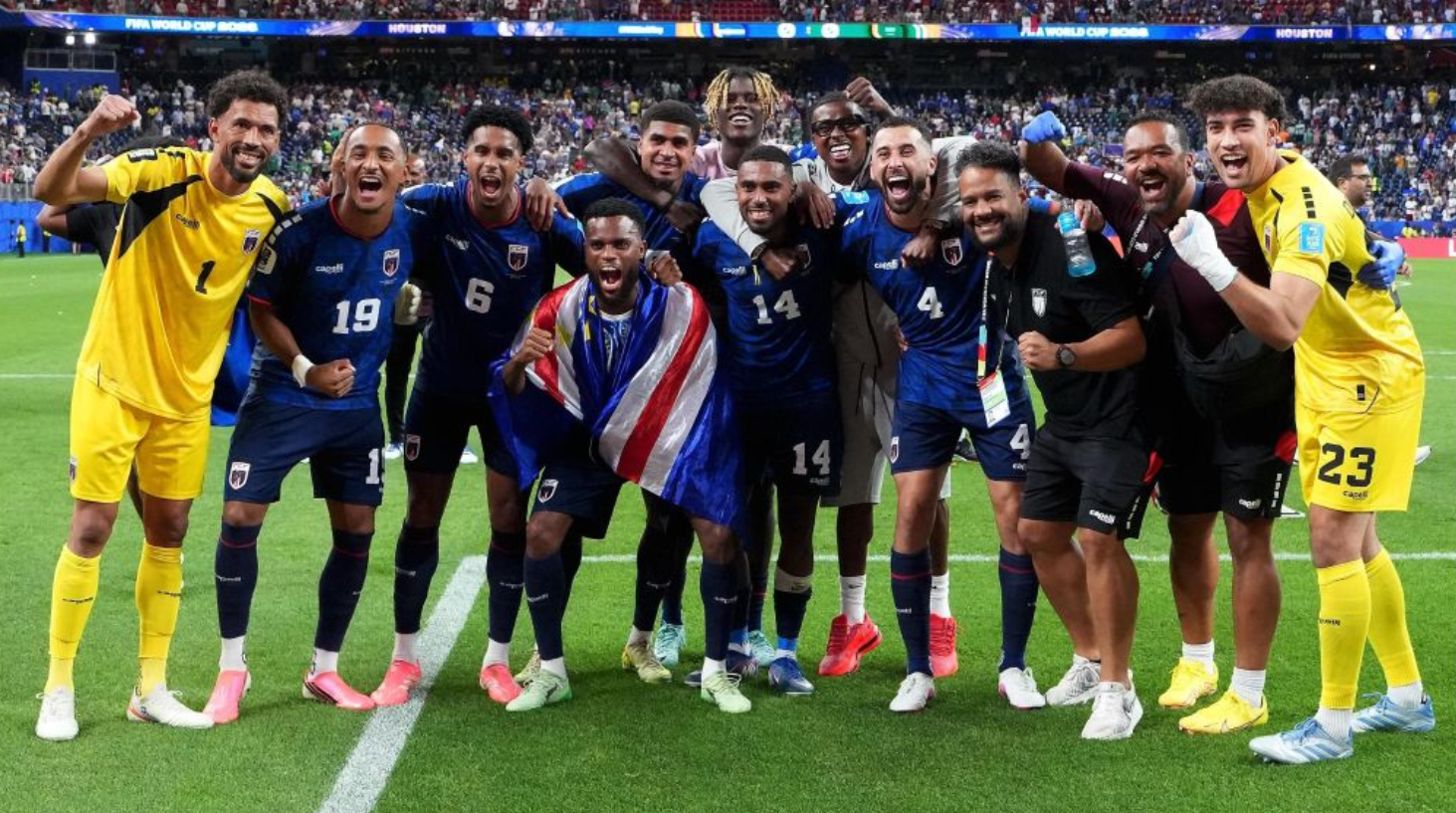
Cabo Verde produced one of the tournament's biggest surprises.
The debutant advanced to the knockout stage as group runner-up after drawing all three matches. With a population of just over 500,000, Cabo Verde became the smallest nation by both population and territory ever to reach the World Cup knockout rounds.
South Africa, Canada, Bosnia and Herzegovina, Egypt, Cote d'Ivoire and DR Congo also reached the knockout stage for the first time.
74
South Africa's 1-0 victory over South Korea on June 24 secured the nation's first-ever place in the World Cup knockout rounds.
The result also made Belgian coach Hugo Broos, aged 74 years and 75 days, the oldest manager to win a World Cup match.
426,834
Attendance records have also fallen.
On June 16, a total of 281,223 spectators attended four World Cup matches, surpassing the previous single-day record of 277,070 set in 1994.
That mark was broken again on June 25, when 426,834 fans watched six group-stage matches.
TACTICS IN NUMBERS
Some numbers reveal the contrasting styles adopted by different teams.
10
France, the Netherlands and Germany were the highest-scoring teams of the group stage, each netting 10 goals.
The Dutch were the most efficient, scoring 10 goals from only 40 shots. France required 48 shots, while Germany needed 53.
France and the Netherlands also significantly outperformed their expected goals figures of 4.96 and 4.66 respectively, highlighting the finishing quality of their attacking stars.
26%
Japan recorded the best shooting efficiency of the tournament.
The Asian side scored seven goals from 27 shots, giving it a conversion rate of 26 percent. All seven goals came from assisted plays, underlining the team's collective approach.
4%
Türkiye ranked second in total shots with 70 and third in total distance covered, but scored only three goals.
Its conversion rate of just four percent was among the lowest in the tournament. Türkiye also attempted a tournament-high 33 shots from outside the penalty area, reflecting its frustration in front of goal.
The lack of efficiency ultimately led to an early exit.
2,191
Spain once again showcased its trademark possession-based football.
The Spaniards completed 2,191 passes during the group stage, including 2,013 successful passes for a completion rate of 92 percent. Both figures ranked first among all teams.
Spain's average possession of 62 percent also topped the standings.
358,610.48
The United States led all 48 teams in total distance covered, with its players running a combined 358,610.48 meters across three matches.
The co-host also ranked first in high-speed runs, third in sprints and fourth in average running speed, helping it finish top of its group.
206
Paraguay emerged as one of the tournament's most aggressive defensive teams.
It ranked first in direct defensive pressure with a score of 206, comfortably ahead of Ecuador's 168. Paraguay also ranked second in forced turnovers with 150.
The intensity came at a cost, however, as Paraguay shared the group-stage lead in yellow cards with Curacao, receiving seven cautions.
PLAYERS IN NUMBERS
The 2026 tournament is also the first World Cup to feature FIFA's official Player Power Ranking.
Developed under the guidance of FIFA chief of global football development Arsene Wenger, the system evaluates players in attacking, creativity and defensive categories using official match data and football intelligence algorithms.
8.37
Germany forward Deniz Undav topped the attacking rankings with a score of 8.37, narrowly ahead of Messi's 8.33.
Undav scored three goals and provided two assists in only 106 minutes, converting three of his five shots.
8.02
French winger Michael Olise led the creativity rankings with a score of 8.02, the only player to exceed the eight-point mark.
Olise registered three assists, completed 184 passes at an 85-percent success rate and led France in both distance covered and total sprints.
8.12 and 7.26
France captain Kylian Mbappe was the only player ranked among the top five in both attacking and creativity categories.
He ranked third in attacking with 8.12 points and fifth in creativity with 7.26.
Mbappe contributed four goals and two assists during the group stage. Despite an expected goals figure of only 1.72, he scored four times, underlining his clinical finishing ability.
7.30
Canada defender Derek Cornelius topped the defensive rankings with a score of 7.30, narrowly ahead of Spain's Ballon d'Or-winning midfielder Rodri on 7.29.
Cornelius won 13 aerial duels and maintained an 87-percent passing success rate across 251 minutes, demonstrating the consistency and resilience that helped Canada reach the knockout stage for the first time.


 京公网安备 11010802027341号