 Share:

The World Cup knockout stage features two familiar favorites, a record African contingent and a chance for emerging nations to rewrite their football history.
Here are five themes to watch as the round of 32 gets underway.
1. Can France and Argentina be stopped?
France and Argentina enter the knockout stage as the sides to beat.
Argentina won all three matches in Group J and conceded just one goal, with Lionel Messi remaining the heartbeat of the team at 39. France's attacking threat extends well beyond Kylian Mbappe, with Ousmane Dembele, Michael Olise and Desire Doue offering Didier Deschamps an enviable range of options.
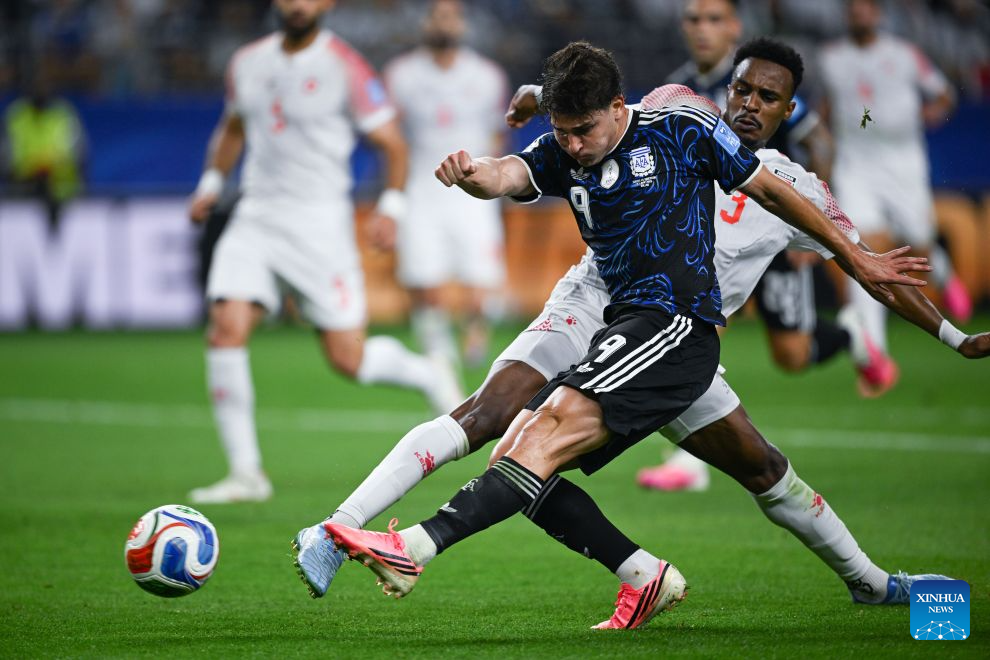
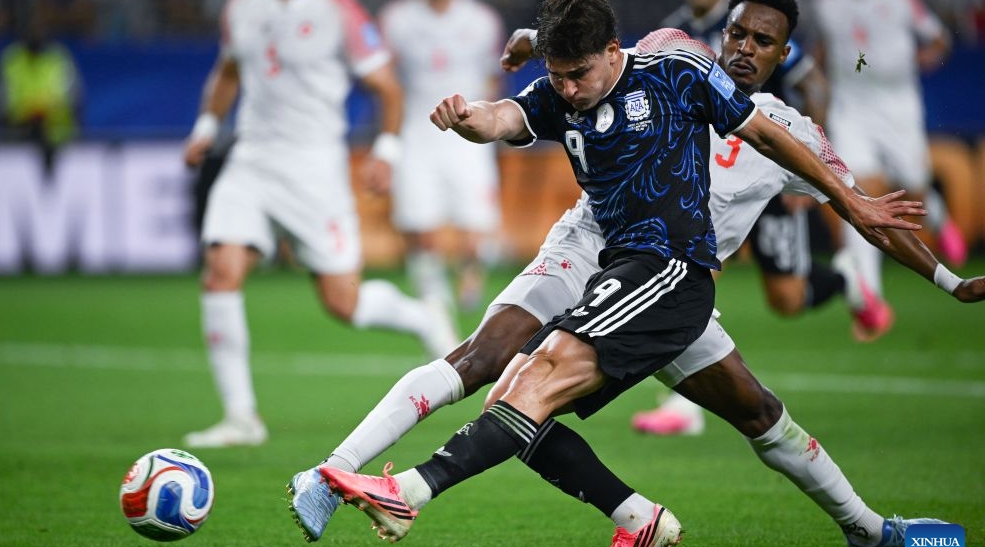
Julian Alvarez (front) of Argentina competes during the group J match between Jordan and Argentina at the 2026 FIFA World Cup at Dallas Stadium in Dallas, the United States, on June 27, 2026. (Xinhua/Wu Xiaoling)
Their opening knockout ties present contrasting challenges. Argentina faces Cabo Verde, a debutant already enjoying the best month in its football history. France meets Sweden, a more seasoned opponent with the physical edge to make life uncomfortable.
2. Who can challenge the favorites?
Cabo Verde has already broken new ground, but Argentina is a brutal reward for that achievement.
Morocco, however, may represent the strongest threat outside the established favorites. The reigning African champion reached the World Cup semifinals four years ago and now meets the Netherlands after another impressive group-stage campaign.
Algeria also has reason to believe against Switzerland, while the Democratic Republic of the Congo set up a meeting with England after a landmark win over Uzbekistan.
Now comes the harder task of turning promise into a deep tournament run.
3. Is this Africa's breakthrough World Cup?
Africa arrives in the knockout stage with unprecedented depth. Nine of the continent's 10 teams advanced, including four of the eight best third-placed finishers.
Senegal, Egypt, Morocco, Algeria, Ghana and Cote d'Ivoire are joined by Cabo Verde, DR Congo and South Africa.
Beyond Morocco, Africa has no shortage of teams capable of troubling opponents. Mohamed Salah remains Egypt's biggest weapon, while Senegal again looks built for tournament football.
Riyad Mahrez underlined his importance to Algeria with a two-goal display against Austria, and Cabo Verde and DR Congo have already produced the best World Cup performances in their history.
4. Can Japan or Australia go further?
Asia's hopes now rest with Japan and Australia. Japan was the continent's standout team in the group stage, going unbeaten and scoring seven goals, its highest total at a World Cup. Brazil now provides the strongest possible test of Hajime Moriyasu's side.
Australia secured back-to-back knockout berths for the first time in its history with a game plan built more on discipline than attacking sparkle. Tony Popovic's team placed second behind the United States in Group D and now faces Egypt.
For Japan, Daizen Maeda, Ritsu Doan and Ayase Ueda lead a forward line that could unsettle Brazil's defense. For Australia, Jordan Bos and Nestory Irankunda give Popovic's side pace and directness against Egypt.
5. Which player will define the tournament?
The World Cup's biggest names have reached the stage that shapes legacies.
Messi and Mbappe remain the central figures, not only because of their teams' ambitions, but also because their World Cup scoring race has become a story of its own.
Harry Kane enters the tournament's decisive phase after becoming England's all-time leading World Cup scorer. Cristiano Ronaldo, now 41, is pursuing the one major trophy still missing from his career, while Vinicius Junior gives Brazil another match winner as it seeks a sixth title.
The established stars may not have the spotlight to themselves. Morocco midfielder Ayyoub Bouaddi and Cote d'Ivoire winger Yan Diomande are among the young players who have already enhanced their reputations and could leave an even bigger mark in the knockout rounds.


 京公网安备 11010802027341号