 Share:

Hangzhou Qiuguo Planning Technology returned to the fourth China International Supply Chain Expo (CISCE) in Beijing, which ran June 22 to 26, bringing AI models and smart wearables designed to digitize traditional Chinese medicine (TCM).
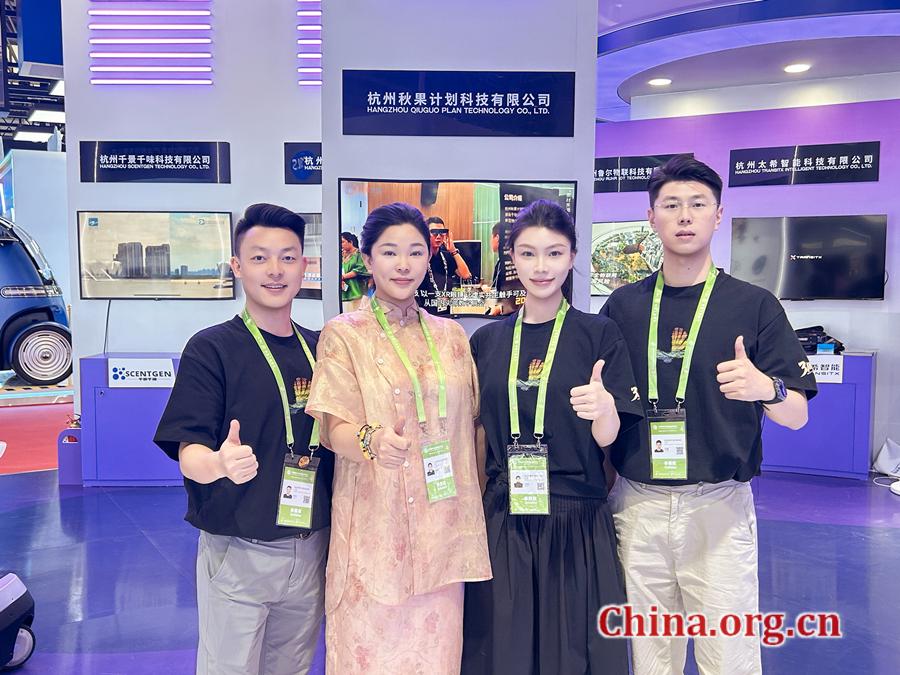
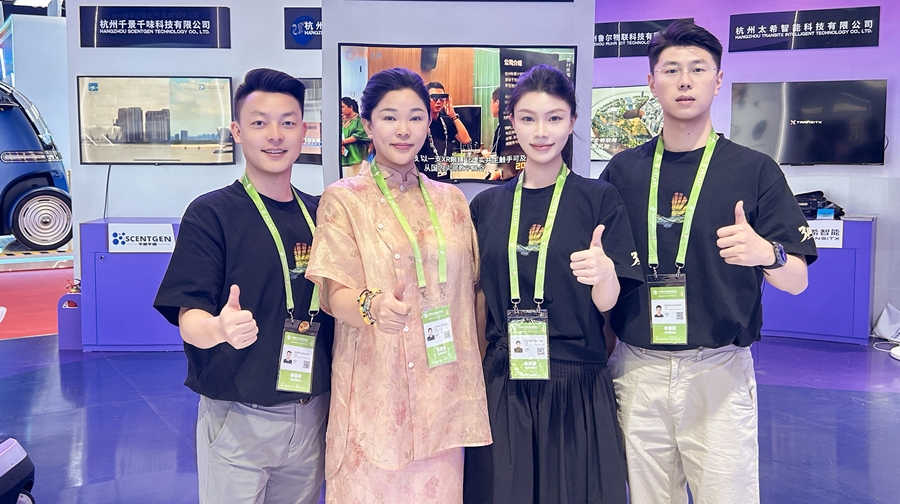
Shi Chunling (second from left), deputy general manager of Hangzhou Qiuguo Planning Technology Co., Ltd., poses with colleagues at their booth at the fourth China International Supply Chain Expo in Beijing, June 24, 2026. [Photo/China.org.cn]
"Last year, when we exhibited here for the first time, our core goal was brand exposure. The expo opened a global market window for us, and we established cooperation intentions with merchants from multiple countries and regions," said Shi Chunling, deputy general manager of the Hangzhou-based tech company.
She said the greatest value of CISCE lies in "connecting businesses and connecting ecosystems."
Qiuguo Planning came to this year's expo to launch its self-developed TCM four-diagnosis AI model and accompanying hardware, including XR glasses and TCM smartwatches, while gathering market intelligence to guide future strategy.
"We hope that through CISCE, we can establish deep cooperation with upstream and downstream partners across the industrial chain, including technical integration and scenario implementation," she said.
The company's lead product is an AI system called the "TCM four-diagnosis vertical model," which Shi said is the world's first capable of integrating TCM's four diagnostic methods — inspection, auscultation, inquiry and pulse-taking — into a single AI system.
It draws on data from tongue and facial readings, voice analysis, user interaction and a TCM smartwatch to generate health reports covering constitution identification, risk warnings and wellness recommendations.
Shi said the model tackles two core problems: a shortage of TCM experts and the difficulty of standardizing data. Qiuguo Planning uses AI to digitize veteran practitioners' experience and collects data through wearables, she said, allowing personalized TCM services to scale for the first time.
Qiuguo Planning is also displaying Wigain Omnision XR glasses and TCM smartwatches. The glasses handle visual interaction and health data display, while the smartwatch continuously monitors physiological data including pulse waves.
"AI model capabilities ultimately need to be delivered through hardware to truly reach users," Shi said, adding that the company's supply chain expertise in smart wearables is what makes the solution possible.
There is no mature, ready-made supply chain for AI wearables, she said, so Qiuguo Planning works closely with upstream suppliers from the R&D stage to tackle challenges together.
"Wearable devices need to solve core issues like energy consumption, weight and heat dissipation — there are no off-the-shelf answers. We trial and iterate with our suppliers, and this model has already supported the R&D and iteration of our glasses and watch products," she said.
Once the TCM four-diagnosis model is deployed, Shi said the company plans to open its data capabilities to partners across health management, insurance and elderly care. "The model itself is the 'brain,' and the hardware is the 'limbs,' but the real value lies in enabling partners across the supply chain to access and leverage this entire set of capabilities."
Qiuguo Planning has several new smart wearable products in development, including glasses, watches and a smart ring.
"Our logic is clear: model iteration and hardware iteration go hand in hand, with the ultimate goal of making AI-powered health capabilities feel as natural as wearing a watch," Shi said.


 京公网安备 11010802027341号