 Share:

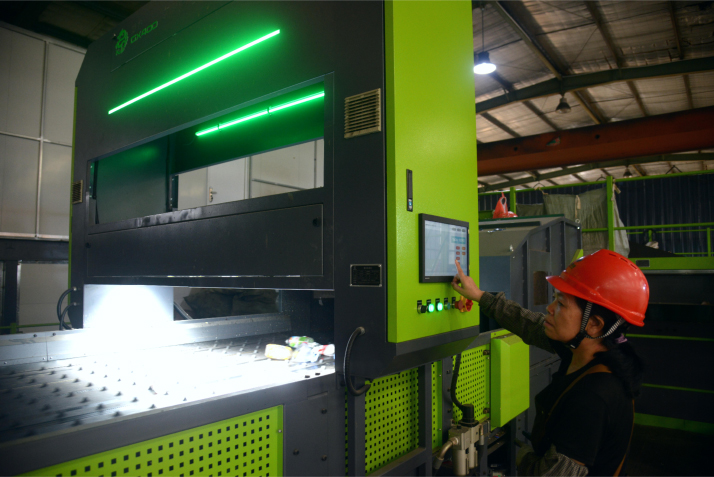
A worker operates an intelligent sorter to screen recyclable waste at a renewable resources sorting center in Fuzhou, Fujian Province, on September 13, 2025. (XINHUA)
Earlier this year, Xie Keqiao, a 32-year-old Beijing professional, developed a new habit, one that costs her nothing and pays her small, consistent dividends.
Every evening after work, she carries her kitchen trash down to the communal bins outside her apartment building. She doesn't go straight back upstairs sometimes, though. Instead, she makes a short detour to a bright green recycling machine, tucked in a corner of the compound. From her bag or pockets, she pulls out whatever she's collected during the day: flattened cardboard boxes, rinsed plastic bottles, and an empty can or two. She scans the QR code on the screen, feeds the items into the machine's mouth, and within seconds, her digital wallet on Chinese superapp Weixin pings with a tiny deposit, usually a few jiao (a few U.S. cents).
"At first, I didn't think much about it," she told Beijing Review. "I just had too much cardboard from delivery packaging piling up, and a neighbor told me the machine actually pays you."
These machines, scattered across cities nationwide, are operated by Aihuishou (translated as Love Recycling), an online-to-offline platform of ATRenew, a Shanghai-based company dedicated to recycling. Founded in 2011, Aihuishou started out offering electronic product recycling and trade-in services, but has since expanded into multi-category item recovery, collecting everything from plastics and paper to metals, clothing and luxury goods.
"The moment that money hit my account, I had one thought: How much have I been throwing away all these years?" she said.
Xie is hardly alone. Across China, a growing number of young people are embracing environmental causes not out of obligation, but because they've found ways to make it fun, social and even rewarding. From using superapps to jointly planting trees with friends and from sharing recycling hauls on social media to teaming up for community collection drives, eco-friendly behaviors have morphed into a new kind of social currency that is lighthearted, shareable and unexpectedly addictive. For this generation, saving the planet no longer feels like a chore; it feels like a game they actually want to play.
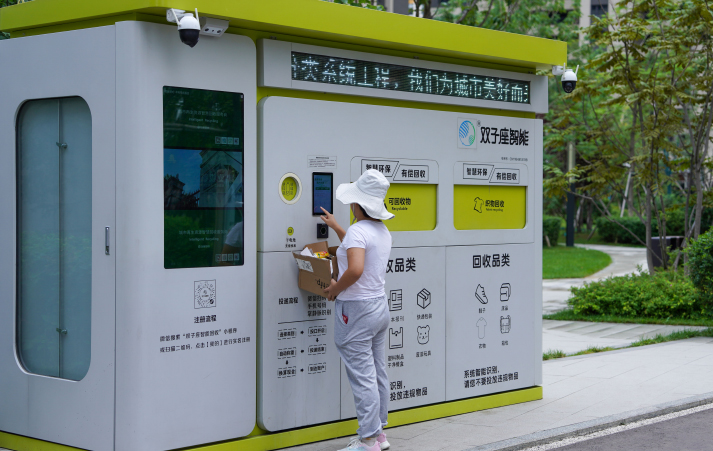
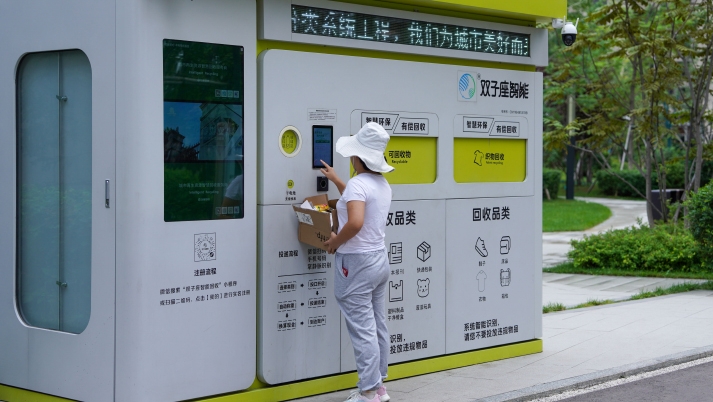
A resident deposits cardboard from delivery packaging into a smart recycling collection machine in a residential compound in Changchun, Jilin Province, on August 11, 2025. (XINHUA)
A new habit
The smart recycling machines first began appearing around 2019 and since then, their rollout has accelerated, driven by supportive policies. In August 2024, Beijing launched a citywide push to install the machines. Today, they have been deployed in thousands of residential compounds across the capital, with more than 10,000 units in operation.
Residents can toss in all accepted recyclables, including paper, metals, plastics, fabric and more, without sorting or separating anything. The machines pay 0.6 yuan (8 cents) per kg of recyclables, all credited directly to the user's account on their superapp. Withdrawals can be made anytime.
What makes the experience even more engaging, though, is that the same account can also be used to redeem rewards. Users can exchange their recycling credits for everyday items such as boxes of tissues, handbags or pet food.
"I once traded my earnings for a stylish handbag made of recycled plastic," Xie said. "It sounds small, but somehow getting something tangible out of it feels more satisfying than just seeing a number in my wallet."
"After all, there is a simple joy in knowing that the things you no longer need can become something useful again, and that your small daily actions add up to something meaningful," she added.
What happens after the bins are full? The materials collected are transported to sorting facilities, where a semi-automated line sorts them into more than 80 categories. Once sorted, the recyclables are compressed into one-cubic-meter bales and sold to manufacturers that turn them into new products. The sorting process is powered by an intelligent system that uses AI and optical sensors. It can identify items on the conveyor belt at high speed using image recognition and cloud-based computing. The system recognizes everything from plastic bottles and milk cartons to aluminum cans, with an accuracy rate of over 98 percent.
Social experience
In China, recycling and protecting the environment have long been social experiences. On Ant Forest, a green initiative within e-commerce giant Alibaba's ubiquitous Alipay app, users fuel the growth of virtual trees by making low-carbon choices in their daily lives, whether it is walking instead of driving, paying utility bills online or using public transport. When a virtual tree reaches maturity, a real tree is planted in one of the country's desert regions. Friends and families often join forces to grow trees together, watering each other's saplings and competing to see who can rack up the most green energy. The platform turns what could be a solitary act of environmentalism into a playful, shared competition.
Beyond the digital world, the social side of sustainability is also spilling into real life. In cities across the country, young people are organizing weekend trash cleanup outings, often through social media groups or lifestyle apps like RedNote (Xiaohongshu). These spontaneous groups often combine trash collection with activities young people already enjoy, such as hiking, mountain climbing, jogging or going on picnics. What starts as a solo effort quickly becomes a group activity, with strangers meeting up to clean parks, riverbanks and trails together. After the bags are full, they often take group photos and post them online, turning a modest cleanup into a statement. It is less about activism and more about doing something meaningful while spending time outdoors with like-minded people. For a generation that values both purpose and connection, these shared green activities have become a new way to bond and belong.
After one such cleanup event in Shijiazhuang, Hebei Province, a participant told local newspaper Yanzhao Evening News, "When I pulled that bag of trash out of the ground, it felt like I was removing a patch of moss from the earth's skin, or maybe scraping barnacles off a whale."
What starts as a personal habit can lead to something bigger. Xie recently took part in an event organized by Aihuishou and visited one of its sorting facilities, where she saw the journey of her recyclables firsthand. "Before, it was just a green box on my street corner. Now I actually see where it all goes, and it makes me want to recycle even more," she said.
She also noticed that many parents had brought their children along for the visit. "I thought that was really great," she said. "Teaching children about recycling from an early age makes it feel like second nature to them. They grow up knowing that waste isn't just waste, that it can have a second life. That kind of mindset stays with you for life."


 京公网安备 11010802027341号