 Share:

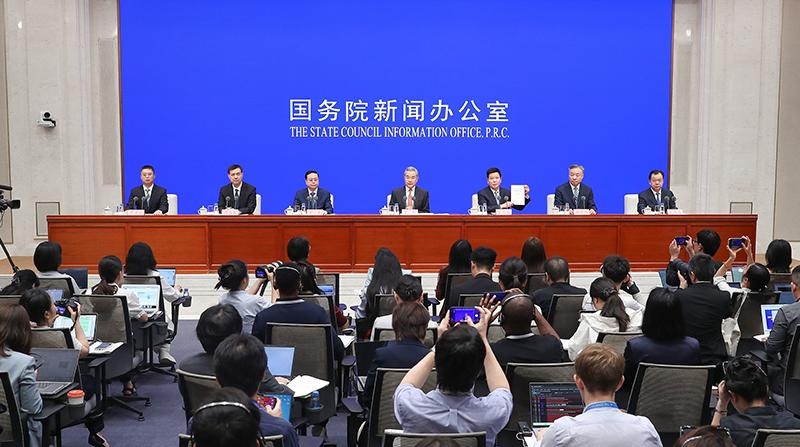
Speakers:
Mr. Wang Yi, a member of the Political Bureau of the Communist Party of China (CPC) Central Committee and minister of foreign affairs
Mr. Jin Xin, deputy director of the International Department of the CPC Central Committee
Mr. Miao Deyu, vice minister of foreign affairs
Mr. Zhou Haibing, vice chairman of the National Development and Reform Commission
Mr. Zhao Fengtao, vice chairman of the China International Development Cooperation Agency
Chairperson:
Mr. Mo Gaoyi, deputy director of the Publicity Department of the CPC Central Committee and minister of the State Council Information Office
Date:
June 17, 2026
Mo Gaoyi:
Ladies and gentlemen, good morning. Welcome to this press conference held by the State Council Information Office (SCIO).
Today, the SCIO released a white paper titled "More Just and Equitable Global Governance: China's Principles, Proposals and Actions," and organized this press conference to introduce and interpret its main ideas.
Guided by Xi Jinping Thought on Socialism with Chinese Characteristics for a New Era, the white paper provides a systematic overview of the historical context, rich implications and significance of the Global Governance Initiative. It comprehensively presents China's extensive involvement in the reform and building of the global governance system, and further clarifies China's goals, principles and actions in global governance.
The white paper consists of a preface, main body and conclusion, totaling around 20,000 Chinese characters. The main body consists of five chapters: "The World Today Faces Severe and Complex Challenges"; "The Global Governance Initiative Responds to Challenges of Our Times"; "China's Contribution to Promoting Global Governance"; "Guiding the Direction of Change Towards a Bright Future"; and "Moving Forward Hand in Hand at a Critical Juncture in History."
The white paper is published in eight languages — Chinese, English, French, Russian, German, Spanish, Arabic and Japanese — by the People's Publishing House and the Foreign Languages Press. It is available at Xinhua Bookstores nationwide.
To facilitate a deeper understanding of the white paper, we have invited Mr. Wang Yi, a member of the Political Bureau of the Communist Party of China (CPC) Central Committee and minister of foreign affairs, to introduce the white paper and take your questions.
Also present are: Mr. Jin Xin, deputy director of the International Department of the CPC Central Committee; Mr. Miao Deyu, vice minister of foreign affairs; Mr. Zhou Haibing, vice chairman of the National Development and Reform Commission; and Mr. Zhao Fengtao, vice chairman of the China International Development Cooperation Agency.
Now, Mr. Wang Yi will brief you on the relevant information.
Wang Yi:
Good morning, distinguished guests and friends. I am pleased to witness with you the release of the white paper "More Just and Equitable Global Governance: China's Principles, Proposals and Actions."
Global governance is a common endeavor that bears on the well-being of all humanity, and reforming and improving the global governance system is a shared vision pursued by people around the world. The main purpose of releasing this white paper today is to systematically present China's principles, proposals and actions in global governance, and to build broader international consensus and synergy for reforming and improving the global governance system and effectively addressing global challenges.
The international system established after World War II has been severely disrupted by multiple crises, placing global governance at a critical crossroads. Progress is imperative; failure to advance risks falling behind. At this crucial juncture, President Xi Jinping solemnly put forward the Global Governance Initiative, calling on all countries to join hands in building a more just and equitable global governance system. The initiative offers Chinese wisdom and Chinese solutions to address the global governance deficit and chart the course for humanity's progress.
This major initiative responds to the shared desire of the international community to improve global governance. In the initiative, President Xi Jinping outlines five core principles: adhering to sovereign equality, abiding by international rule of law, practicing multilateralism, advocating a people-centered approach, and taking concrete actions. It articulates the principles and pathways to follow in reforming and improving global governance, and echoes the international community's strong call for fairness rather than hegemony, the rule of law rather than disorder, cooperation rather than confrontation, and practical action rather than empty talk.
This major initiative expands the practical pathways for building a community with a shared future for humanity. The Global Governance Initiative is yet another significant public good that President Xi Jinping has contributed to the world, following the Global Development Initiative, the Global Security Initiative and the Global Civilization Initiative. Providing systematic solutions, China's four major global initiatives run in parallel with a focus on different domains and form a complete action framework built upon four dimensions: development, security, civilization and governance, thus providing clear strategic guidance for promoting the building of a community with a shared future for humanity.
This major initiative also opens up new horizons for international political civilization. The initiative is committed to promoting greater democracy and rule of law in international relations, and to forging a new path of global governance guided by consultation, joint contribution and shared benefits. It transcends the outdated "core-periphery" order under traditional international relations theories, rejects the law of the jungle that "might makes right," deepens people's understanding of the laws governing human social development, and innovates both the theories and practices of international political civilization.
This explains why the Global Governance Initiative has garnered extensive and positive responses from the international community since its announcement. To date, nearly 160 countries and international organizations have welcomed and endorsed it, while over 60 countries have enthusiastically joined the Group of Friends of Global Governance. The Global Governance Initiative has transformed from China's solution into international practices, increasingly demonstrating its strong vitality.
Friends, this year marks the 55th anniversary of the restoration of the lawful seat of the People's Republic of China in the United Nations. As a permanent member of the U.N. Security Council and the largest developing country in the world, China has always actively participated in the building of the global governance system. Especially since entering the new era, under the scientific guidance of Xi Jinping Thought on Diplomacy, China has championed the building of a community with a shared future for humanity and taken the lead in practicing true multilateralism. It has consistently been a builder of world peace, a contributor to global development, a defender of the international order and a provider of public goods, making continuous efforts to reform and improve global governance.
We uphold common security and contribute to international collective security. To date, China has participated in 29 UN peacekeeping operations, promoted the first issuance of a joint statement of the leaders of the five nuclear-weapon states on preventing nuclear war, and fully safeguarded global strategic stability. We have pioneered the use of a unique Chinese approach to addressing international flashpoints, unswervingly mediated for peace and promoted dialogue, and contributed China's strength to the peaceful settlement of international disputes.
We uphold openness and cooperation, injecting momentum into global economic growth. China firmly safeguards the multilateral trading system with the World Trade Organization (WTO) at its core and has become the main trading partner of more than 160 countries and regions. Guided by the principles of extensive consultation, joint contribution and shared benefits, we have promoted the Belt and Road Initiative (BRI) as an international platform for mutually beneficial cooperation. China has implemented a zero-tariff policy for African countries and the least developed countries (LDCs) with which it has diplomatic relations, bringing trade dividends and development opportunities to a growing number of nations.
We uphold fairness and justice, and speak up for the Global South countries. We have facilitated the historic expansion of BRICS and the growth of the Shanghai Cooperation Organization (SCO), supported the African Union's accession to the G20, proposed an initiative for open and inclusive Global South cooperation, and announced eight measures in support of Global South cooperation, helping the Global South countries march together toward modernization.
We uphold solidarity and coordination, and build platforms for international governance cooperation. China has initiated the establishment of the International Organization for Mediation (IOMed), filling a gap in the international mediation mechanism. We have launched the Conference on Dialogue of Asian Civilizations and the Ancient Civilizations Forum to promote exchanges and mutual learning among civilizations around the world. China has established the Kunming Biodiversity Fund, put forward the Global Initiative on Data Security and the Global AI Governance Initiative, and worked to improve governance rules in new domains.
Friends, the world has entered a new period of turbulence and transformation, and humanity needs more than ever to revitalize multilateralism, uphold the rule of law and ensure more efficient governance.
First, we should be steadfast in safeguarding the central role of the United Nations. At a high-level meeting of the Security Council initiated by China last month, all parties called for revisiting the founding mission of the U.N. Charter and restoring the authority of the U.N. We must effectively implement the UN80 Initiative to boost the quality and efficiency of the United Nations, and enhance the capacity for action of the Security Council. This will enable the Security Council to fulfill its mandate of maintaining international peace and security, while jointly resisting any unilateral actions that bypass the Council.
Second, we should actively work to de-escalate flashpoints. We are committed to resolving disputes and conflicts through dialogue and consultation, achieving lasting peace and stability through universal security, and promoting the political settlement of hotspot issues, including the Ukraine crisis and the Gaza conflict. The situation in the Middle East affects the whole world. The top priority is for all parties to work toward the same direction, firmly commit to a ceasefire and an end to hostilities, and lay the foundation for a sustainable security architecture in the region.
Third, we should maintain the correct path of open development. We will firmly uphold the multilateral trading system with the WTO at its core, support trade and investment liberalization and facilitation, maintain the stability and smooth flow of global industrial and supply chains, and promote a universally beneficial and inclusive economic globalization. This year marks both the launch of China's 15th Five-Year Plan and the APEC "China Year." China will further expand high-standard opening up, advance the building of an Asia-Pacific community, and share development opportunities with other countries around the world.
Fourth, we must give full play to the vital role of the Global South. We will promote high-quality development of cooperation within the expanded BRICS and the SCO family frameworks, advance the reform of the International Monetary Fund (IMF), the World Bank and other international institutions, and continuously enhance the voice and representation of developing countries in international affairs. We should support Global South countries in hosting multilateral summits and advancing multilateral agendas, and pool their strength.
Fifth, we must focus on addressing weak links and deficiencies in the global governance system. In the face of new frontiers and new challenges, we must keep pace with the times, innovate governance mechanisms, and fill gaps in the rules. We must ensure that the process of climate governance does not backslide, that common but differentiated responsibilities are upheld, and that we continue to advance the global transition to green and low-carbon development. We need to improve the rules of governing outer space, the polar regions, and cyberspace, and develop a widely accepted governance framework. China is accelerating the establishment of the World Artificial Intelligence Cooperation Organization and welcomes all parties to join and promote the use of AI for good.
Friends, "the world's momentum either flourishes or declines; its governance either progresses or regresses." China is willing to work shoulder to shoulder with all parties and hold high the torch of multilateralism. We will forge stronger synergy through broader consensus and tackle global challenges through closer cooperation. Together with all sides, China will put the Global Governance Initiative into practice, work to promote the building of a more just and equitable global governance system, and make steady progress toward the grand goal of building a community with a shared future for humanity. Thank you.
Mo Gaoyi:
Thank you, Mr. Wang. The floor is now open for questions. Please identify the media outlet you represent before raising your questions.


 京公网安备 11010802027341号