 Share:

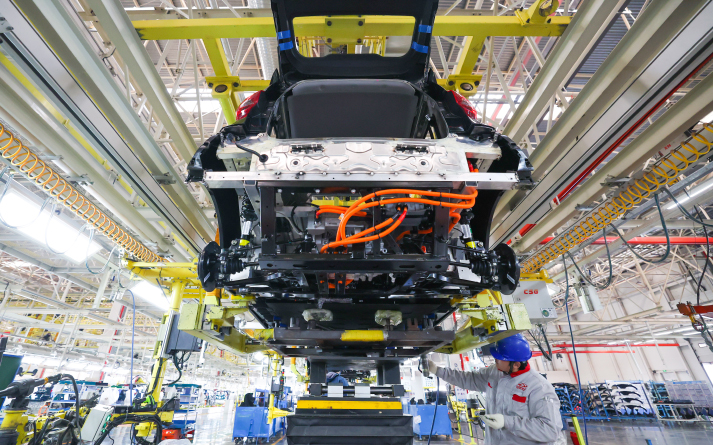
A new-energy vehicle assembly line at a workshop of Chinese automaker Chery in Hebei province on January 8. [Photo/Xinhua]
The Chinese economy grew 4.7 percent year on year in the first half (H1) of 2026, according to data released by the National Bureau of Statistics (NBS) on July 15.
The world's second largest economy generated around 69.57 trillion yuan ($10.25 trillion) in output during H1. In the second quarter (Q2) alone, China's GDP expanded 4.3 percent year on year. The country has targeted 2026 growth at 4.5 to 5 percent.
Mao Shengyong, deputy head of the NBS, told a press conference on July 15 that this steady economic performance has laid a solid foundation for achieving the annual growth target, attributing the slowdown in Q2 mainly to short-term factors and external influences.
Chen Wenling, a senior research fellow at the Academy of Contemporary China and World Studies, said at a forum hosted by China News Service on the same day that external and domestic demand both contributed to China's H1 economic growth, with foreign trade performance beating expectations.
Chen noted that rising protectionism and escalating tariff conflicts around the world pose serious challenges to China and other countries alike. "Despite these headwinds, new sources of growth are emerging, particularly through the expansion of technology-driven, high-efficiency industries that are strengthening economic resilience and competitive edges," she said.
Growth drivers
The strength of China's industrial system, with its extensive supply chains and supporting networks, has helped absorb external shocks and stabilize growth, Wei Qijia, Director of the Industrial Economy Research Office at the State Information Center's Department of Economic Forecasting, said at the forum.
NBS data showed that the total value added of industrial enterprises above the designated size, or those with annual revenue from principal business over 20 million yuan ($2.94 million), rose 5.4 percent year on year in H1, with that of hi-tech manufacturing expanding 13.3 percent.
New growth drivers, represented by high-end manufacturing, the digital economy and modern services, contributed over 40 percent to economic expansion during the first six months, while energy consumption per unit of GDP declined 1.9 percent year on year.
From industrial robots to AI hardware, the hi-tech sectors are forming pillars of new productivity by rapidly increasing the application of their technologies to daily work and life. Many of these hi-tech products and solutions were on show at this year's China International Supply Chain Expo held in Beijing in late June.
DingTalk, an online workplace platform created by Chinese tech company Alibaba, has introduced an AI-powered device for real-time translation and meeting recording. It is thin and light enough to be attached to a phone for operation.
"The device, equipped with Alibaba's AI model for speech recognition and processing, captures our conversations and transcribes them. It also supports real-time transcription and translation across more than 120 languages, making it useful for travel and cross-language communication," Wu Fengyan, an employee of the company, told Beijing Review.
According to Wu, this creates a valuable knowledge base for business people, who can review and analyze historical communication data and create a database for future AI applications.
On one charge, the device can last for around 60 days of standby time and 45 days of continuous recording, she said. Even in noisy environments, it can identify the speaker's voice while filtering out interference. "All models of the device are equipped with six microphones. In larger environments, they can capture sound from a distance of around 6 meters," Wu said.
Robotics companies have also raced to upgrade their products. Beijing-based Yue Quan Bionics Ltd., founded in 2022, has introduced dexterous robotic hands for operations in diverse scenarios. According to the company, these systems can master fine movements such as turning book pages.
"We currently have two products. One of them has just entered the market, and the other is the high-degree-of-freedom model yet to be released," Hu Zheqi, a manager overseeing technology affairs of the company, told Beijing Review, noting that the 38-degree-of-freedom robotic hand is currently the most articulated of its kind in the world.
The 38-degree-of-freedom model allows the dexterous hand to perform highly delicate tasks, such as threading a needle or applying eyeliner, enabling more human-like hand movements. With a pulling capacity of approximately 40 kg, it is expected to be deployed across various sectors including auto part manufacturing.
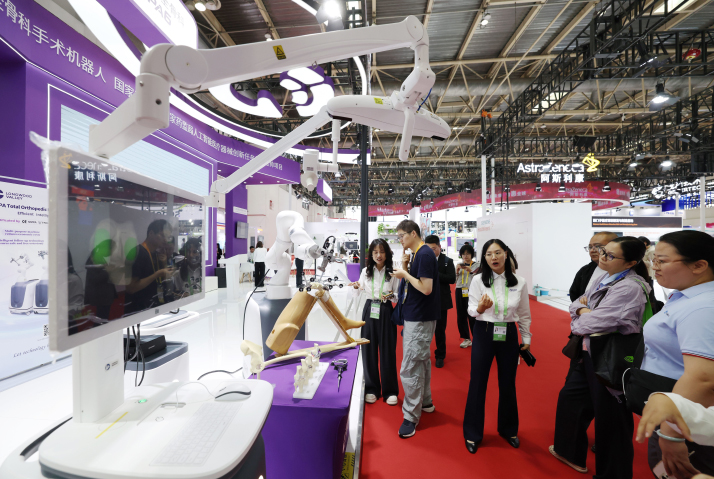
AI-powered robotic arms for the medical sector on show at the Fourth China International Supply Chain Expo in Beijing on June 23. [Photo/Xinhua]
Sustained trade growth
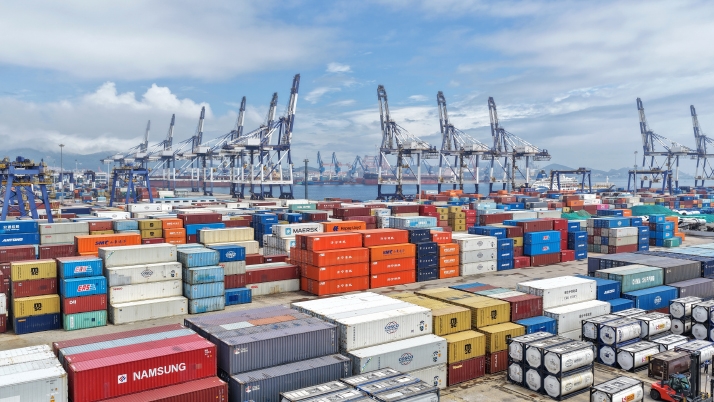
China retains its position as the world's largest goods trader amid the robust foreign trade performance, according to the data from the General Administration of Customs of China (GACC).
Of the total, exports rose 13.4 percent year on year to 14.73 trillion yuan ($2.18 trillion), maintaining growth for 11 consecutive quarters, while imports expanded 22.1 percent to 10.74 trillion yuan ($1.59 trillion), the GACC said.
In H1, exports of mechanical and electrical products rose 20.1 percent year on year, taking up 63.5 percent of total overseas shipments. Hi-tech product exports surged 39 percent from a year ago.
According to Chen, China is moving away from a growth model built on low-cost competition and heavy reliance on overseas markets for profits. Digital trade, services trade and e-commerce are emerging as some of the fastest-growing segments.
Zhou Mi, a research fellow at the Chinese Academy of International Trade and Economic Cooperation under the Ministry of Commerce, said at the forum that China's robust exports and imports have been achieved amid a slowdown in global trade growth, which could be attributed to the opening-up policies. Its westward opening strategy, including expanded land-based transport routes, has helped diversify trade destinations and models.
According to Zhou, China's exports serve as an indispensable anchor for the stability of global supply chains. "A notable share of Chinese exports consists of intermediate goods and components. Many products that cannot be sourced elsewhere can still be obtained consistently from China," he said.
The recent surge in exports of Chinese-made air conditioners to Europe, following earlier shipments of heating products during the continent's energy crisis, highlights the growing influence of Chinese innovation and manufacturing capabilities in overseas markets, Zhou added.
Cautioning against equating China's strong manufacturing capacity with overcapacity or weak domestic demand, Chen said China's factories support both domestic consumers and global markets, rather than representing an attempt to export excess stock.
"Markets are now globalized, and the Chinese and international markets are integrated. No country produces solely for its own consumption," Chen said.
GACC data showed that private companies accounted for about 57 percent of China's total foreign trade in H1. Foreign-invested enterprises in China saw trade growth slightly faster than that of domestic private companies, by 0.1 percentage point.
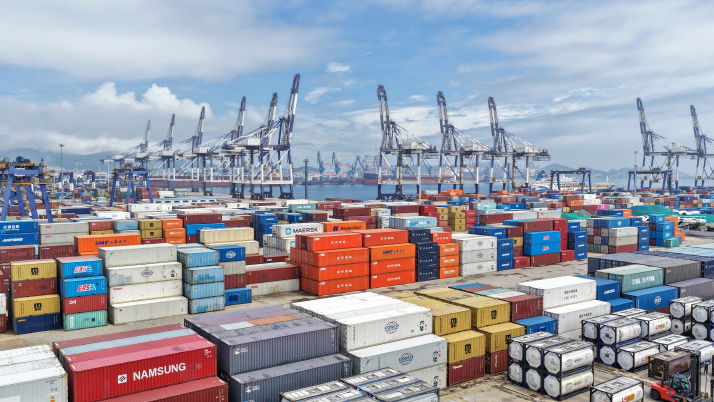
An international container terminal at Yantai Port in Yantai, Shandong province, on July 14. [Photo/Xinhua]
Boosting domestic demand
According to the NBS, China's total retail sales of goods and services, a major indicator of the country's consumption strength, increased 2.7 percent year on year in H1.
In the period, the retail sales of services went up 5.3 percent, and that of goods grew 1.1 percent from a year ago.
Chen emphasized that while people's daily consumption remains stable—which is positive—services consumption is booming with the popularity of short-video platforms, offline events like concerts and the emotional economy (consumption of non-necessities to fulfill emotional needs).
China's surveyed urban unemployment rate stood at 5 percent in June, down from 5.1 percent in the previous month, while per-capita disposable income went up 5.2 percent year on year in H1.
Earlier in July, China rolled out its first five-year plan dedicated exclusively to expanding consumption, aiming to unlock the full potential of the country's super-large market, optimize the consumption structure and improve people's livelihoods.
Wei said more efforts should focus on ensuring that fiscal and monetary support reaches the sectors and businesses that need it most. Urbanization offers considerable room for further investment, with projects such as parking infrastructure beneficial for both economic development and public wellbeing.

Tourists enjoy a coffee and music carnival in Yinchuan, Ningxia Hui Autonomous Region, on May 4. [Photo/Xinhua]
Navigating headwinds
China's economy still faces persistent challenges from weak domestic demand, external uncertainty and the transition to new growth drivers, Wei said, highlighting maintaining steady growth momentum as a priority.
Chen cautioned a widening divergence across the economy amid industrial restructuring. While emerging sectors driven by new technologies and productivity gains are advancing rapidly, traditional industries and many small and medium-sized enterprises remain under structural pressure, necessitating a gradual, well-calibrated transition, she said.
Zhou expressed confidence in steady foreign trade growth in the coming months. According to him, China's trade expansion in recent years has been driven by real production and consumer demand rather than stockpiling or short-term profit-seeking. It is working to negotiate new free trade agreements and improve old trade arrangements, providing businesses with more stable expectations.
"China's services trade expansion will also create new opportunities for global economic cooperation," Zhou said.
To stabilize employment and improve people's incomes, more targeted policies for different groups should be put in place to avoid a broad, unfocused distribution of resources, according to Wei.
Policymakers should also lift restrictions in the consumption sector and improve the consumption environment to bolster both consumer confidence and purchasing power, he said.
The International Monetary Fund recently lowered its forecast for global economic growth this year to 3 percent, but raised that for China's full-year growth by 0.2 percentage points.
Mao said he expected the strong momentum of new growth drivers to extend into the second half of 2026 with the effects of policy measures. "The government will introduce more proactive and targeted policies to keep steady economic growth and promote innovation-driven development," he said.


 京公网安备 11010802027341号