 Share:

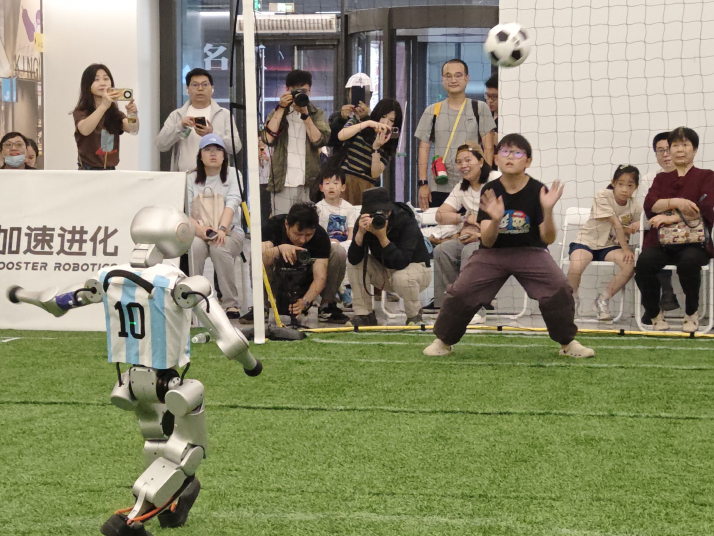
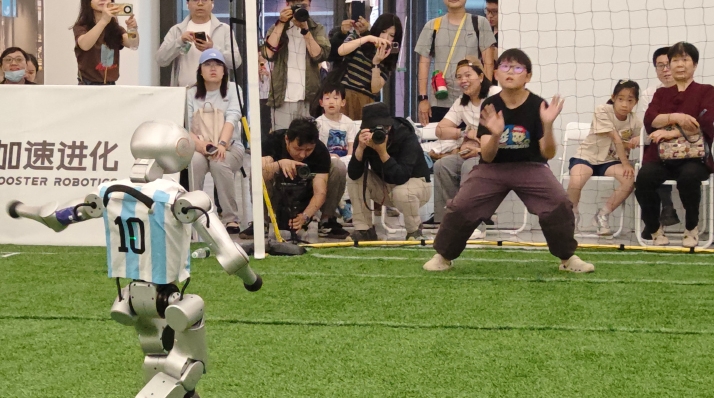
A pre-game robot soccer match at the Zhongguancun (Haidian) Embodied Intelligence Innovation Industrial Park in Beijing, with a young spectator acting as goalkeeper, on June 13 (WANG JINXU)
In late afternoon, inside the Beijing Innovation Center of Humanoid Robotics (BICHR), the atmosphere is one of focused, rhythmic precision. A humanoid robot named Tianyi is completing its seventh consecutive hour of work without a hint of fatigue. Tianyi was responsible for delivering baskets of parts from the floor up to the production line, for producing Tien Kung, a full-size bipedal humanoid.
Tianyi, launched by the center in 2024, stands 163 cm tall and weighs 72.5 kg. It features omnidirectional wheeled mobility and an adjustable function that allows it to synchronize its height with the humans it assists. With a large, high-definition chest display, Tianyi possesses advanced capabilities in positioning, navigation and natural language interaction and is hence suitable for operation on indoor flat surfaces such as factory floors, exhibition halls and supermarkets. Its counterpart, Tien Kung, also launched in 2024, represents an even higher standard of technology. It is engineered to walk and run across complex, uneven terrains, which places enormous demands on its internal perception and real-time decision-making models.
The building housing these robots serves as the pilot validation platform for BICHR. Located in the Beijing Economic-Technological Development Area, also known as Yizhuang or E-Town in southeast Beijing, this five-story facility is an integrated hub. It covers the entire lifecycle of humanoid robot development, from the micro-level of key components to the final assembly of the complete machines.
Bridging the divide
"The embodied intelligence industry is scaling rapidly nationwide," Huang Zhe, head of production at BICHR, told Beijing Review. "However, moving from brilliant ideas in a laboratory to mass industrial production is a daunting leap. Pilot validation is the critical bridge that simply cannot be bypassed. Our center's pilot validation platform was established precisely to fill this industrial gap."
Launched in 2025, this platform stands as one of the first of its kind in China dedicated to humanoid robots. Its existence signifies that China has succeeded in constructing a bridge in the humanoid robot field between technological research and industrial manufacturing.
Central to this industrial shift is a move away from traditional, scripted programming toward the dynamic capabilities of embodied intelligence. Traditional robots rely on static, written computer programs to repeat mechanical movements. In contrast, embodied intelligence integrates "embodiment," the presence of a physical body and the integration of sensors or "senses," such as sight and hearing, with "intelligence," a system that understands, analyzes and learns. Rather than following a script, these machines interact with the physical world by perceiving their environment and making real-time, context-aware decisions.
This intelligence was on full display during the world's first humanoid robot half-marathon in Beijing in April last year. At the event, Tien Kung Ultra (an advanced humanoid robot engineered to conquer the challenges of a half-marathon) clinched the championship with a completion time of approximately 2 hours and 40 minutes. The robot relied entirely on its onboard sensor array to interpret the track, plan its path, and coordinate its gait dynamically. It was a powerful testament to the maturity of machines that can "think" and "act" simultaneously.
Leapfrogging the competition
This rapid evolution in athletic performance is not confined to the track, but is mirrored in the complex, real-time decision-making required for team sports.
In the basement of the Zhongguancun (Haidian) Embodied Intelligence Innovation Industrial Park in Beijing, humanoid robots are pitted against one another in soccer matches. The robots autonomously identify the ball, make agile changes in direction, and execute jumps to score; their movements are fluid, and their stability and explosive power far surpass those of previous years.
Su Ying, Vice President of leading humanoid robot company Booster Robotics, told Beijing Review: "Last year, our robots could only shoot at a height of 35 cm, barely completing a basic shot. This year, they can launch long-distance shots reaching 2 meters. Their competitiveness and flexibility have been vastly improved."
Other breakthroughs on the field are also striking. Tsinghua University's Huoshen (Hephaestus) Team successfully defended its Humanoid League crown at the world's largest AI robotics competition, RoboCup 2026, which concluded in Incheon, South Korea, on July 5. The victory came a year after the team ended a 28-year title drought for Chinese competitors by winning the championship in Brazil. The team competed using the Booster T1 humanoid robot platform developed by Booster Robotics.
The robotic soccer tournament serves as a proving ground for intelligent robotics. With no manual control allowed, the matches are a comprehensive test of abilities and hardware performance, AI algorithms, motion control, and tactical decision-making.
Behind the dazzling performance on the field lies an explosion in commercial deployment, the most hard-core achievement for Booster Robotics this year. Data show that the company's annual shipments surged from 45 units last year to 1,034 units this year, a growth of more than 20 times, with revenue exceeding 100 million yuan ($15 million). This marks a critical transition from laboratory prototypes to large-scale mass production and delivery.
Today, the company's clients span over 20 countries and regions. These include top-tier universities like Stanford and UC Berkeley in the U.S., as well as industry giants like NVIDIA and Amazon.
Su said that looking forward, the company intends to move beyond sports and gradually expand into civilian fields such as home companionship and intelligent logistics, transforming humanoid robots from stars of the stadium into partners in daily life.
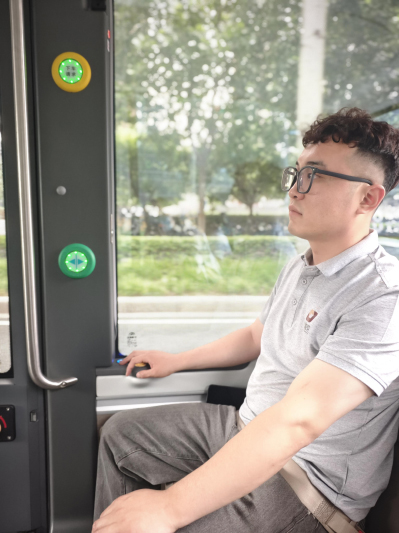
Safety officer Chen Jiawei works in an autonomous shuttle bus in Beijing on June 12 (WANG JINXU)
Hitting the road
If the factory floor and the laboratory show us the industrial potential of embodied intelligence, autonomous driving demonstrates its immediate impact on the consumer experience.
Chen Jiawei, a safety officer for an autonomous shuttle bus in Yizhuang, recalled his initial experience with the technology. "On December 5, 2024, I was on duty, and my hands were locked onto the emergency brake button the entire time, sweating despite the winter chill," he told Beijing Review. "I was dealing with the instinctive human fear of the unknown."
Today, that fear has vanished. As the shuttle bus navigates the streets, the onboard intelligent system fully recognizes road conditions and makes decisions in realtime, yielding at crosswalks and stopping when traffic signals malfunction. "The onboard systems are so mature now," Chen said as he watched a driverless taxi nearby gracefully yield to a delivery robot. "There is nothing to be nervous about anymore."
Since 2020, Beijing's High-Level Autonomous Driving Demonstration Zone in Yizhuang has attracted giants like Baidu, Pony.ai and JD.com. By facilitating real-world tests across eight distinct scenarios, from logistics to automated sanitation, the zone has moved technology from the drawing board to the street.
The autonomous driving pilot in Yizhuang exemplifies Beijing's comprehensive approach to building the future of embodied intelligence—an approach underpinned by a unique ecosystem that connects policy, research and industry.


 京公网安备 11010802027341号