 Share:

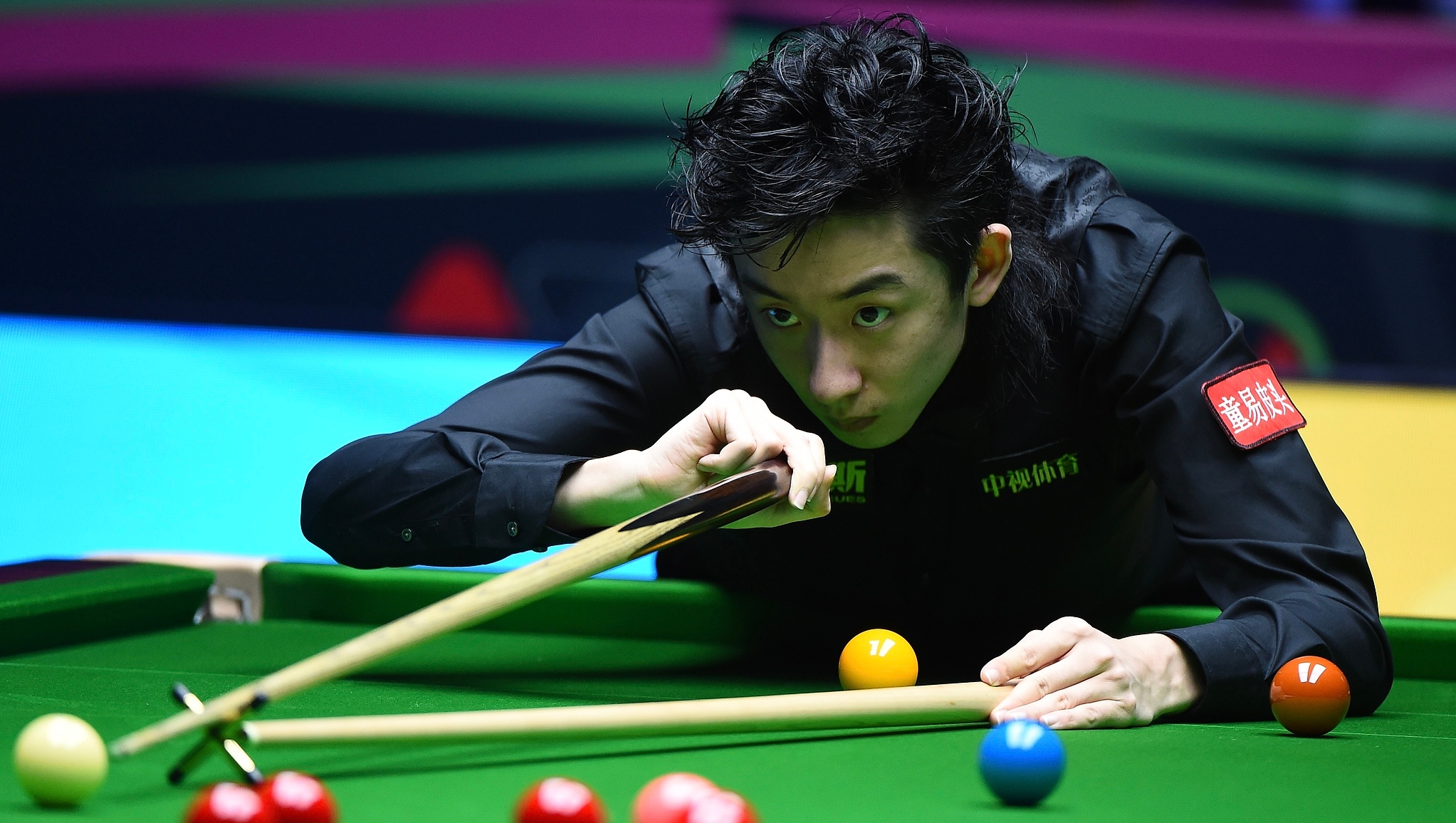
He was just a small boy, "a little taller than the snooker table", and had been handling a cue for a few years — but he already had his life mapped out.
It was more than a decade ago, and Wu Yize was watching the television broadcast of the final of the Snooker World Championship final at the Crucible Theatre in Sheffield, England.
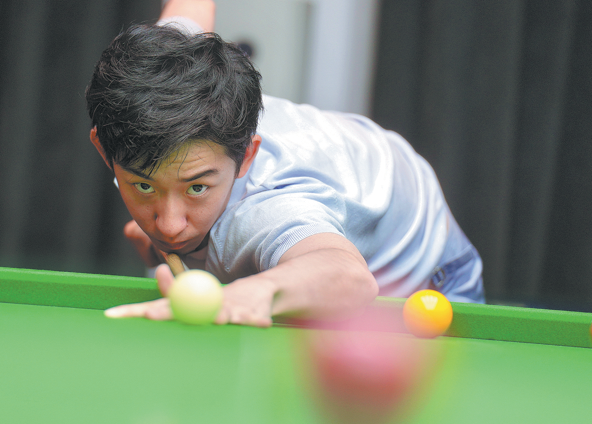
Wu Yize demonstrates his cue work at a billiards venue during an interview with China Daily in Hong Kong in June. ADAM LAM/CHINA DAILY
Thousands of miles away, young Wu was having his own imaginary victory ceremony. "That's what I want," Wu told himself, "I'll stand there too."
In May, Wu's boyhood promise to himself was fulfilled when he won the world championship at the tender age of 22 in the same venue.
The talent pipeline that delivered him from makeshift tables to the pinnacle of the sport has parachuted a generation of Chinese snooker professionals onto the global tour.
The place where young Wu began his full-time pursuit of a snooker career, as well as the national base for professional youth development, is South China's Guangdong province. Its neighboring regions have also played an important role in the sport's development.
Wu spent several years at various training facilities in several Guangdong cities including Dongguan, widely referred to as China's premier "snooker hub".
The official figures don't lie. Over 70 percent of China's professional snooker players have trained in the city at some stage. For aspiring professionals age under 21, that proportion climbs to 90 percent.
Long way to the top
Wu's path to the pinnacle of the sport was a circuitous one that started at his hometown of Lanzhou, a city best known for its beef noodles, in Gansu province.
He began playing snooker at a young age, initially under the guidance of his father, who later sold his business to support his son's career.
The young prodigy was later mentored in several cities in Guangdong. One of his childhood coaches, UK-born Roger Leighton, remembers him as a "funny and cheeky"11-year-old kid.
"He was always laughing and giggling and he's still a bit like that now," Leighton said in an interview with Metro UK.
"But he's more serious because obviously now he's at the top, at the business end. He's not the complete player yet, but he's getting there."
Wu's childhood memories are of the sheer joy snooker brought him. "I loved it straight away," he said in an interview with China Daily.
"My dad was into it (at that time), and the first time I tried it, I just enjoyed playing. When I first picked up a cue, I could set up properly and hit a ball. I think my dad, back then, thought that I had a bit of a feel for it."
His parents made multiple sacrifices to help his career.
There were "so many things — my dad buying me my first cue, for example; my parents believing in me, supporting me, letting me give up school to go down this path. It wasn't one big thing — it was every single day, building up over time", he explained.
He moved to Sheffield at age 16 with his father. At first it was hard, he conceded.
"Suddenly, being in a new country, a new life, and (with) new challenges, it was tough," Wu said.
"The place we stayed in had no separate bedroom. The living room and kitchen were all one space — the bed was right next to the kitchen. It was tiny, no windows, no ventilation. I shared a bed with my dad."
When asked if the austere living conditions dulled his passion for the sport, Wu replied: "No, not at all. If anything, it helped me. It made me more resilient when things got difficult."
One of the toughest decisions he made was becoming a full-time player when he was a teenager. Wu earned a two-year professional tour card for the 2021–22 and 2022–23 seasons, turning pro at the age of 17 and being named Rookie of the Year in 2022.
Wu told China Daily he discussed the proposition with his parents. "But to be honest, I didn't really have a deep understanding back then (about what going full-time would mean). I was young, I just knew I wanted to play, and I was excited. I didn't think too far ahead about the future. But I did talk to them about it."
"They told me I could only choose one path. And if I chose this, I had to do it properly. They said I needed to think it through and take responsibility for my own life."
Generation next
Wu represents the new young face of the sport, according to Feng Huanhuan, chief executive officer of F-Sports Promotions.
Her company has organized the annual World Grand Prix in Hong Kong since 2025, and opened the Hong Kong Billiard Sports Academy at Hong Kong's Kai Tak Sports Park.
She believes Wu is a player whose character traits and career represent two decades of the maturation of China's professional snooker players.
The trend started with Chinese snooker pioneer Ding Junhui, who sprung to prominence on the world stage in 2005 by winning the China Open at age 18.
The focus of Chinese snooker's youth training system, is no longer a question of quantity, but one concerning "the sustainability of the careers it churns out".
Ding began formal training at 9 years old. Wu — the first world champion born after 2000 — started around age 7. In 2012, at age 8, he had already shared an exhibition stage with Stephen Hendry, the seven-time world champion, in Lanzhou.
Feng first saw Wu compete in 2025, when he was invited to the inaugural Grand Prix as one of the world's top 32 players.
By then, the just-finished HKBSA was open to players for warm-ups, and Wu was the first to step inside. "From dawn to dusk, he practiced, skipping dinner, asking only if he could come again tomorrow," she said.
She said Wu has "a love for the game — raw, sincere", possesses "natural talent", and has "youth, stamina, a strong work ethic, and mental resilience", all essential qualities for a top player. Moreover, he came up the "hard, but, very representative" way.
Huang Zhufeng, president of the Dongguan Billiards & Snooker Association, is well aware of the risks and rewards young players face in turning professional.
He said Wu came to him in the summer of 2019, asking to shoot practice frames against world-class professionals who used Dongguan as a pre-competition training base before heading to major events across the Chinese mainland.
Huang also oversees the CBSA (Chinese Billiards and Snooker Association) World Snooker Academy's Guangdong branch. He estimates that Dongguan has more than 70 long-term training facilities, with over 500 full-time trainees aged 8 to 21.
Tough decisions
Wu remembers the fraught conversations at home when he chose to drop out of middle school to pursue a professional snooker career.
"My parents argued over it," he said, matter-of-factly.
"They wanted me to be certain. They didn't want to saddle me with a difficult life if it didn't work out."
Feng said in the end, very few young players break through to become champions. "Most of these kids will never win a title — so what happens to them?" she said.
She said both parents and the young players themselves need to understand the risks of going pro.
"Outside of the specialized snooker training, I believe there's a lot of room to build better academic support for these players," Feng said.
Huang said that Dongguan is now working to have billiards recognized under the local sports-education integration mechanism.
That designation, if granted, would allow young billiard players to stay enrolled in school while devoting themselves to intensive training — a safety net that most aspiring young professionals in China currently need.
Huang added that a professional snooker career in China today does not necessarily have to result in a world ranking. There are other ways to stay in the sport.
As snooker programs spread into schools, former trainees can study for a state-issued social sports instructor certificate and teach in classrooms. Or they can go through the World Professional Billiards and Snooker Association's coaching tiers or the CBSA's certification process and run a local billiards club.
"There's a real shortage of grassroots coaches and referees in Chinese billiards," Huang said. In Dongguan, he noted, a coach at a typical billiard club can expect a monthly income of 15,000 ($2,220) to 20,000 yuan.
Huang's longer-term vision for Chinese snooker balances elite development with a broader push to draw more people to "just play it for fun", bring snooker into more schools as a regular activity, and establish a contest pyramid that gives both the hobbyists and professionals a rung to reach.
Southern strengths
Within China's multi-pronged approach to snooker development, Huang is confident that the Guangdong-Hong Kong-Macao Greater Bay Area will remain at its core.
What sets the region apart, he said, is not only its head start in the sport but its concentration of training resources thanks to the ever-greater cross-border movement of people, investment, and expertise.
Vincent Law Wing-chung, who chairs the Billiard Sports Council of Hong Kong China, shares that perspective, and said GBA cities are complementary across player and coach exchanges, training, event hosting, equipment manufacturing, and commercial strategy.
Hong Kong is the region's essential link to the international snooker circuit, but the mainland's well-appointed youth training infrastructure has also increasingly rebounded to the city's benefit, he said.
In 2024, seven-time world champion Ronnie O'Sullivan and top English player Judd Trump both secured Hong Kong residency. By June 2025, former world champion Neil Robertson had also announced he had done the same.
Law disclosed that more top players are currently pursuing Hong Kong residency.
Huang said Dongguan's expertise in the sport and well-equipped venues have made it a premier destination for visiting snooker teams. Hong Kong players, he noted, have been joined in Dongguan by those from Saudi Arabia, Qatar, Germany, Belgium, Thailand, and elsewhere.
Hong Kong is well-suited for high-end, smaller-scale international tournaments, Law said, whereas larger ones are already being hosted by mainland cities.
In May, the Dongguan Changping Snooker Center opened and hosted the World Women's Snooker Championship. In June, the Dongguan Humen Convention and Exhibition Center staged the World Team Snooker Championship, the sport's premier global amateur team event. A Chinese team made history by clinching the title for the first time.
Huang said the GBA also plays a key role in the global billiard equipment trade.
While equipment manufacturers are centered in Jiangxi province's Yushan and Hebei province's Bazhou — the commercial gateway to markets worldwide is in Guangdong and Hong Kong, funneling products to markets worldwide.
According to the China Customs, Dongguan exported 22.07 million yuan of billiards equipment in the first three months of 2026, up 29.7 percent from the same quarter the year before.
Recent data from the CBSA showed that there are 245 million people actively playing cue sports in China and over 200,000 venues, with 550,000 enterprises feeding into the ecosystem.
"Billiards is now the sport with the highest degree of marketization in China," said Feng.


 京公网安备 11010802027341号