 Share:

On Nov. 5, 1935, as snow blanketed Ganquan county in what is now Yan'an, northwest China's Shaanxi province, a speech declared the victory of the Central Red Army's Long March and the defeat of its enemies.
Ninety years later, Yan'an has become the final stop for China International Communications Group's (CICG) international communication project, "Together on the Long March: 90th Anniversary of an Epic Journey." After retracing key sections of the Long March route from Yudu in Jiangxi province through Guangxi, Guizhou, Sichuan and Gansu, a group of Chinese and international experts, scholars and social media influencers arrived at the Shimen Tofu Scenic Area in Ganquan, where they explored how a region known for its revolutionary history is pursuing rural revitalization through local specialty industries, tourism and cultural heritage.
The scenic area, located in Shimen town, was built around Ganquan tofu, a local specialty made using traditional techniques that date back to the Han dynasty (202 B.C.-A.D.220).
"We have clear advantages in developing the tofu industry," said Zhang Haiqing, deputy head of Ganquan county.
"The first is our water. Ganquan [which literally means 'sweet spring'] is known for its high-quality water, rich in minerals, which is especially suitable for our traditional tofu-making techniques. The second is our locally grown soybeans. Thanks to the climate and soil of the Loess Plateau, the protein content of our soybeans is higher than that of ordinary varieties."
Ganquan tofu was recognized as a national geographical indication (GI) product in 2016, and the Shimen Tofu Scenic Area was designated a national 3A tourist attraction in 2023.
To support the project, the local government invested in roads, utilities and other public infrastructure while attracting hotels and tofu-processing enterprises. Local residents have also opened farm restaurants, homestays and food stalls, creating new employment and business opportunities close to home.
"This has increased participating households' annual income by around 6,000 yuan on average," Zhang said.
According to Zhang, visitors can take part in traditional tofu-making, enjoy tofu banquets and experience northern Shaanxi folk customs.
"The scenic area now receives around 55,000 visitors each year and generates between 1.2 million and 1.5 million yuan in annual tourism revenue," he said.
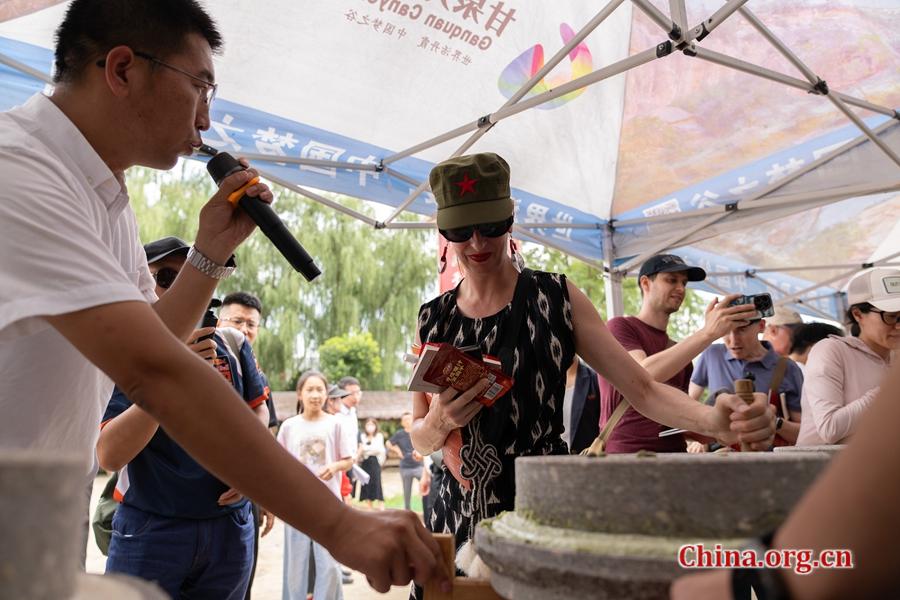
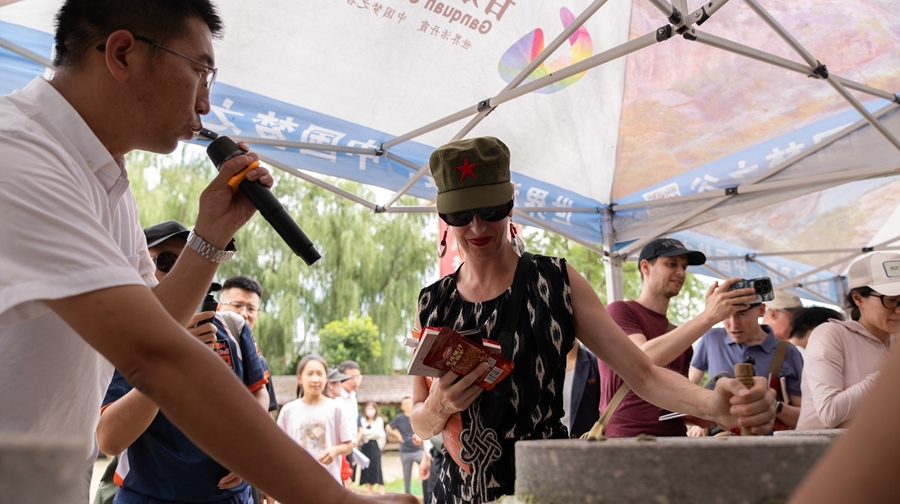
Dutch sinologist Elsbeth van Paridon experiences the traditional process of grinding soybeans at the Shimen Tofu Scenic Area, Ganquan county, Yan'an, Shaanxi province, July 22, 2026. [Photo by Yang Jia/China.org.cn]
For Dutch sinologist Elsbeth van Paridon, a foreign expert at the Center for the Americas of CICG, what stood out was the town's ability to build on its own strengths.
"What I find interesting here is that you see how it tries to find its own asset. And here it's tofu," she said. "They make tofu and jasmine soybean milk. I think they can also try tofu coffee and tofu ice cream."
"I'm happy to see that, development-wise, it's headed in the right direction, even in this remote town," she said. "Many of the villages we visited during the Long March journey are close to revolutionary sites, which already attract tourists. Here, too, tourism, culture and local specialties come together."
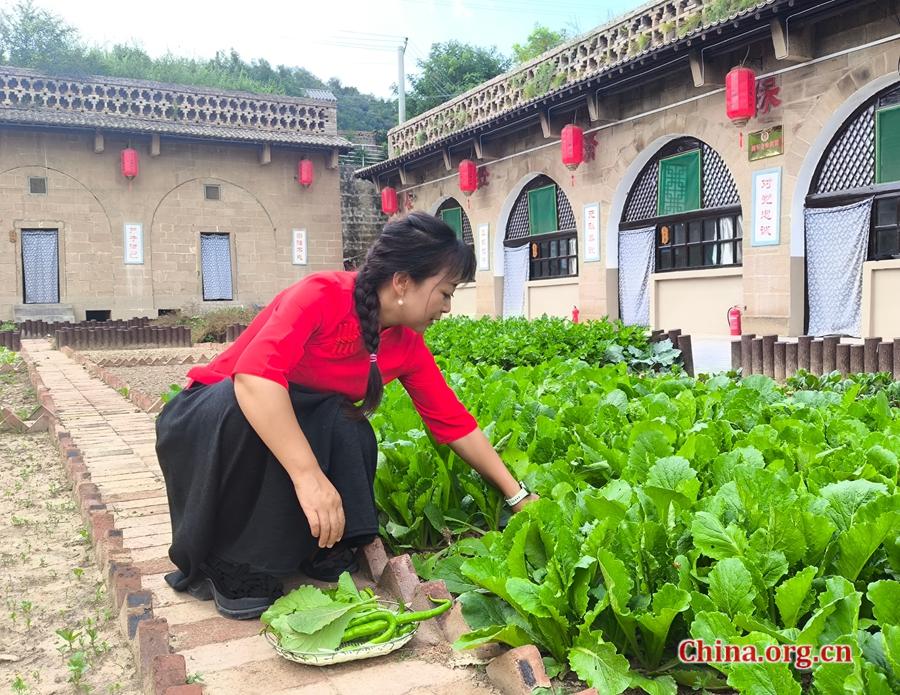
Zhang Cuicui picks fresh vegetables in the courtyard of her Xishi Tofu Banquet Restaurant at the Shimen Tofu Scenic Area, Ganquan county, Yan'an, Shaanxi province, July 22, 2026. [Photo by Xu Xiaoxuan/China.org.cn]
Among those benefiting from the town's transformation is Zhang Cuicui, the owner of Xishi Tofu Banquet Restaurant.
After working as a kindergarten teacher for 20 years in Xi'an, the capital of Shaanxi province, she returned to her hometown in 2024 after seeing the opportunities created by the scenic area's development.
"I felt this place had great potential," she said.
Her restaurant now offers more than 30 tofu-based dishes, along with a variety of local specialties. During peak tourism seasons, it welcomes between 100 and 200 customers a day, with visitors coming from Hong Kong, Guangdong, Shanghai and other parts of China.
"My income has increased a lot," she said. "Now I can take my family on trips every year."
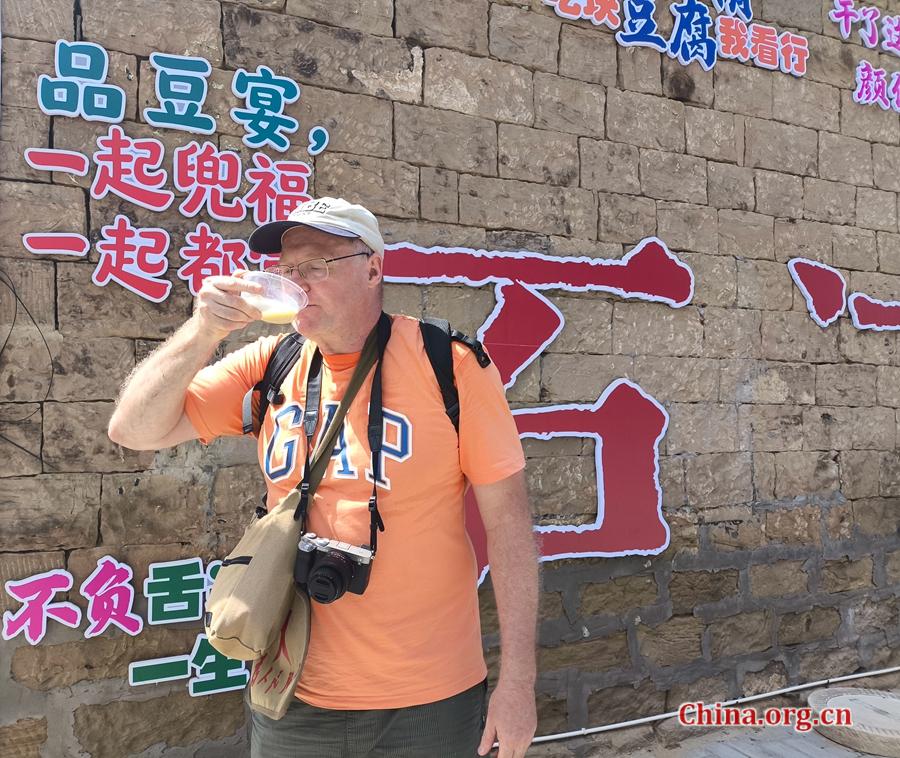
German scholar Nils Bergemann tastes jasmine soybean milk at the Shimen Tofu Scenic Area, Ganquan county, Yan'an, Shaanxi province, July 22, 2026. [Photo by Xu Xiaoxuan/China.org.cn]
Nils Bergemann, a German scholar and teacher at the University of International Business and Economics in Beijing, said the village demonstrated how rural areas can retain and attract talent.
"It's a small village, but people want to stay in their hometown," he said.