 Share:

Tired of working out at the rundown gym in your community? Hang in there, as a bigger and better one is likely to be taking shape nearby.
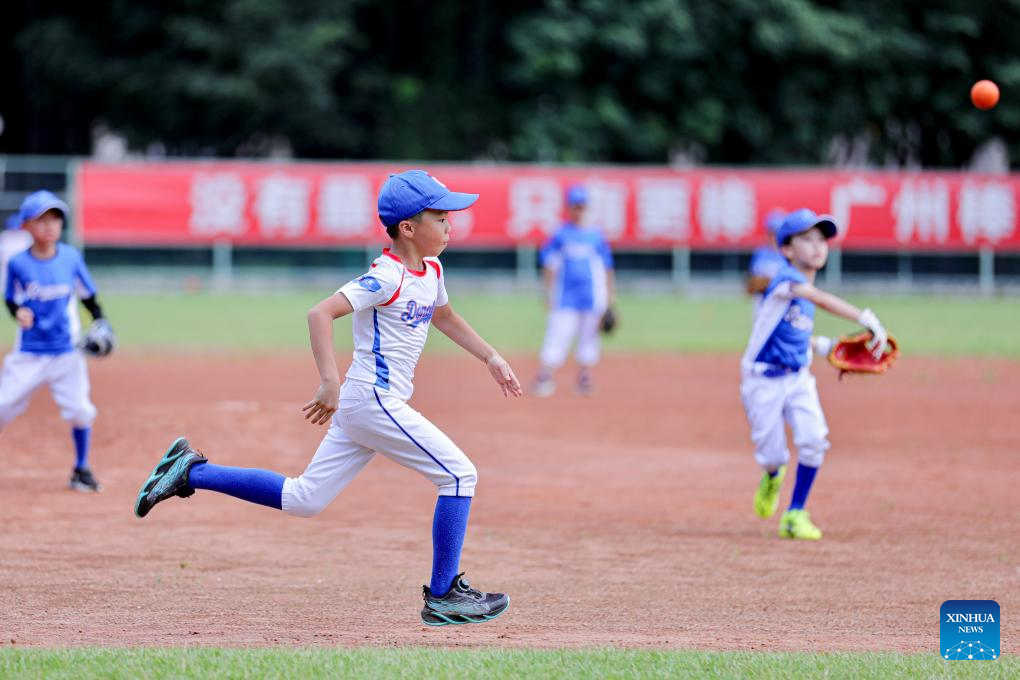
Children play baseball at Tianhe Baseball and Softball Stadium, which was the sports venue for softball at Guangzhou 2010 Asian Games in Guangzhou, south China's Guangdong Province, Aug. 22, 2023. Some sports venues used or built for Beijing and Guangzhou Asian Games have already been open to the public after completion, which plays an important role in promoting mass fitness and attracting more people to get into sports. (Photo by Huang Jinwen/Xinhua)
With a focus on mass fitness, China has unveiled a new five-year plan to promote sports development, aiming to not just maintain the country's strong performance at elite competitions such as the Olympics, but to improve the physical and mental wellness of the public through more accessible sports participation.
As the core of the master plan, which was issued by the General Administration of Sport of China on Wednesday, a nationwide project is tasked with increasing the per capita sports venue area to 4 square meters by the end of 2030, up from 3.11 sq m in 2025.
The plan also aims to raise the proportion of regular exercisers, who participate in sports activities at least three times a week, to around 40 percent of the total population.
The robust infrastructure project is tapping into the potential of underused urban spaces, including roadside open ground, rooftops and outdoor lawns at parks, to build and renovate at least 5,000 small, removable and accessible fitness centers and gyms in the next five years, with priorities for use by the elderly, children and people with disabilities.
The ultimate goal is to meet growing public demand for sufficient and affordable community sports facilities, and to address the current imbalance in sports resources distribution between the country's urban and rural areas, according to experts.
Huang Haiyan, a sports industry researcher and dean of Beijing Sport University's School of Management, said, "The entire plan was developed around one priority, and that is the people's well-being.
"Highlighting the upgrading of the mass fitness campaign at the top of the task list, above the elite sports program, the sports industry and other issues, speaks volumes for the resolve of the central government to make sports development truly relevant to people's daily lives," said Huang.
The blueprint, which sets out 38 key tasks across areas such as mass fitness, elite sports, physical education for young people and the anti-doping program, has been integrated into China's 15th Five-Year Plan (2026-30).
Wei Zhenyong, a deputy director of the policy and regulation department at the GASC, said that it's the first time that the sports sector's own long-term plan has been officially included in the country's overall development road map for the next five years.
"It shows that sports' evolving role as a facilitator for the coordinated development of public health, economic growth and urban civilization has been recognized at the highest level," said Wei.
"To build a world-leading sporting powerhouse, we need to do more than just prove our athletic prowess at elite-level international events. It's also about improving the fitness level of the entire nation and making sports participation a way of life for the public," Wei added.
The plan also calls for a comprehensive upgrading of China's State-run elite sports program through management reform, more transparent talent selection and better scientific support, to help cement the country's status as a world-class contender in future Olympic Games and world championships.


 京公网安备 11010802027341号