Share:


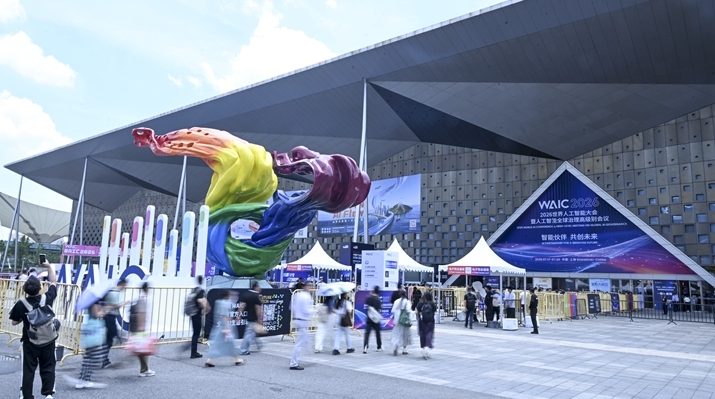
The exterior of the Shanghai World Expo Exhibition and Convention Center in Shanghai on July 17, the day of the opening of the 2026 World AI Conference (WAIC) and High-Level Meeting on Global AI Governance (XINHUA)
The 2026 World AI Conference (WAIC) and High-Level Meeting on Global AI Governance was held in Shanghai on July 17-20. The day before the event, representatives from 29 countries signed an agreement to establish the World AI Cooperation Organization (WAICO). The move reflects, to a certain extent, China's contributions to advancing global AI development and governance.
In truth, China's efforts extend far beyond this milestone. Its technological prowess, development model and cultural philosophy point to an AI development and governance paradigm with distinct Chinese characteristics, one that aims to deliver shared benefits.
The historical trend
Every previous round of sci-tech revolution and industrial transformation has profoundly reshaped humankind's modes of production, livelihood and social organization, and the ongoing revolution, with AI stands at its core, will be no exception. Its enormous potential is widely acknowledged: At the micro level, it helps tackle complex scientific challenges, discover new materials and synthesize new medicines; at the intermediate level, it spawns new industries and transforms traditional business models; at the macro level, it shifts the balance of national power and restructures the global economic landscape.
AI capabilities are advancing at a rapid pace. Artificial general intelligence (AGI) is the hypothetical type of AI that can master all types of cognitive task achievable by humans, instead of merely handling specialized tasks. While AGI remains an unknown distance away, foundation models continue to upgrade at a staggering speed and have developed unexpected specialized capabilities.
Additionally, foundational support for AI is being continuously strengthened. No longer merely a tool to assist decision-making and boost efficiency, AI, together with computing power networks and data platforms, is becoming part of the critical infrastructure underpinning economic and social operations.
Spanning smart factories, autonomous driving and humanoid robots, large model technologies have evolved sequentially from natural language models to multimodal models and then to world models, enabling AI to move from "thinking" to "acting." On this basis, AI is accelerating its integration into real-world scenarios including manufacturing, transport, healthcare and urban governance, delivering deep convergence between digital intelligence and physical systems.
Divergent pathways
Based on their respective resource endowments and constraints, China and the United States adopt differing priorities and possess differing strengths in AI development. Leveraging its solid foundations in advanced chips, computing infrastructure and developer ecosystems, the United States sustains its leadership in the iteration of foundation models. Most of the world's top 10 AI models by overall performance in leading international benchmarks are developed by U.S. firms.
China places greater emphasis on algorithm innovation and engineering optimization, building steady advantages in computing efficiency. Measured by the ratio of intelligence index to training computing scale, representative Chinese large models deliver roughly 30 percent higher computing efficiency on average than leading U.S. counterparts. Meanwhile, China's AI systems are rapidly closing the capability gap with their U.S. peers, which industry insiders generally estimate at around six months.
China and the United States also follow markedly different pathways for AI application. The United States prioritizes deployment in scientific research and high-value sectors such as finance and healthcare. Drawing on its super-large market and complete industrial system, China deploys AI extensively across manufacturing, healthcare, transport, education, finance, urban governance and other sectors, striving to foster a development dynamic where technological innovation and real-world application reinforce one another.
A unique paradigm
China adheres to a people-centered approach and pursues an AI development model guided by the vision of AI for good, fairness and inclusiveness, and collaborative governance. This paradigm encompasses, but is not limited to, the following dimensions.
First, balancing development and security. The emergent abilities of AI are partially unexplainable with intricate internal reasoning mechanisms, meaning technological progress is constantly accompanied by unknowns and uncertainties. Without effective regulatory constraints and security governance, AI development risks straying from its original mission of benefiting humanity.
As AI grows more closely intertwined with the real world, challenges such as data security, algorithmic fairness and privacy protection continue to emerge. Deepfakes and AI-enabled fraud have posed growing threats to social trust and ethical norms. Chinese President Xi Jinping noted at this year's WAIC that "AI should be a trusted tool for humanity."
In recent years, China has stepped up top-level design to advance deep integration of AI across all industries. Meanwhile, it continues to improve full-spectrum governance covering algorithms, data, models, applications and ethics. It has explored an inclusive, prudent and tiered regulatory framework for AI, guiding its development toward greater safety, reliability and controllability.
This philosophy of encouraging innovation while emphasizing governance aims to counterbalance uncertainties brought by technological advances with institutional certainty. It embodies China's commitment to safeguarding people's rights and improving public wellbeing as the fundamental goal of AI development.
Second, open-source collaboration and international cooperation. Open source is a practical choice for China's AI development and aligns with the inherent laws of AI technology evolution. Having embarked on AI development relatively late, China can continuously upgrade model performance through sustained feedback from real-world scenarios only if open sourcing lowers technical barriers, broadens developer participation and unlocks space for user-driven innovation.
Experience has proven that AI requires data accumulation through extensive deployment, pooled wisdom via open-source collaboration and rapid iteration based on real-world feedback to form an innovation flywheel of "research and development (R&D) first, then application, feedback and the renewed R&D."
Unlike countries that curb the spread of AI technologies through export controls and access restrictions, China upholds that AI is a global technology whose value should not be defined by a handful of nations or a single civilization.
China released an action plan on AI cooperation and development during this year's WAIC, putting forward eight initiatives covering data, computing power, industrial ecosystems, talent, rules, governance and ethics. It aims to promote open AI development and win-win collaboration worldwide through concrete actions.
Third, inclusive sharing and collaborative governance. While profoundly reshaping economic and social development, AI risks widening the global digital and intelligence divides. Many countries in the Global South, particularly the least developed ones, cannot build viable AI capacity relying solely on domestic resources.
As a member of the Global South and a responsible major country, China actively promotes AI as an international public good that benefits all humanity.
Following the Global AI Governance Initiative in 2023, China released the AI Capacity-Building Action Plan for Good and for All in 2024 and the AI Plus International Cooperation Initiative in 2025. It also facilitated the adoption of a UN General Assembly resolution on enhancing international cooperation on AI capacity building and promoted the establishment of the Group of Friends for International Cooperation on AI Capacity-Building in 2024, advancing global AI governance from conceptual proposals to institutional development.
China has scaled up AI technical assistance to other Global South countries, helping them build AI application capacity in agriculture, energy, power supply, transport, disaster prevention and mitigation and other areas.
These efforts conform to the international vision of building a community with a shared future for humanity, serve the practical need to sustain sound long-term global economic and social development, and offer a vivid, significant footnote to China's path to modernization through peaceful development.
Huang Ning is deputy director and researcher at the Institute of Science and Technology Planning and Foresight, Chinese Academy of Science and Technology for Development, and Wang Shuang is a postdoctoral researcher at the institute.


 京公网安备 11010802027341号