 Share:

In Yan'an, Spanish youth leader Jacobo Pombo García reflects on the CPC, the Long March spirit, and China's path to modernization.
"Young Europeans need to visit not only China's economically developed regions, but even more so Yan'an, the revolutionary holy land, to understand both the starting point and the destination of the Chinese revolution. They need to learn how the Communist Party of China (CPC) grew from a small party into a globally influential ruling force that has led China to such tremendous developmental achievements," Jacobo Pombo García, president of the Global Youth Leadership Forum, told China Today.
From July 22 to 23, while participating in the Shaanxi segment of the China International Communications Group's (CICG) "Together on the Long March: Marking the 90th Anniversary of an Epic Journey" international communication project, García visited the Yangjialing Revolutionary Site. There, he toured the Central Auditorium, the site of the Seventh National Congress of the CPC, and the working and living quarters of Mao Zedong and other veteran CPC leaders. "European young people desperately need to come here," García remarked to China Today. He believes that young Europeans should deeply engage with the CPC's history, especially the history of the Chinese Workers' and Peasants' Red Army's Long March and the building of revolutionary base areas. They should learn how, under extremely harsh conditions, the CPC rallied the people and grew from a party with just over 50 members into a ruling party with over 100 million members that leads the world's second-largest economy. "Only then can they understand the internal logic of China's path and grasp 'why the CPC can deliver,'" García said.
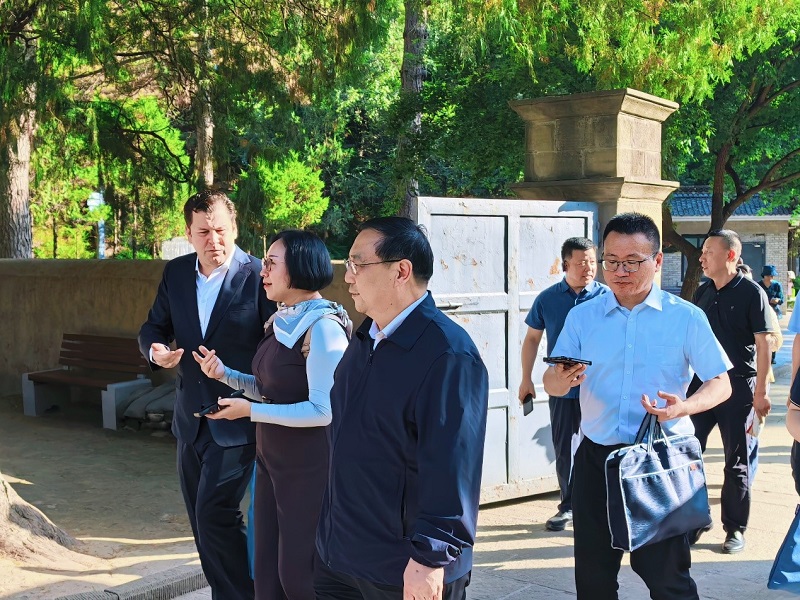
Jacobo Pombo García (left), president of the Global Youth Leadership Forum, visits the Yangjialing Revolutionary Site in Yan'an on the afternoon of July 22, 2026, in deep conversation through an interpreter with Chang Bo (front right), president of CICG, about the history of the Chinese revolution.
Seeking Roots in the Revolutionary Holy Land: Decoding "Why the CPC can Deliver"
In García's view, the key to understanding contemporary China lies not only in the skyscrapers of Beijing, Shanghai, Guangzhou, and Shenzhen but also in the cave dwellings of Yan'an. During this "Together on the Long March" journey, García held in-depth talks with CICG President Chang Bo. Through Chang's introduction, García gained a systematic understanding of the trajectory of modern and contemporary Chinese history: from the Opium War of 1840, which gradually reduced China to a semi-colonial, semi-feudal society, to the arduous attempts by countless people with lofty ideals to explore a path to national salvation, and finally to the introduction of Marxism to China and the founding of the CPC in 1921.
The CPC had only about 50 members when it was founded, yet it became the seed that changed Chinese history. García was deeply impressed by this number, surprised that the CPC started so small, which sparked a strong interest in its development journey. He believes the secret to the CPC's success lies in transforming its fundamental principle of "serving the people wholeheartedly" from a slogan into reality.
He specifically mentioned the recent political transitions and turbulence in some European countries, noting, "Crises of trust in political elites are common in Europe. In many Western countries, politicians verbally pledge to serve the people, but often fail to deliver, and there are even severe problems of political polarization, short-sightedness, and corruption." García said, "In contrast, the CPC has demonstrated astonishing policy continuity and execution capability, able to formulate and implement long-term strategic plans like poverty alleviation and ecological progress, which is hard for Western electoral politics to match."
This trait of "being true in word and firm in deed" has allowed García to see the essential difference between Chinese and Western political culture. He believes this is a continuation of the Long March spirit in contemporary times – once a goal is set, to fear no hardship, persevere, and strive until victory is achieved.
Spiritual Core: The "Red Code" Puts the People First
After learning about the Red Army's Long March, García specifically asked, "What was the Red Army's economic source back then? Who materially supported the Red Army and the subsequent construction of the revolutionary base areas?"
Chang Bo gave a resounding answer: "The people! The people are the driving force pushing history forward. The CPC has always held the people in the highest regard in its heart."
Chang reviewed the arduous journey of the Long March: the Central Red Army set out from Jiangxi with about 80,000 troops, yet only around 7,000 reached northern Shaanxi. It was this very force that fought against overwhelming odds, with inferior equipment, and played a pivotal role in the Chinese People's War of Resistance against Japanese Aggression (1931-1945), ultimately defeating Japanese imperialism and securing victory in the eastern theater of the World Anti-Fascist War (1931-1945). It was still this force that, during the War of Liberation (1946-1950), defeated the millions-strong Kuomintang army. The answer lies nowhere else but in the word "people." For the CPC, all for the people, all rely on the people. The Red Army maintained strict discipline, never taking even a needle or a piece of thread from the masses; the Red Army sought happiness for the people, distributing land and reducing rent and interest rates, thus winning the heartfelt support of the vast majority of the populace. Serving the people wholeheartedly is the CPC's fundamental purpose and key for successfully leading the Chinese people to overcome all difficulties and obstacles and defeat all enemies.
García expressed agreement with this. In recent years, through multiple visits to China, he has sensed the Chinese people's strong identification with and pride in their national identity, viewing it as a vital manifestation of national cohesion. "This belief in relying on the people and serving the people is the key to understanding the success of the Chinese revolution, development, and construction," he said. In Europe, politics often degenerates into a game for the elite, whereas the CPC has always inscribed the people on its banner. This "people-first" governance logic deeply moved García. He believes this holds strong referential significance for European countries currently facing social fragmentation and public disaffection.
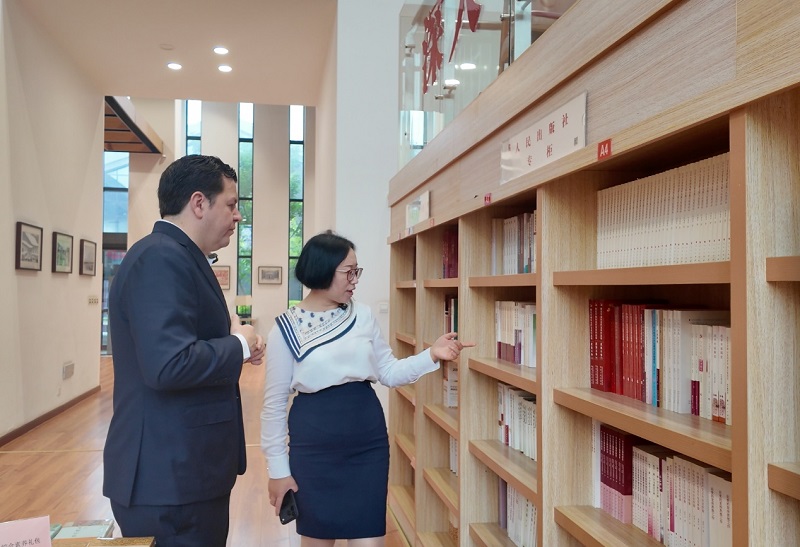
On the morning of July 23, 2026, Jacobo Pombo García, president of the Global Youth Leadership Forum, gives an exclusive interview to China Today at the Study Academy of China Executive Leadership Academy Yan'an. In the picture, García listens as Executive Editor-in-Chief of China Today Zhang Hui introduces the academy's collection of works by CPC leaders and books on CPC history.
Historical Echoes: Shared Memories Across Civilizations
Beyond the real political logic, García also touched upon a historical link in Yan'an that is rarely mentioned in Europe. Chang Bo explained that about 90 years ago, despite its own extremely difficult circumstances, China firmly supported the Spanish people's anti-fascist war. In May 1937, on behalf of the then Central Soviet Government of China, Chairman Mao Zedong published an open letter to the Spanish people, expressing firm solidarity and demonstrating the profound internationalist spirit of the CPC and the Chinese people.
"This history is not widely known in Spain," García admitted frankly. He himself had previously only been aware of the International Brigades' existence and was unaware of the extent of China's direct involvement and support. This historical "unfamiliarity" felt regrettable to him and also pointed him toward a direction for his efforts.
García believes such historical stories should be told more often to awaken the Spanish public's memory of the traditional friendship between the two countries. "This kind of historical resonance is the foundation for strengthening bilateral relations," he said. He plans to use the platform of the Global Youth Leadership Forum upon returning home to tell this story of a "red bond" to European youth. In his view, both Spain's anti-fascist struggle and China's Long March are magnificent epics of humanity's pursuit of justice and freedom, which should serve as a spiritual bridge connecting Chinese and European youth.
Inspiration for the Era: The Long March Spirit and Global Governance
As a youth leader active on the global stage, García ponders not just history, but more so the future. Drawing on his global observations, he pointed out that the world today faces many challenges: the impact of technological revolution, geopolitical conflicts, the threat of climate change… Western traditional governance models seem to have reached an impasse.
In this context, the vision of "building a community with a shared future for humanity" proposed by President Xi Jinping is particularly important. With China's practices in global governance – whether the Belt and Road Initiative or the Global Development, Security, Civilization, and Governance Initiatives – the world sees concrete actions and China's sense of responsibility in building such a community. "It now seems this is the only viable solution for addressing global crises," García said.
He believes the Long March spirit possesses a new dimension of value in the new era. The qualities embodied in the Long March – indomitable perseverance, unity and collaboration, and adherence to a great ideal – are precisely the right remedies for solving current global challenges.
"The story of the Long March did not end in 1936," García said. "In China today, people still talk about a 'New Long March.' Its destination is no longer snowy mountains and grasslands, but national rejuvenation, modernization, and the 'Chinese Dream.' The Long March spirit still holds significant contemporary relevance; it guides China and inspires the world."
The Responsibility of Youth: Building New Bridges of Communication
As president of the Global Youth Leadership Forum, García had another important mission on this trip: to build a bridge for communication between the youth of China and the world. He introduced that the forum not only has extensive cooperation in China but will also host multiple events in countries like Spain, Germany, Mexico, Colombia, Brazil, and the United States in the coming year.
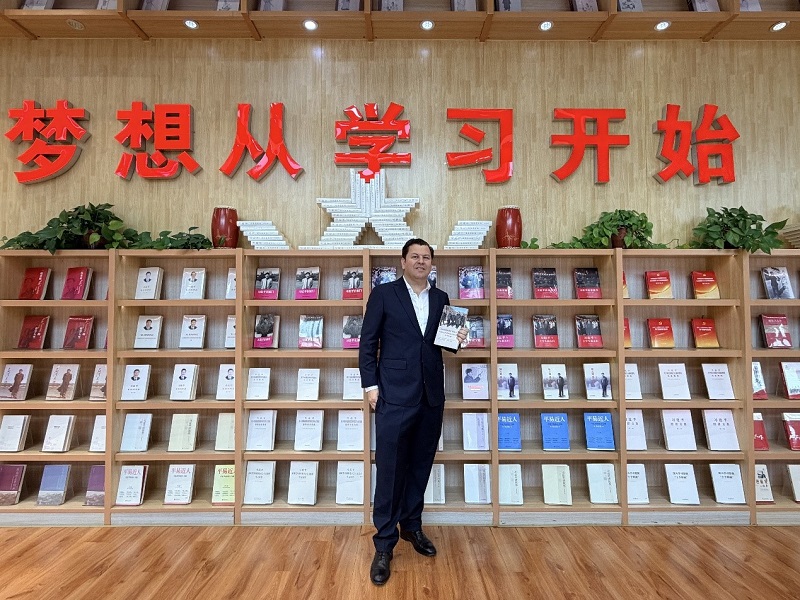
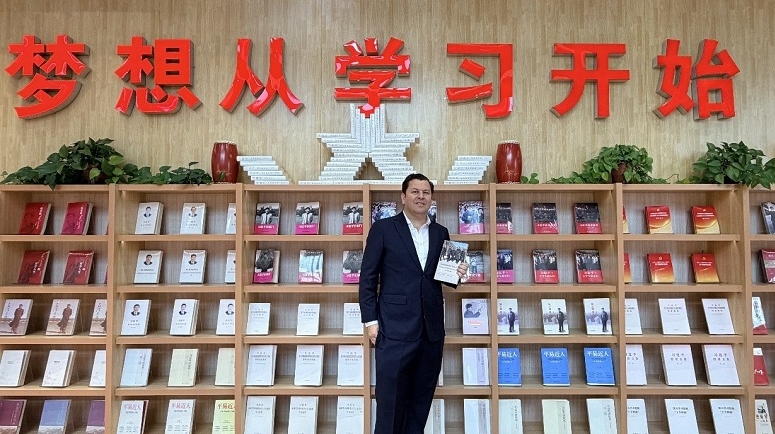
Jacobo Pombo García, president of the Global Youth Leadership Forum, poses for a photo at the Study Academy of China Executive Leadership Academy Yan'an on July 23, 2026, with the English edition of the book Liangjiahe Village: A Story of Chinese President Xi Jinping.
"We feel very honored that every year, many young leaders from China participate in our forum, joining dignitaries and outstanding figures from various countries and fields to discuss the challenges facing the world and the countermeasures," García said. He expressed hope for an opportunity to bring European youth to Yan'an in the future, so that more young Europeans can learn about the history of the Red Army's Long March and the Chinese revolution. He believes the CPC's spiritual lineage is consistent and continuous, and that the Long March spirit can now be seen in areas like technological innovation and rural revitalization – experiences worth learning from for the world's youth.
García also specifically mentioned the importance of education in China. "The educational opportunities China provides for its younger generation, especially the investment in skill development and preparing for future challenges, are deeply impressive," he said. "This ensures the sustainability of the nation's development." In his view, investing in the youth is investing in the future.
From Madrid to Yan'an, crossing vast distances; from history to reality, piercing through the fog of time. Jacobo Pombo García's "Long March journey" was a spiritual baptism. He observed with his own eyes and felt with his heart, arriving at a simple conclusion: The CPC can deliver because it always stands with the people; the Long March spirit is great because it manifests a value pursuit that transcends eras and national borders – striving tirelessly for the people's wellbeing.
As García said at the end of the interview, "If we have a clear vision of serving the interests of all people and persistently work towards it, we can achieve any goal. This is how China has come this far, and this is how the world's youth should move forward." This, perhaps, is the most precious inspiration the Long March spirit offers to the youth of Europe and the world.