


 Share:

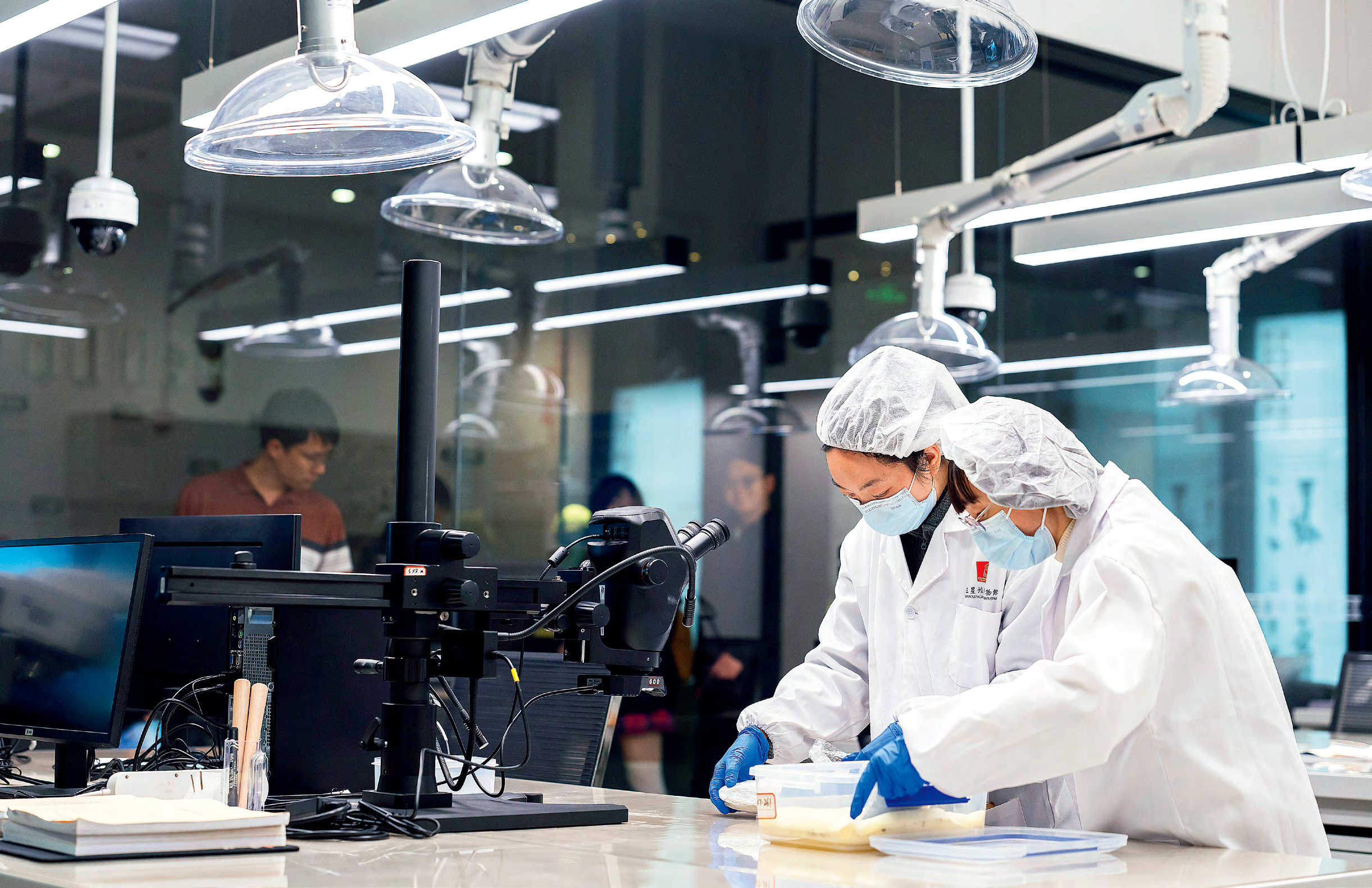
The Cultural Relic Conservation and Restoration Center at the Sanxingdui Museum is a modern facility integrating artifact restoration, scientific research, exhibition, and public education. [Photo by Guo Shasha/China Pictorial]
At the Sanxingdui Museum's Cultural Relic Conservation and Restoration Center, seeing newly unveiled artifacts is only the first step. Visitors can now also witness the entire process of cleaning, preservation, and restoration carried out by the conservators.
Since 2019, more than 17,000 cataloged artifacts have been unearthed from six newly discovered sacrificial pits at the Sanxingdui Ruins. Most items suffered from varying degrees of deformation, fragmentation, and material degradation upon excavation, requiring meticulous cleaning, stabilization, and repair. By collaborating with conservation teams from across the country, the Sanxingdui Museum is successfully restoring these artifacts one by one.
Piecing Together Shattered Artifacts
Towering majestically over the exhibition hall themed "The World of Humans and Gods" is the No. 1 Bronze Sacred Tree, reaching nearly four meters high. Classified as a national first-class cultural relic, it is the largest single bronze artifact of its era found anywhere in the world. When first excavated, however, its trunk and branches were broken, with fragments scattered across the ground. "No one knew what it originally looked like," said Guo Hanzhong, deputy director of the Exhibition and Collection Department at the Sanxingdui Museum. "We had to piece it together through trial and error, much like solving a jigsaw puzzle." In 1990, he began working alongside master restorer Yang Xiaowu to restore the bronze tree—a painstaking process that took seven years. When the Sanxingdui Museum opened in 1997, the No. 1 Bronze Sacred Tree finally debuted, stunning the world.
Now 58 years old, Guo Hanzhong serves as the technical lead for bronze restoration at the Sanxingdui Museum. Over the past four decades, he has participated in the excavation of all eight sacrificial pits at the Sanxingdui site and personally restored more than 6,000 artifacts. Guo generously shares his expertise with his apprentices, insisting that they master the "labor-intensive" traditional skills of manual assembly while also gaining an understanding of modern tools and concepts such as 3D scanning. To date, the team led by Guo has completed cleaning and restoration on hundreds of newly excavated artifacts. "The conservation and restoration of cultural relics is a long-termundertaking," said Guo. "My predecessors passed their skills on to me, and I shoulder the responsibility of passing them on to the next generation. It's a relay race."
Overcoming Ivory Conservation Challenges
Among all categories of cultural relics, ivory has presented perhaps the greatest conservation challenge. Ivory buried underground for millennia softens in texture, and upon excavation, rapid moisture loss causes it to crack and weather quickly, eventually leading to complete disintegration. Therefore, ivory extraction and preservation is considered a global challenge.
Guo Hanzhong has participated in on-site extraction of hundreds of ivory tusks. He innovatively created his own specialized tools and adapted stabilization techniques from orthopedic surgery—specifically, applying "bandages" to the ivory. He wraps the tusks in moistened polymer bandages and extracts them as a single unit once the material has set, ensuring the safe recovery of hundreds of tusks.
To effectively preserve the excavated ivory, the Sanxingdui Museum established a dedicated storage facility in which the temperature is precisely controlled at five degrees Celsius and humidity is maintained at 90 percent, replicating the underground burial environment as closely as possible. The hundreds of unearthed tusks are individually numbered and stored in separate layers. "We regularly monitor and maintain the ivory relics to minimize degradation arising from environment changes, thereby buying time for scientific research into its preservation," added Zhang Yuefen, deputy director of the Exhibition and Collection Department at the Sanxingdui Museum.
Since 2022, research institutions from across the country have engaged in a multi-year, interdisciplinary collaborative effort to develop conservation technologies for excavated ivory. Existing research findings have already been applied to ivory unearthed at both Sanxingdui and Jinsha archaeological sites. In June 2025, a stabilized ivory tusk from Jinsha was successfully put on public display. Sanxingdui ivory is also expected to be displayed in the museum in the near future.
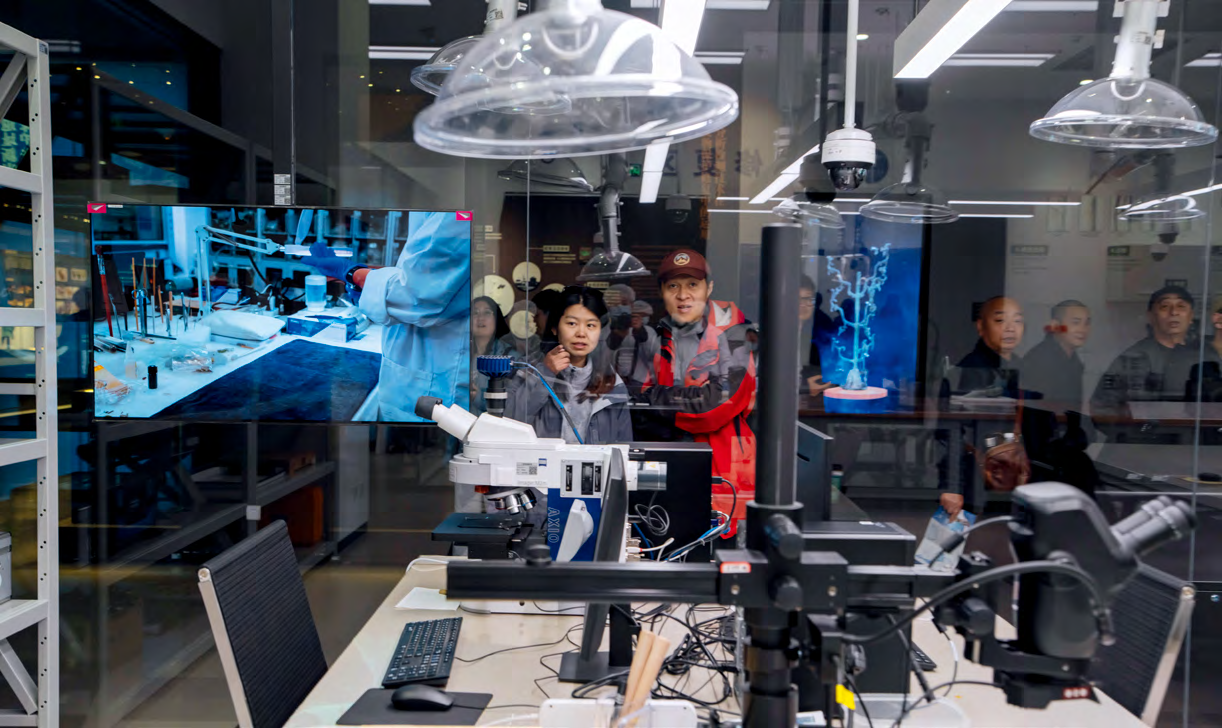
The Cultural Relic Conservation and Restoration Center at the Sanxingdui Museum is divided by a glass wall into a conservation workspace and a public viewing area, allowing visitors to observe the latest achievements in artifact conservation and restoration at close range. [Photo by Guo Shasha/China Pictorial]
Carrying History into the Future
During the early days of the Sanxingdui Museum in the 1990s, only two people—one of them being Guo Hanzhong—were committed to restoration of cultural relics. In 2008, the Sanxingdui Museum became one of the first institutions in China to be certified for restoration of movable cultural relics. That same year, the museum began recruiting university graduates specializing in artifact conservation and authentication. "That group of young people was cultivated back then," said GuoHanzhong. In 2021, a master workshop for artifact conservation, led by Guo Hanzhong, was established at the Sanxingdui Museum. A cohort of young conservators has since rapidly matured into key professionals in the field of cultural heritage.
Zhu Yarong, deputy director of the Sanxingdui Management Committee, noted that in recent years, the Sichuan Provincial Institute of Cultural Relics and Archaeology and the Sanxingdui Museum have jointly trained 20 specialists in the conservation and multidisciplinary research of bronze, gold, jade, and ivory artifacts, leveraging projects dedicated to the preservation and restoration of items unearthed from the Sanxingdui site. Furthermore, the Sanxingdui Museum actively engages in exchange with domestic and international peers to continuously enhance the professional expertise and comprehensive capabilities of its conservation staff.
To these conservators, ancient artifacts are not merely cold objects, but living history. Their mission is to ensure that this history remembers its origins while moving toward a more distant future.


 京公网安备 11010802027341号