Share:

Wang Yong still remembers the excitement when he watched a snow football match on the frozen Songhua River in northeast China's Heilongjiang Province last winter.
As a tourist from the tropical island province of Hainan in southern China, he rarely sees snow, let alone football matches played on a snow field with temperatures plunging to minus 20 degrees Celsius.
"The atmosphere is amazing. Snow football is so much fun. This trip is absolutely worth it," Wang said, adding that he extended his two-day trip to five days to watch more matches.
Months later, the frozen river thawed, the playing fields turned green and thousands of fans were filling stadiums to support their hometown teams.
The contrasting scenes reflect a growing sports economy in northeastern China, driven by two homegrown competitions: the "Ice Super League" in winter and the "Northeast Super League" in summer. Together, the competitions have extended the region's sports calendar, attracting visitors and supporting local businesses.
WINTER: ICE SUPER LEAGUE
Heilongjiang, a two-time host of the Asian Winter Games and the birthplace of many Winter Olympic champions, has long been a center for ice and snow sports in China.
Last winter, the province launched the inaugural Ice Super League and organized thousands of related events as part of a broader push to expand participation in winter sports.
Guan Na, a visitor from south China's Guangdong Province, experienced winter sports for the first time in Qitaihe, a city known for producing multiple Olympic and world champions in short track speed skating.
"I've never been to China's cold northeast before, and it was my first time trying an ice slide. It's quite addictive," Guan said after taking part in activities on a frozen lake in January.
Launched in December 2025, the Ice Super League was designed to combine sports, tourism and local commerce while encouraging broader public participation.
"We want people of all ages to take part, so we've included plenty of recreational activities," said Wang Xianyu, director of the Heilongjiang Provincial Sports Bureau.
Official figures showed that the province built 3,000 public ice and snow sports facilities last winter.
The events have also been used to promote tourism. In Mudanjiang, known for its heavy snowfall, a hiking race through snow-covered forests introduced participants to local scenery and cuisine.
"It reminded me of a movie filmed here. After the race, I decided to stay longer and explore the city," said Wang Pei, a participant from Zhejiang Province.
Mudanjiang also organized food festivals and distributed spending vouchers to participants alongside sporting events to encourage tourism and local consumption, Vice Mayor Sun Li said.
Official data showed that winter sports events in Heilongjiang generated 775 million yuan (107 million U.S. dollars) in direct consumer spending during the 2025-26 winter season.
SUMMER: NORTHEAST SUPER LEAGUE
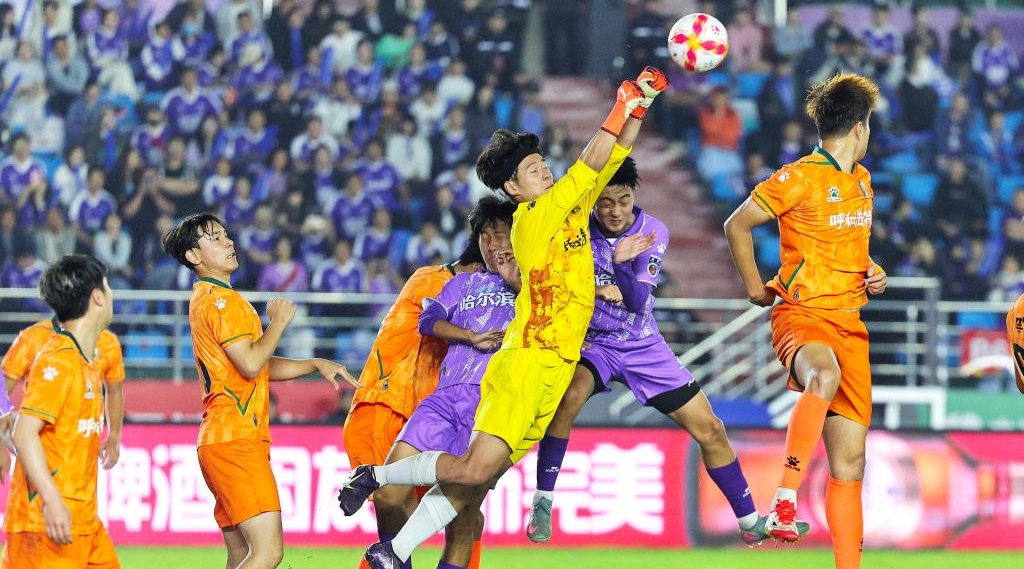
The inaugural Northeast Super League kicked off on May 23 with matches in Shenyang, Changchun, Harbin and Hohhot, becoming China's first cross-regional amateur football league. Eight teams from Liaoning, Jilin, Heilongjiang and Inner Mongolia Autonomous Region are competing in a season that runs through early October.
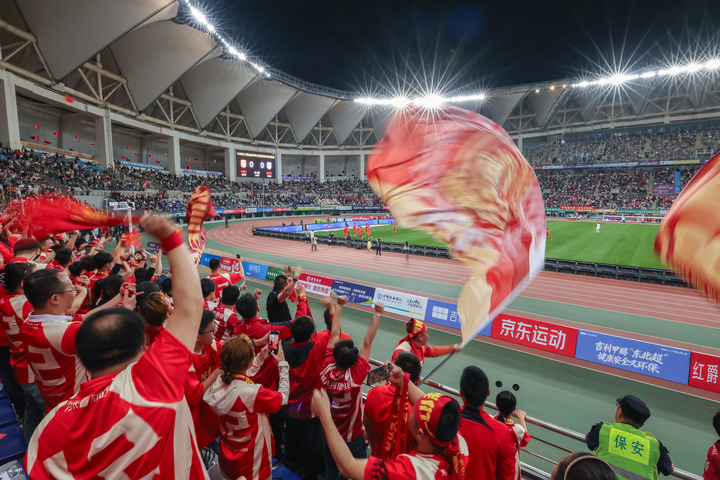
Opening-day attendance topped 100,000 across the four host cities, with tickets priced at 19.9 yuan.
The league has also boosted business around match venues.
Li Qiang, who runs a barbecue restaurant near Harbin's home stadium, said business has surged since the season began.
"On match days, the place is packed with fans from out of town," Li said. "Normally I stay open until 2 a.m., but everything is sold out by 9 p.m. Around match days, customer traffic increases by about 40 percent."
Like similar regional leagues in Jiangsu and Guizhou, the Northeast Super League is intended to promote tourism and local spending alongside football.
The four host regions have jointly launched a "Super Northeast Tour" campaign featuring seven travel routes. Fans can use match tickets to receive discounts at participating hotels, restaurants, shopping malls and bathhouses.
"We've organized more than 20 restaurants. Any customer with a Northeast Super League ticket receives a complimentary specialty dish per table," said Lou Baozhong, president of the catering chamber of commerce in Harbin's Acheng District.
The league has also encouraged travel between host cities. According to Tongcheng Travel, one of China's leading online travel agencies, searches for trips from Jixi, Yanbian, Harbin and Tongliao to Shenyang have risen by more than 70 percent since the league began.
Commercial interest has also grown. Sponsorship revenue has exceeded 100 million yuan, with more than 30 companies signing partnerships, ranging from national brands such as Geely Auto and CATL to local restaurants and retailers. In Liaoning, six key competition days of the Northeast Super League generated a total of 7.6 billion yuan in consumption across related industries.
TWO EVENTS, ONE MODEL
The Ice Super League runs from December through March, while the Northeast Super League is held from May through October, creating a nearly year-round calendar of sporting events.
"From the Ice Super League to the Northeast Super League, the transition is not coincidental, it is by design," Wang Xianyu said.
Despite taking place in different seasons, the two competitions follow a similar model by combining sports with tourism, culture and commerce.
"Both leverage low ticket prices to maximize accessibility and participation. Both recognize that the real economic value lies not in ticket sales alone, but in tourism, dining, accommodation and retail spending that fans generate before and after the games," said Zhang Qiang, director of the Acheng District Bureau of Culture, Sports, Radio, Television and Tourism.
China's 15th Five-Year Plan (2026-2030) identifies the sports event economy as a development priority, with the country's sports industry expected to generate more than 7 trillion yuan in output by 2030.
"Winning or losing doesn't matter," said Liu Wei, a factory worker from Jilin. "What matters is that a 19.9-yuan ticket stub can unlock a city, and that a football match on a summer night can remind an entire region of what it means to come together."


 京公网安备 11010802027341号