 Share:

Golden confetti fell inside Hangzhou's Binjiang Gymnasium, as Shanghai Jiao Tong University celebrated an unlikely championship victory on Tuesday.
Three knockout games, three victories against formidable opponents and three dramatic comebacks carried Shanghai to the Asian University Basketball League title. It was the kind of hot-blooded, fairy tale drama that only seems possible in youth sports — or the movies.
After the final buzzer sounded, one of Xu Yang's players told him: "Coach, we fought for it. We finally made our dream come true."
A moment that the Shanghai head coach said reminded him of Slam Dunk, the Japanese basketball anime series he watched as a child.
"I feel extremely proud to have led these students into such a high-level competition," Xu said.
Shanghai's path to the championship was not straightforward. It edged Peking University by two points in the quarterfinals before beating Tsinghua University with an overtime buzzer-beater in the semifinals, overcoming two of China's leading university programs in three days.
Then came the final against defending champion Chengchi University from Taiwan, which had beaten Shanghai twice previously — in their first meeting during last year's tournament, and again in the group stage this year.
In the final, though, trailing by 12 points in the second quarter, Shanghai fought back.
It pulled level in the closing stages and capitalized on late turnovers to seal a 72-69 victory.
Chen Tiancan led the side with 14 points, seven rebounds and five assists, team highs in all three categories, and was named the tournament's Most Valuable Player.
"If I were a director making a film, I probably couldn't come up with a story like this," Chen said. "The audience would probably have thought it was too unrealistic."
Yet Xu did not see the title as a miracle. For him, it was the reward for a team that had grown through every setback.
"When we first played Chengchi (last year), we lost by a large margin. In the group stage this year, we gave everything, but still lost, but only by around 10 points. Then, in the final, the team earned this hard-fought victory," he said.
"That progression reflects Shanghai Jiao Tong's resilience and character. Many people did not believe in us, but we fought one game at a time, and our players began to believe in themselves.
"The championship medal is the best proof of that."
The second edition of the AUBL, held in the Zhejiang provincial capital from Aug 2-11, brought together 12 university teams from across Asia, yet the tournament is more than just a championship contest.
By bringing young players from different basketball cultures onto the same court, the league is creating a space for student-athletes to test themselves against unfamiliar opponents, exchange ideas and develop through competition.
While six teams from last year's inaugural tournament returned, six others, including university teams from the Philippines and Australia, made their AUBL debuts.
The diverse field produced contrasting styles and close contests.
All four quarterfinals were decided by five points or fewer. Both the final and third-place playoff were group-stage rematches, but each produced a different winner.
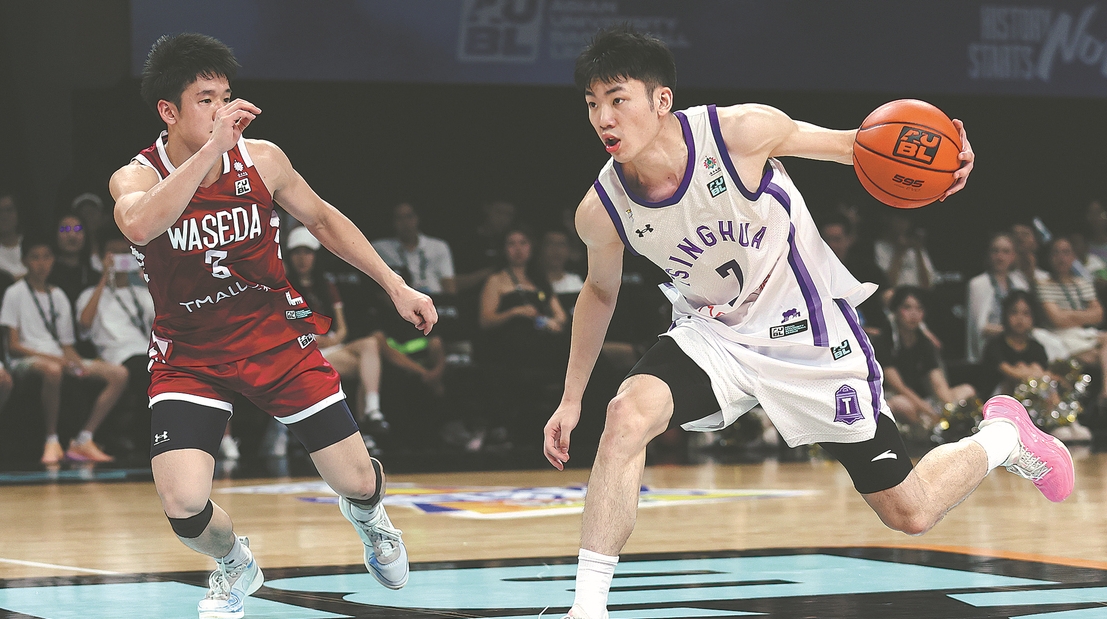
Tokyo's Waseda University reversed its earlier result against Tsinghua to claim third place with a 98-91 win.
Tsinghua coach Chen Lei said facing Waseda, the University of the Philippines and the University of Sydney gave his players exposure to different styles of play.
"The AUBL has opened our eyes," Chen Lei said.
"It gives us an opportunity to understand teams from different countries and regions, with different tactical approaches. This platform can potentially develop players capable of representing the national team."
Last year, Tsinghua guard Zheng Junhao was forced to watch from the sidelines injured as his teammates narrowly lost to Chengchi in the final. Finally able to compete this summer, he said the stronger field made adaptability essential.
"The competition is even tougher this year, with teams we had never faced before," Zheng said.
"The Philippine players are athletic and strong one-on-one, while the Japanese teams emphasize shooting, execution and teamwork. Although we study footage beforehand, these are often first-time encounters, so we have to read our opponents and adjust as the game unfolds."
And the league is already demonstrating its value as a professional pathway.
Sung Hsin-hao, former Chengchi guard who won the inaugural tournament's MVP award, was selected as the first overall pick in this year's Chinese Basketball Association Draft.
The performances of this year's MVP Chen Tiancan have similarly strengthened expectations surrounding his future professional prospects.
Sanctioned by the Asian University Sports Federation, the AUBL is now set to expand into a full home-and-away season.
According to AUBL CEO and co-founder Li Jintian, 16 teams will compete across Asia when the league tips off again in November. It will run through April 2027, with the season culminating in a championship event modeled, in part, on the NCAA's March Madness.
Li noted that the league intends to make school identity the defining feature of home games.
"The most important element of campus sports is having a home court where a university can express its own culture, cheering traditions and colors," Li said.
"We will approach the presentation and visual experience through a different logic (to that of the last two weeklong competitions that took place in Hangzhou)."
Li added that the league hopes to expand to around 30 teams within two to three years, with universities from more countries and regions. It is also exploring the introduction of a women's competition.


 京公网安备 11010802027341号