Share:

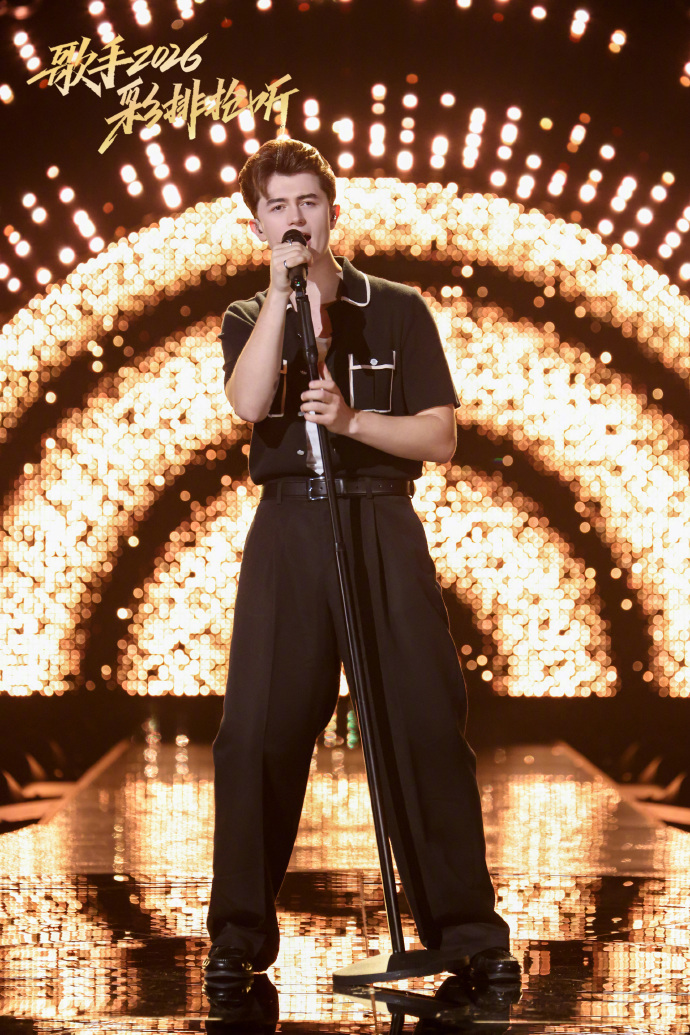
Elliot James Reay performs on stage during a dress rehearsal for "Singer 2026." [Photo provided to China.org.cn]
When Elliot James Reay took the stage as a replacement singer on "Singer 2026," a hugely popular Chinese singing competition featuring performers from both China and abroad, the young British artist brought with him a sound that seemed to come from another era.
At 24, Reay has built his musical identity around the rock 'n' roll and pop sounds of the 1950s and '60s, with over 6 million followers across social media platforms. His debut single, "I Think They Call This Love," has amassed more than 210 million streams on Spotify. But stepping onto a new stage, competing with artists from another country — most of whom already had a solid fanbase in China — and facing Chinese audiences as a "nobody" made him, by his own admission, "really nervous."
His nerves, however, soon gave way to excitement.
Competing on "Singer 2026," he said, made him feel as if he were starting his career all over again — and gave him a renewed sense of "hunger" and "fire."
Many audience members see echoes of Elvis Presley in his music. But for Reay, looking back is not about staying in the past. It is about understanding where today's music came from — and finding a way to carry that legacy forward.
When he listens to today's biggest artists, he often likes to trace their musical lineage backward: asking where an idea came from and who influenced the artist behind it. Much of contemporary pop, he believes, can ultimately be traced back to the sounds that emerged in the 1950s.
"Someone has to start the wave before you can see the wave and everyone can ride it." Reay said.
That belief took on a new meaning in China. For Reay, music from the '50s and '60s may be decades old, but it can still resonate with audiences today.
And Chinese audiences seem to have proved his point. His vintage voice and old-school style have struck a chord in China, particularly with younger listeners. Some Chinese fans have described him as someone who "looks young but sounds old," while others have compared his voice to red wine.
But the exchange has not been just one-way. While Reay came to China with a sound rooted in the West's musical past, his journey on "Singer 2026" also pushed him beyond his own musical comfort zone.
One example was his decision to perform a Chinese-language song. Having never sung in another language before, Reay spent five days listening to the song repeatedly and working on the pronunciation.
He admitted that the experience was difficult. Some Chinese sounds, he said, are unlike anything in English, and learning them became less about simply hearing the difference and more about understanding how the sounds felt to pronounce.
Still, the challenge proved rewarding.
"I felt like I gave everything," he said. "And the response was really good, so that's all I could have asked for."
The experience also gave him a glimpse into a different musical culture. What Reay found on the Chinese stage, however, was not a single musical formula to follow. He was struck instead by the individuality of the artists around him, each with a distinct style and identity, which in turn, reinforced a lesson of its own: he did not need to become someone else to connect with a new audience.
"It really showed me that I can just be who I want to be and I can just sing how I want to sing," he said. "I don't have to have an expectation."
Looking beyond, Reay's experience is part of a broader shift in the global music industry, as international artists are increasingly looking beyond traditional Western markets and toward China. In 2025, more than 350 international artists and groups performed in the country, according to figures from the China Association of Performing Arts.
For Universal Music Group, which represents Reay, that shift has become part of a broader "Go East" strategy, aimed at helping international artists enter and develop long-term careers in the Chinese market. Launched in China early this year, the initiative brings together Universal Music's global resources and local expertise to provide international artists with support ranging from promotion and performances to commercial development.
In that sense, Reay's appearance on "Singer 2026" was not simply a television appearance. It was also part of a wider effort to build new connections between international artists and Chinese audiences. His experience suggests that music can travel far beyond the era and culture in which it was born — and that cultural exchange is often a two-way conversation. Reay came to China hoping to share a sound rooted in the 1950s and '60s. In return, he found a new audience and encountered a different musical culture.
Now, moved by the enthusiasm of his Chinese fans, the 24-year-old singer says he hopes to "have a career here." Perhaps one day, he will return to China with a new album and an even bigger presence.
As Reay himself put it: "Who knows?"


 京公网安备 11010802027341号