Share:

China's animated movie industry has never seen a detective comedy quite like "Mystery of Chang'an." Blending Tang dynasty (618-907) aesthetics with intricate mechanical fantasy elements, the film pushes the boundaries of what Chinese animation can be.

(Left to right) Directors Benjamin Huang and Cheng Teng, voice actor Lei Songran, and producers Cao Zijian and Li Yingying pose for a photo at a screening event of "Mystery of Chang'an" in Xi'an, Shaanxi province, Aug. 8, 2026. [Photo courtesy of Wishart Media]
"We made a comedy detective film, the first of its kind, because there is no such sub-category in China's animation market today," said producer Cao Zijian. Audiences are used to genres like sci-fi, crime, romance and historical drama in live-action movies, Cao observed, but animation rarely offers the same variety. "Looking at Europe, the United States, Japan and South Korea, they all have these categories. I kept thinking, why can't Chinese animation do the same?"
Producer Li Yingying explained that the creative spark came from director Cheng Teng's longstanding fascination with mystery and puzzle-solving narratives. "Cheng has always wanted to make different types of films in the Chinese animation field. We felt that detective and comedy genres were currently absent, so we decided to try something new."
For Cheng, the challenge was reconciling animation's visual spectacle with the rigorous logic of detective fiction. "I've loved puzzle-solving stories since I was in school," he recalled. "But as an animation director, I knew the medium excels at creating wonders and visual impact, while detective stories need strict logic in a realistic physical world. The two seemed contradictory."
That solution arrived in late 2019, when conversations with friends led to a breakthrough: using creatures from the "Classic of Mountains and Seas" as suspects and witnesses in a Tang dynasty crime story. "We turned ancient descriptions of mythical beasts into criminal clues," Cheng said. "That's how the concept of 'demons committing crimes' was born."
The project, which took six years to complete, presented numerous challenges — not least of which was building a world that felt both fantastical and credible. "The biggest challenge was making the audience believe this world is real," Li Yingying said. Co-director Benjamin Huang, a veteran Hollywood animator, echoed this: "The audience must trust the logic. If they don't, the entire film falls apart."
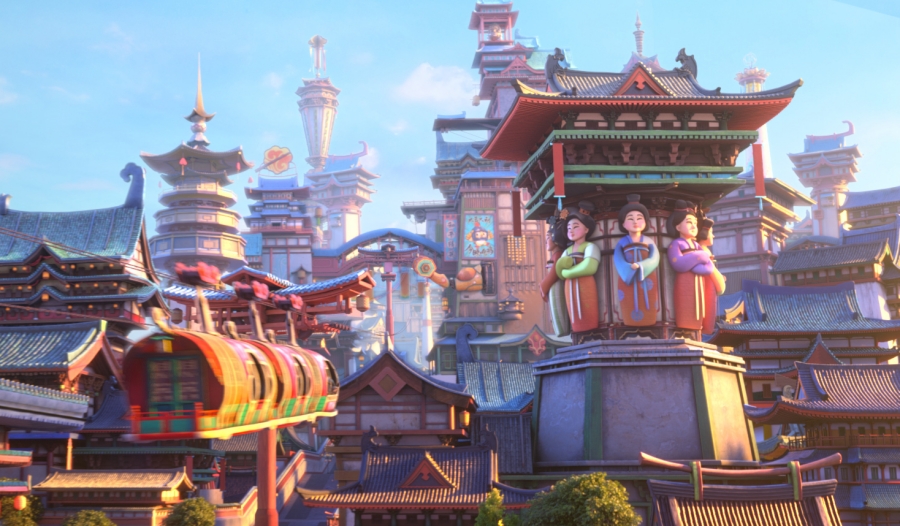
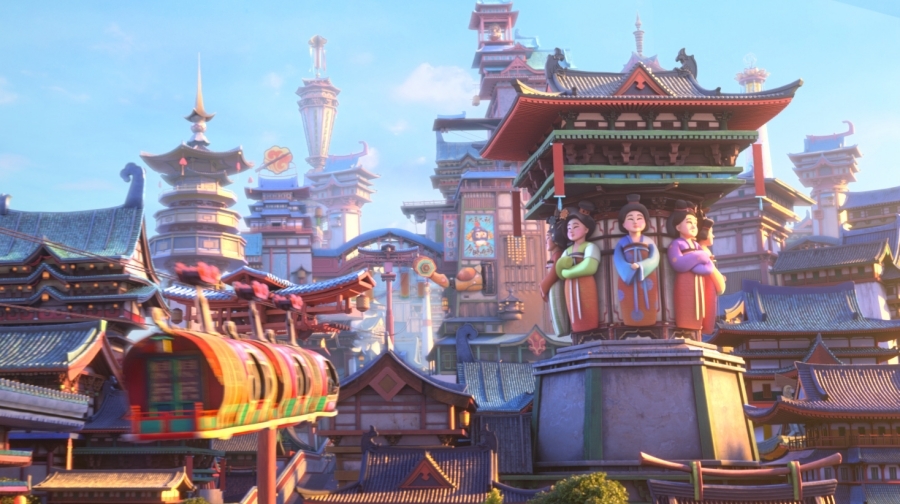
A still from "Mystery of Chang'an." [Image courtesy of 10M House Animation]
That logic was especially critical in designing Chang'an, reimagined as a "clockpunk" metropolis powered by gears, ropes and ironwork. The team conducted extensive research on architecture from the Tang dynasty and even assembled mechanical toys to understand interlocking structures. The result is a city where gears, ropes, wooden arches and ironwork power everything, including elevators operated by water and pulleys.
But visual extravagance was never the end goal. "Visual effects should always support the story, never overshadow it," Huang emphasized. "Whether through lighting, composition or character design, everything serves the narrative."
Cheng, known for his perfectionism, pushed the team to extraordinary lengths. The film contains over 2,100 shots, far exceeding the typical 1,600 to 1,800 for a 120-minute feature. "Cheng reviews each frame individually — hair, fur, every detail," Li said. Cao added: "Some scenes only appear on screen for a second, but he fills it with detail anyway."
The film's world-building extends to its nearly one hundred demon characters, each with distinct backstories. "Everything living around us has a soul; we just don't know what form it takes," Li said. Some demons are drawn from historical records and museum artifacts, others are original creations inspired by plants and animals that evoke Eastern aesthetics, such as lotuses, goldfish, lions and butterflies.
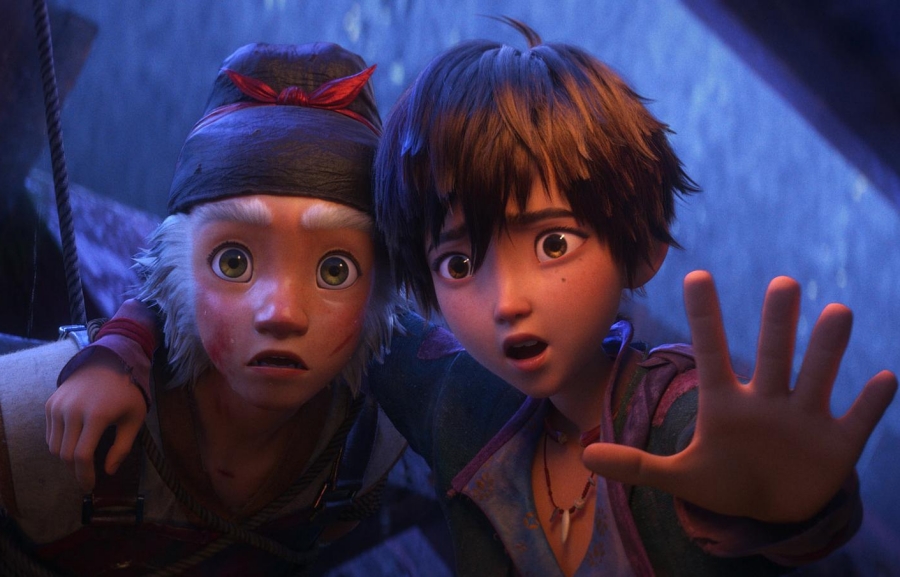
A still from "Mystery of Chang'an." [Image courtesy of 10M House Animation]
The film's emotional core lies in its unlikely protagonist duo. "We wanted to create two grassroots characters — Di Shao and his partner are both marginalized in society," Cheng explained. "One is an intern constable, the other is a civilian detective. They solve a conspiracy using unorthodox methods."
Producer Cao offered a more contemporary reading: "Demons in this film can be seen as people with different experiences or backgrounds. It's not about good versus evil — it's about how we join hands in times of crisis to do something that benefits us all." Li agreed: "We're reflecting the social classes of today through the symbols of demons and the underclass. We want to say that no matter what your status, young people today are fearless — we are all the same."
Asked about future plans, the producers confirmed that while the film itself may not yet be an established IP, the world is rich enough for expansion. "Every character has a background — though many were cut due to time constraints," Cao said. "If audiences respond well, we'll explore spin-offs, short-form content, graphic novels, even AI-generated side stories. The world of 'Mystery of Chang'an' has a lot more to offer."


 京公网安备 11010802027341号