Share:

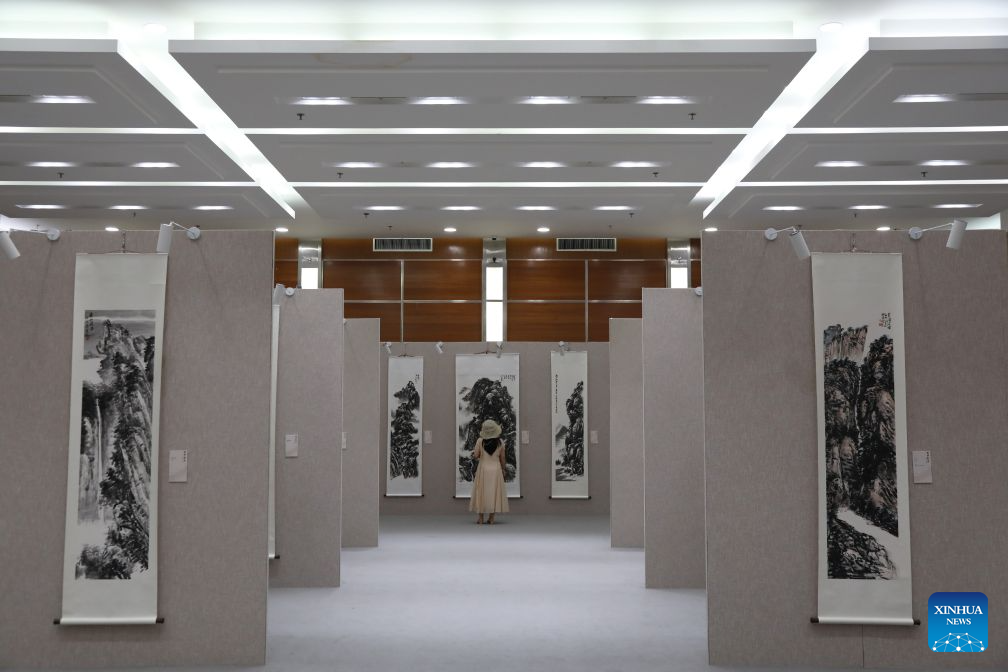
A visitor views exhibits during a traditional Chinese painting exhibition in Beijing, capital of China, Aug. 1, 2026. [Photo/Xinhua]
A half-drawn mountain disappears into a stretch of untouched paper that becomes mist. A branch extends across one corner of a painting, leaving most of the paper untouched. A garden wall contains a single window, offering only a fragment of the landscape beyond. A poem ends before everything has been explained.
In Chinese aesthetics, what is absent can be just as important as what is present. This idea is often expressed through the term 留白 (liúbái), literally "to leave white" or "to leave blank." The term has its roots in the visual arts, where an artist deliberately leaves areas of a composition unpainted. Yet the blank space is not simply empty. It participates in the work.
This can be seen particularly clearly in traditional Chinese ink painting. A landscape does not necessarily fill the paper from edge to edge. Mountains may emerge from great expanses of untouched silk or paper. Water may be represented not by painting the water itself, but by painting the banks, rocks, boats, or reeds around it. Mist can exist precisely because nothing has been painted where the mist should be. The artist does not show us everything. Instead, the viewer is invited to complete what has been suggested, filling the blank spaces with their imagination.
This is one reason the English term "negative space," although useful, does not quite capture everything implied by the Chinese expression. Negative space is primarily a compositional description, but 留白 also points toward an aesthetic choice: the deliberate decision not to fill, explain or complete.
The same principle can be seen in calligraphy. The characters themselves matter, but so do the spaces within and between them. Dense strokes need openness around them. The untouched paper gives the written forms room to breathe. What appears to be nothing becomes part of the rhythm of the composition.
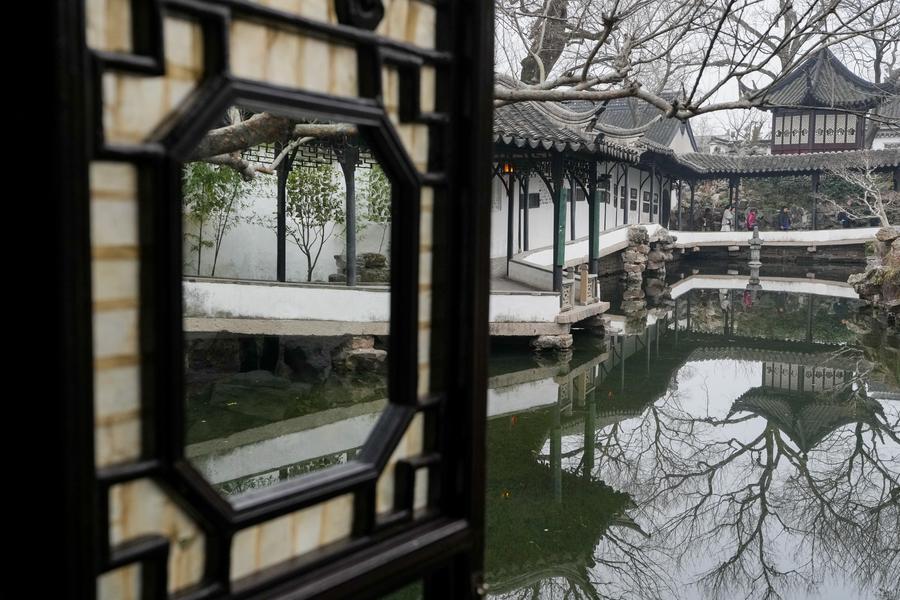
Tourists visit the Humble Administrator's Garden in Suzhou, east China's Jiangsu Province, Feb. 25, 2025. [Photo/Xinhua]
Once we understand this principle from painting and calligraphy, it becomes easier to recognize elsewhere in Chinese culture. Classical Jiangnan style gardens offer a particularly vivid example. A Jiangnan garden rarely reveals itself all at once. Walls interrupt views. Corridors turn unexpectedly. Windows frame only part of a scene. Rocks conceal what lies beyond them. A visitor may hear water before seeing its source.
The result of these design choices is not deprivation. It is anticipation. By withholding part of the landscape, the garden enlarges the visitor's imaginative experience of it. A moon gate does not merely provide passage through a wall. It frames what lies beyond. A lattice window may reveal a few branches, part of a pavilion, or the edge of a rock formation while concealing everything else. And through this framing technique, the unseen portion of the garden remains present in the imagination.
Here, 留白 is no longer literally white space. It has become a principle of experience.
Something similar happens in classical Chinese poetry. A poem need not — and really, should not — explain every emotion it evokes. Images are often placed beside one another without an explicit statement telling the reader exactly how they are connected. A departure, an empty boat, a distant mountain, or the moon seen from two different places can carry emotional weight precisely because the poet does not explain everything those images are supposed to mean. The reader enters the space the poet has left open.
This points toward something larger than a technique used in individual art forms. 留白 reflects a particular understanding of beauty: completeness does not always require everything to be present. Indeed, Chinese aesthetic traditions repeatedly demonstrate that filling every available space can sometimes diminish rather than enrich an experience. If every part of a painting is covered, the eye has nowhere to rest. If every view in a garden is immediately revealed, there is nothing left to discover. If every implication in a poem is explained, there is no room for the reader's imagination.
The power of 留白 lies partly in restraint. That restraint can be found in contemporary design as well. Interior spaces may use emptiness to draw attention to a small number of carefully chosen objects. Graphic design can allow blank areas to give greater force to what remains. Photography can isolate a subject within a large open field. In each case, absence helps determine how presence is experienced.
The principle can even extend beyond aesthetics. Human communication depends on much more than just the words we use — equally important is what we choose not to say. A pause can carry meaning. An implication may sometimes communicate more delicately than an explicit statement. A story that leaves something unresolved invites the listener to continue thinking after it has ended.
Of course, not every silence is 留白, just as not every empty wall or unpainted piece of paper is aesthetically meaningful. Emptiness alone is not the point. 留白 is intentional — something is withheld so that something else can emerge.
That distinction should not be overlooked. The point is not minimalism for its own sake. Instead, the spaces left blank are an invitation. It is easy to imagine creativity as an additive process. We improve something by adding another detail, another explanation, another feature or another sentence. Yet Chinese aesthetic traditions repeatedly remind us that creation can also involve subtraction. The decision to stop can be as consequential as the decision to begin, and choosing to withhold can be the most generous act. At its best, 留白 leaves the completion of the art in the hands of the reader, listener or viewer.
Perhaps that is why 留白 travels so easily from painting into gardens, poetry, design and even everyday life. The forms change, but the underlying principle remains remarkably consistent. What is left open creates room for imagination. What is concealed encourages discovery. What is left unsaid allows another person to participate in creating meaning.
Shelly Bryant is a writer and culture & communication consultant living in Singapore and China's Shanghai.
Opinion articles reflect the views of their authors, not necessarily those of China.org.cn.


 京公网安备 11010802027341号