 Share:

Rescuers in southwest China's Xizang autonomous region are racing against time under harsh, high-altitude conditions following a massive mudslide on Aug. 26 that struck the Gyirong border port. As of Aug. 29, official reports confirmed 16 fatalities, with 546 people still missing.
The catastrophe was triggered by a high-altitude glacier collapse on Mount Langtang Lirung in neighboring Nepal. Originating at an elevation of roughly 5,200 meters, an ice-rock avalanche swept down the mountain, transforming into a torrential debris flow that traveled nearly 22 kilometers before engulfing Gyirong Port at an altitude of 1,800 meters. The disaster flattened a 0.7-square-kilometer area, and destroyed 27 buildings, leaving the primary port facility reduced to bare steel frames.
Search teams are facing extraordinary operational hazards. In the core disaster zone, rescuers are contending with steep valley terrain, volatile weather and thick mud up to 1 meter deep. Strong currents and heavy sediment make movement treacherous, yet emergency crews continue conducting line searches across designated grids.
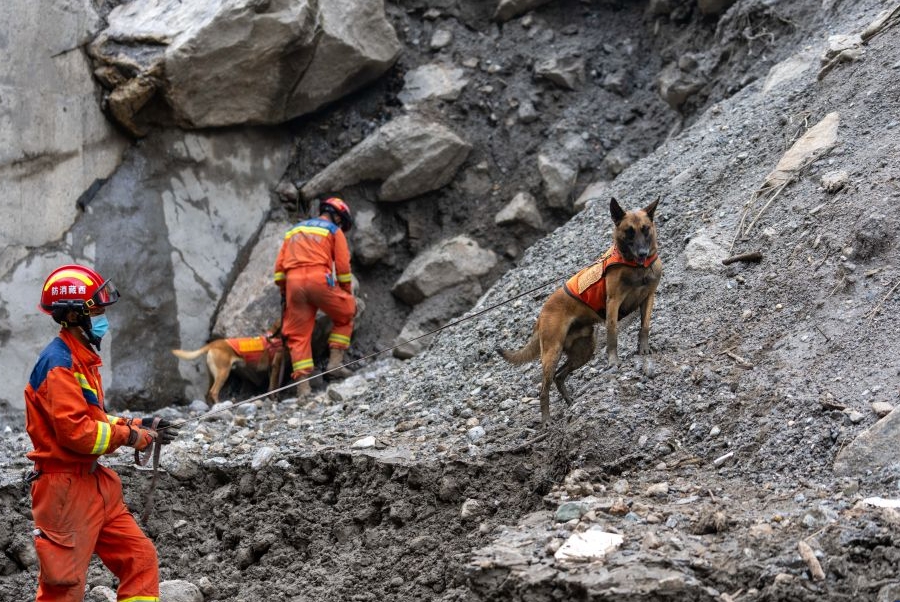
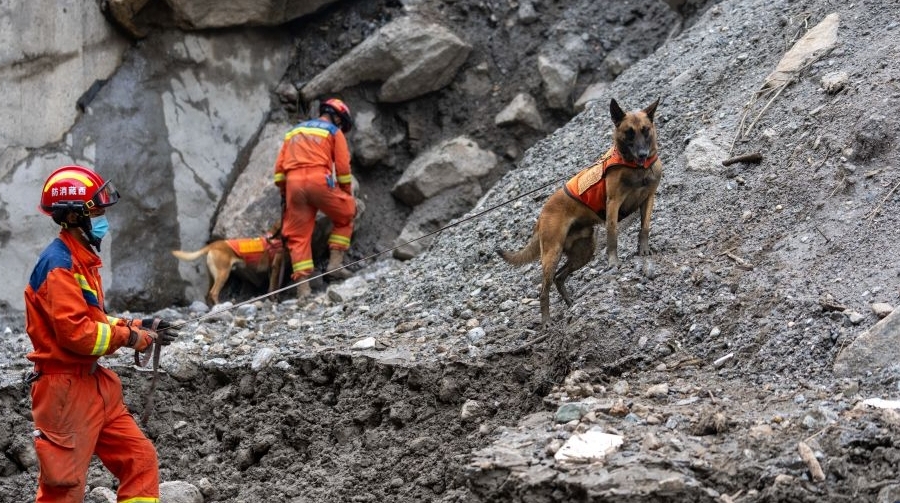
Rescuers and sniffer dogs search for missing people in the mudslide-hit area in Gyirong county, Xizang autonomous region, Aug. 30, 2026. [Photo/Xinhua]
So far, a total of 2,141 personnel — including members of the People's Liberation Army (PLA), the People's Armed Police Force and state engineering enterprise China Anneng — have been deployed alongside 269 rescue vehicles and nearly 4,000 sets of rescue equipment.
Numerous overseas social‑media users lauded China's efficient disaster relief mobilization capability, observing that China is carrying out all-out search-and-rescue work in the face of grave difficulties.
As of the evening of Aug. 30, telecom operators in Xizang had restored one damaged base station and built nine new ones. Communications signals will continue to be further optimized, with efforts underway to achieve full‑signal coverage across the entire port area as soon as possible.
On the afternoon of Aug. 30, the latest on‑site monitoring of the Gyirong disaster in Xizang found that the new barrier lake formed by the mudslide had achieved natural overflow and had mostly drained. All emergency rescue and disaster relief operations are pressing ahead at full speed.
Nepal's National Disaster Risk Reduction and Management Authority posted on social media on Aug. 30 that as of 6 p.m. local time, the bodies of 781 victims had been recovered in mudslide‑hit areas of the country, with another 2,502 people reported missing.


 京公网安备 11010802027341号