Share:

A group of international media members toured BYD's global headquarters in Shenzhen's Pingshan District on Friday, where they experienced high-speed driverless drifting, witnessed extreme cold battery tests and learned about the company's rapid rise from a small battery workshop to a Fortune 500 automaker.
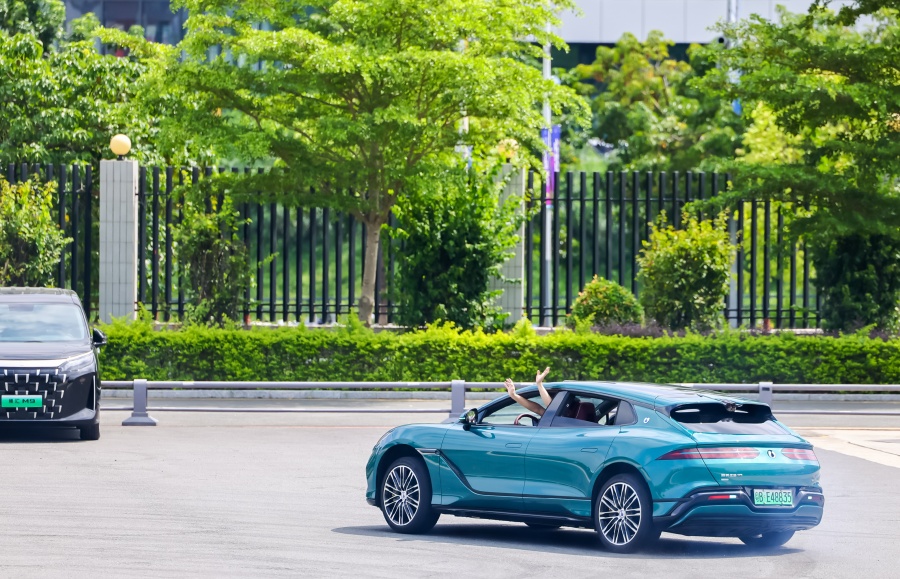
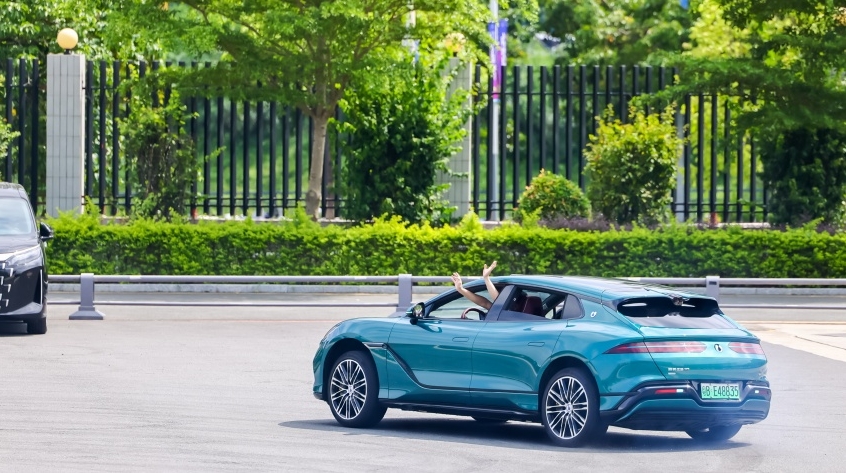
Alexey Migunov, co-founder of PrimaMedia, sits in a BYD vehicle to experience high-speed driverless drifting at BYD's global headquarters in Shenzhen, Guangdong province, Sept. 4, 2026. [Photo/China.org.cn]
The visit was part of the larger Asia-Pacific Media Forum, which opens in Shenzhen on Sept. 5 under the theme "Building a Path to Shared Prosperity for the Asia-Pacific Community: Media Consensus and Action."
Alexey Migunov, co-founder of PrimaMedia, a Russian media conglomerate, experienced high-speed driverless drifting at a square of BYD's headquarters.
Speaking on this as he exited the vehicle, he said it was "very exciting, it was an amazing experience." After settling he said, "Now I'm seeing in the future to buy an electric car. It's fast and it's useful. It's soundless and so on. This is our future."
Muhammad Zahir Shah of Bol News Television in Pakistan said Chinese cars "do have a lot of potential to capture not only the Pakistani market, but even Southeast Asia and Central Asian markets. It's a chance that they can move."
Shah added that he believes China is winning global influence and people's hearts not through force or coercion, but through economic development, high-tech innovation and quality products.
At the headquarters, journalists toured the brand exhibition hall and smart testing workshops. They showed strong interest in BYD's extreme cold testing chamber, where staff demonstrated the "water to ice" experiment at minus 30 degrees Celsius. This shows how vehicles can still charge normally in extremely cold conditions. In a nail penetration test, a BYD blade battery remained stable after being pierced, amazing the visitors.
BYD was established in 1994 and is headquartered in Shenzhen. Its business spans four major industries: automobile, electronics, renewable energy and rail transit. With more than 120,000 R&D engineers, BYD has the largest R&D team among global automakers. The company has applied for more than 71,000 patents and obtained more than 42,000 authorized patents worldwide. In 2025, BYD's revenue reached 800 billion yuan for the first time, a new record.
A company representative said BYD has built a "full industry chain" in new energy vehicles, from batteries and motors to electronic controls.
Shenzhen has gathered more than 2,400 upstream and downstream enterprises in the new energy vehicle industry chain.
BYD's self-developed humanoid robot is expected to complete deployment of 20,000 units in 2026, redefining the "super factory" concept, the representative said.
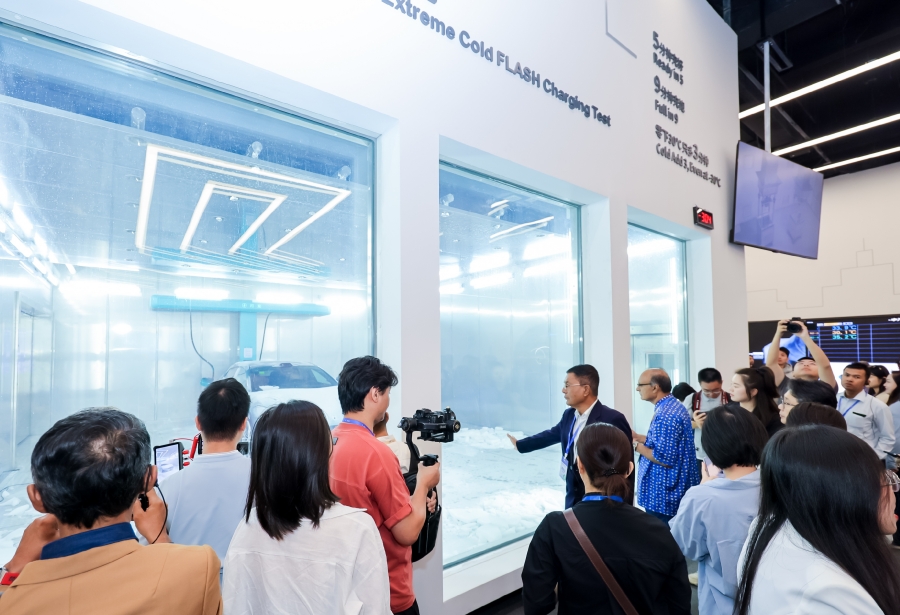
International media members watch extreme cold flash charging test at BYD's global headquarters in Shenzhen, Guangdong province, Sept. 4, 2026. [Photo/China.org.cn]
The company's second-generation blade battery and flash charging technology have created the world's fastest mass-produced charging speed record, according to the company. In normal conditions, the system can charge a battery to 70% in five minutes. BYD plans to build 20,000 flash charging stations by the end of 2026.
From their battery plant of 800 square meters in Shenzhen, BYD has since grown into a Fortune 500 company with a presence in 121 countries and regions. Its new energy vehicle sales exceeded 4.6 million units in 2025, with overseas sales surpassing 1 million units for the first time, up 145% year on year. On average, nine customers choose a BYD new energy vehicle every minute, according to the company.
Shenzhen has given great support for the development of enterprises like BYD. As of 2025, the city had opened more than 2,100 kilometers of roads for intelligent connected vehicle testing, more than a quarter of the city's total road mileage, covering the largest area among first-tier cities in China.


 京公网安备 11010802027341号