 Share:

In 1980, when Shenzhen was established as a special economic zone, its GDP was 270 million yuan ($40 million) and its permanent population numbered fewer than 30,000. By 2025, the city's GDP had reached 3.87 trillion yuan and its population topped 20 million, a more than 14,000-fold increase in economic output.
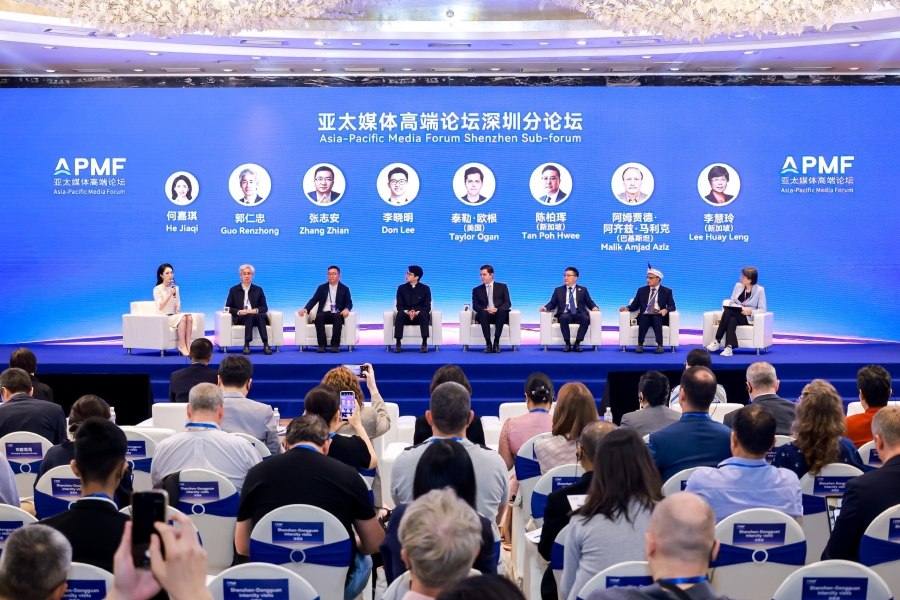
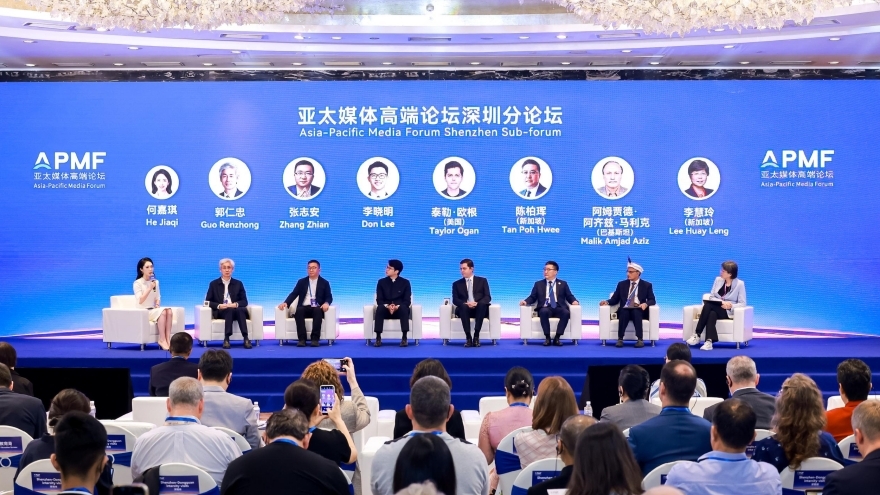
Experts discuss "Decoding the Shenzhen Miracle Code" during the Asia-Pacific Media Forum Shenzhen Sub-forum in Shenzhen, Guangdong province, Sept. 4, 2026. [Photo/China.org.cn]
Experts from China, Pakistan, Singapore and the United States discussed what drives the city and what its rise means for the broader Asia-Pacific region at the panel, titled "Decoding the Shenzhen Miracle Code," held Sept. 4 during the Shenzhen sub-forum of the Asia-Pacific Media Forum.
Guo Renzhong, an academician with the Chinese Academy of Engineering and director of the Research Institute for Smart Cities at Shenzhen University, traced Shenzhen's smart city work back to the 1990s. He said the city received an award for its geographic information applications at the 2013 Geospatial World Forum in Rotterdam, showing that China had developed its own approach to urban geographic information systems. In 2024, Shenzhen won the City Award, the top honor of the World Smart City Awards, at the Smart City Expo World Congress in Barcelona, chosen from 429 cities in 64 countries and regions.
"Shenzhen's successful experience can serve as a reference for any city in the world," Guo said, adding that Shenzhen companies have already carried out smart city projects in Singapore, Kazakhstan, the United Arab Emirates and Saudi Arabia.
Taylor Ogan, founder and CEO of Snow Bull Capital, moved his company from Boston to Shenzhen three and a half years ago. "Boston is a great city of thinkers," he said. "But Shenzhen is where thinkers become makers. That's a key difference."
He noted that Silicon Valley rarely produces actual products anymore. "Shenzhen is still producing high-tech products — that's the biggest difference. Shenzhen companies are innovating, designing and manufacturing."
Asked why Shenzhen startups succeed, Ogan said founders point to proximity to their supply chains. "Their entire supply chains are within a one-hour driving radius. That's crazy. There is no city in the world like that. No place is more innovative."
Malik Amjad Aziz, chief editor of Daily Kasoti, a newspaper based in Peshawar, Pakistan, said Shenzhen offers valuable lessons for countries across Asia.
"Shenzhen is a powerful example of how vision, planning, policy continuity, investment in people and confidence in the future can come together and create miracles," he said. "Shenzhen proves that development is not accidental. It requires long-term planning, solid infrastructure, quality education, technological progress, strong institutions and continuous reform."
For Pakistan, he identified two lessons: continuity of economic planning and connectivity. "China understands that to develop the economy, you must first build roads," he said, citing the China-Pakistan Economic Corridor. "Shenzhen's remarkable journey tells us that transformation is possible when vision is supported by determination, planning and sustained effort."
Lee Huay Leng, editor-in-chief of SPH Media's Chinese Media Group in Singapore, reflected on Shenzhen's evolution. She recalled attending the China Hi-Tech Fair 30 years ago, when people lined up in the rain for tickets to hear a Nobel laureate speak.
"At that stage, Chinese people's hunger for new knowledge and desire to learn from abroad were very strong," she said, adding that Shenzhen's status as a pilot zone gave it greater policy flexibility, fostering a more dynamic and open business environment.
She said Lee Kuan Yew, Singapore's founding prime minister, remarked during a 1988 visit: "If Shenzhen succeeds in the next 10 to 15 years, there is no reason for China not to succeed."
Tan Poh Hwee, president of the Asia Academy of Digital Economics in Singapore, said Shenzhen's true strength lies in its ability to translate differences into interfaces.
"People from different places and backgrounds can all take root in Shenzhen," he said. "Shenzhen's real product is the ability to bring technology, capital, talent and markets together and make them react with one another."
Zhang Zhian, a distinguished professor at Fudan University and director of the Center for Communication and State Governance Research, offered a nuanced perspective. "Many people know Shenzhen's technology, but they may not know its ecology," he said. "They may know its speed, but not its calm."
Zhang said he chose the mangroves at Shenzhen's Futian Mangrove Ecological Park as a symbol because they reveal a side of the city few outsiders see, a space to slow down and experience its ecology. That, he said, reflects a different kind of progress rooted in sustainability and quality of life. The mangroves, in his view, are a metaphor for Shenzhen's cultural depth and long history beyond the past five decades of rapid development.
With APEC leaders scheduled to meet in Shenzhen in November, panelists said the city's experience could benefit the wider Asia-Pacific region.


 京公网安备 11010802027341号