 Share:

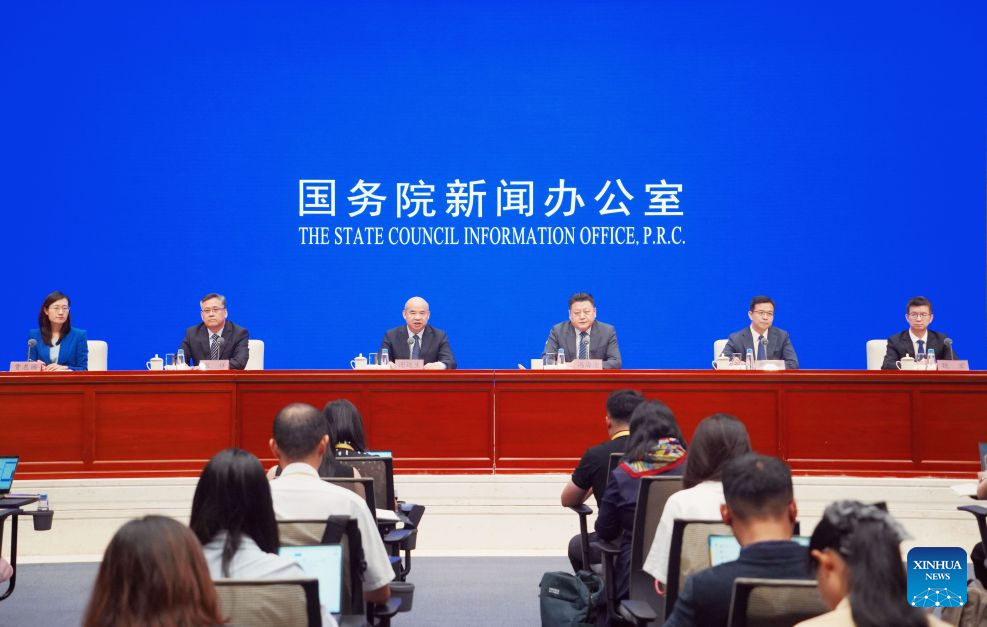
The State Council Information Office (SCIO) holds a press conference on promoting high-quality development of renowned traditional industries in Beijing, capital of China, Sept. 7, 2026. (Xinhua/Pan Xu)
China on Monday issued its first national guideline on boosting the high-quality development of time-honored industries such as silk, tea and porcelain, targeting 50 leading enterprises with annual revenues exceeding 10 billion yuan (about 1.48 billion U.S. dollars) each by 2028.
The guideline, jointly issued by the Ministry of Industry and Information Technology (MIIT) and five other government departments, also aims to shape 100 national consumer brands and build several industrial clusters with an annual output of over 100 billion yuan by 2028, and to foster world-class enterprises and renowned brands by 2030 as these industries move up the global value chain.
Developing established industries with profound Chinese features, which also cover traditional Chinese medicine, brewing, arts and crafts, and the "four treasures of the study" -- writing brush, ink stick, paper and inkstone, is an effective way to expand domestic demand and boost consumption, as well as an important vehicle for passing on Chinese civilization and strengthening cultural confidence, according to the guideline.
Representative sectors of these traditional industries now boast about 25,000 enterprises above the designated size, employing nearly 3.5 million people and generating about 8 trillion yuan in annual revenue, MIIT Vice Minister Xie Yuansheng told a media conference on Monday. "Time-honored industries are the crystallization of Chinese civilization and national treasures," he said.
The guideline comes as China seeks to turn its cultural heritage into market competitiveness. Feng Haicang, an official with MIIT's consumer goods industry department, noted that about 90 percent of China's silk products are exported, but mainly as raw materials or original equipment manufacturer goods, with domestic brands having limited pricing power in the global market.
To help classical industries embrace innovation without losing tradition, the guideline calls for building "industrial brains" in major production areas, applying artificial intelligence to decode traditional craftsmanship, and constructing smart tea factories, smart pharmacies, intelligent kilns and digitalized breweries.
"Embracing AI does not mean abandoning old craftsmanship, but giving millennia-old techniques a pair of technological wings," Xie said. In silk weaving, AI-assisted design can now generate thousands of patterns in minutes, he added.
On consumption, Xie said Chinese consumers are shifting from "buying more goods" to "seeking better services and experiences," and that revitalizing these industries requires coordinated efforts in products, scenes and channels to help time-honored craftsmanship "come alive, go viral and reach every household."
Specifically, the guideline encourages integrating heritage industries with culture, tourism, wellness and rural vitalization, and supports global launches of heritage brands, access to duty-free channels, and international recognition of carbon footprint accounting for silk, tea and porcelain products.
The move is expected to be part of China's broader push to expand domestic demand, which the Central Economic Work Conference listed as the top priority this year.
The country will hold the first national exposition of time-honored industries in east China's Hangzhou City in late October, Xie said.


 京公网安备 11010802027341号