Share:

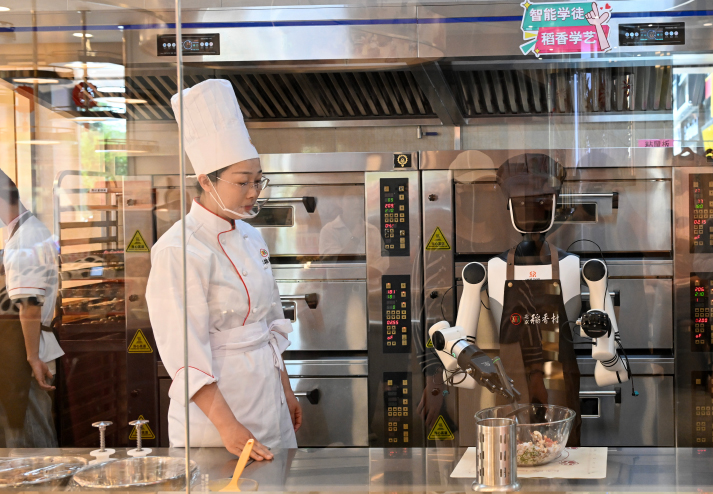
A robot makes mooncakes at a workshop of the Beijing Daixiangcun, a renowned bakery brand founded in 1895 in Beijing, on September 3. [Photo/Xinhua]
AI turns 70 this year. Evolving from the theoretical concepts of the 1956 Dartmouth Workshop in New Hampshire, the United States, where the organizers defined AI as "the science and engineering of making intelligent machines," the technology has become a core productive force deeply embedded in diverse sectors of industry and society after seven decades of exploration. Looking back at the iterations of human industrial civilization, three technological revolutions—steam power, electricity and the Internet—transformed production modes, lifestyles and forms of connectivity. As the core engine of the new-round technological revolution, AI delivers system-wide empowerment characterized by ubiquitous connectivity, human-machine collaboration and cross-border integration.
Against fast-shifting global dynamics, AI innovation has entered an explosive phase. China's core AI industry was valued at more than 1 trillion yuan ($140 billion) last year, with numerous smart applications put into use. Nevertheless, rapid technological expansion has exposed structural contradictions. Some countries adopt tech-hegemony thinking and weaponize AI for geopolitical games. Certain capital groups prioritize short-term gains, giving rise to algorithmic bias, deepfake misuse and data abuse that diverts technology from people-centered purposes.
At this juncture, Chinese President Xi Jinping proposed that all countries should take a people-centered approach and develop AI for the positive and for good, at the 2026 World AI Conference (WAIC) and High-Level Meeting on Global AI Governance in Shanghai on July 17. This pointed the way for global AI governance: Steer cutting-edge technology toward human wellbeing and offer fundamental guidance for tackling shared challenges in the intelligent era.
Unlocking smart growth momentum
AI progress is primarily driven by innovation, and China's vision for AI advocates innovating by cooperating. Openness and win-win outcomes are essential for technology to benefit the world.
In industrial upgrading, physical AI solutions, for example, adaptive industrial robots and collaborative machines, are deployed on factory floors.
In consumer industries, AI design tools raise efficiency dramatically. An AI system at Chinese apparel brand Semir's industrial park generates garment renderings in 30 seconds, condensing multi-day traditional workflows and revolutionizing apparel research and development.
In public services, AI supports justice, transport and healthcare. Chinese AI firm iFLYTEK's AI legal-service tools facilitate judicial analysis, supporting legal professionals by, for instance, automating document review or aiding in case analysis—not replacing human judgment. Shanghai traffic authorities leverage AI technologies for refined urban management, for example by deploying humanoid traffic robots and using AI for traffic anomaly detection, while AI-powered devices at Juxian County People's Hospital, Rizhao City, Shandong Province, reduce missed diagnoses of pulmonary nodules and safeguard grassroots public health. These real-world cases demonstrate how AI is not an exclusive technical barrier but a shared developmental dividend. Open-source collaboration can unlock technological momentum for high-quality economic growth and better public wellbeing.
Security and controllability
Sustained scientific and technological progress hinges on sound risk management. China's AI vision recognizes the connection between development and security, building a regularized legal safety framework enabling AI to advance rapidly yet reliably. In legislation, the newly revised Cybersecurity Law introduces special provisions for AI, together with AI ethics review rules issued by 10 government departments. This delivers a calibrated shift from tolerant experimentation to regulated operation and sets binding compliance standards for the industry.
In judicial practice, landmark rulings define behavioral boundaries for AI. Cases heard by the Beijing Internet Court concerning unauthorized AI-synthesized voice commercialization in recent years confirm that using AI to replicate individuals' voices or likenesses for commercial purposes constitutes infringement. Judgments hold platforms and companies accountable and curb deepfake marketing malpractice. The State Administration for Market Regulation has publicized unfair competition cases in the AI sector, penalizing theft of corporate algorithm codes and big model trade secrets to curb misuse and improper interest transfers. At the same time, leading domestic tech platforms report on their AI-governance work, deploying content traceability and disinformation detection tools to block harmful deepfake material.
Internationally, China calls for rejecting tech confrontation and cross-border risk mitigation via harmonized rules and coordinated supervision. The country's multi-dimensional governance model combining state oversight, judicial checks and corporate self-regulation offers a replicable practice for secure AI usage worldwide.
Safeguarding cultural diversity
Within today's global digital ecosystem, a handful of developed economies leverage platform and technological strengths to promote monolithic digital content. This algorithmic homogenization risks diluting distinctive local and ethnic cultures and creates risks of cultural uniformity.
China's AI framework advocates human-oriented technology development, respects civilizational diversity and champions mutual learning guided by shared human values, with intelligent tools serving as bridges for cross-cultural exchange.
Domestically, AI-powered cultural heritage restoration operates at scale. The Yongle Palace mural restoration project in Shanxi Province uses millimeter-level identification and color reconstruction to restore Chaoyuan Tu, a Taoism-themed mural completed in 1325, for permanent digital preservation. An AI-driven virtual restoration system for Terracotta Army fragments in Xi'an, Shaanxi Province, matches broken pottery textures to assist archaeologists and boost restoration accuracy and efficiency.
Internationally, Chinese AI supports global heritage conservation. A Sino-Egyptian archaeological team employs smart spatio-temporal recording systems to document excavation work at pharaonic sites and build complete digital archives for Egyptological research. These projects demonstrate that AI delivers value beyond productivity gains: It enables equal, fluid dialogue among civilizations.
Multilateral governance
AI belongs to all humanity, and its global governance requires multilateral cooperation and inclusive benefits. Severe imbalances mark global AI development: Developed nations hold advantages in computing power, talent and technology, while Global South countries face capacity shortages. Technological advancement widens North-South gaps and creates new digital inequities.
Committed to true multilateralism, China supplies global public goods and Chinese proposals for AI governance. The World Artificial Intelligence Cooperation Organization, initiated by China, was established in Shanghai as a permanent platform for multilateral consultation. China will offer 5,000 specialized AI training slots for developing countries over the next five years, cultivating local talent across Africa, Latin America, as well as the Association of Southeast Asian Nations (ASEAN) and Shanghai Cooperation Organization (SCO) member states. The domestically developed MAZU meteorological early-warning system has completed pilot deployments and will now be expanded to 30 more countries and regions. It forecasts typhoons, floods and droughts accurately, helping developing nations strengthen disaster preparedness and protect human lives through inclusive AI.
In this intelligent era, only by pursuing multilateral, inclusive governance and rejecting tech monopolies, can AI transcend national borders to benefit humanity and generate sustained impetus for civilizational progress.


 京公网安备 11010802027341号