 Share:


Cyber threats are increasingly transcending national borders, making international cooperation essential, experts said on Tuesday at the ongoing 13th Beijing Xiangshan Forum.

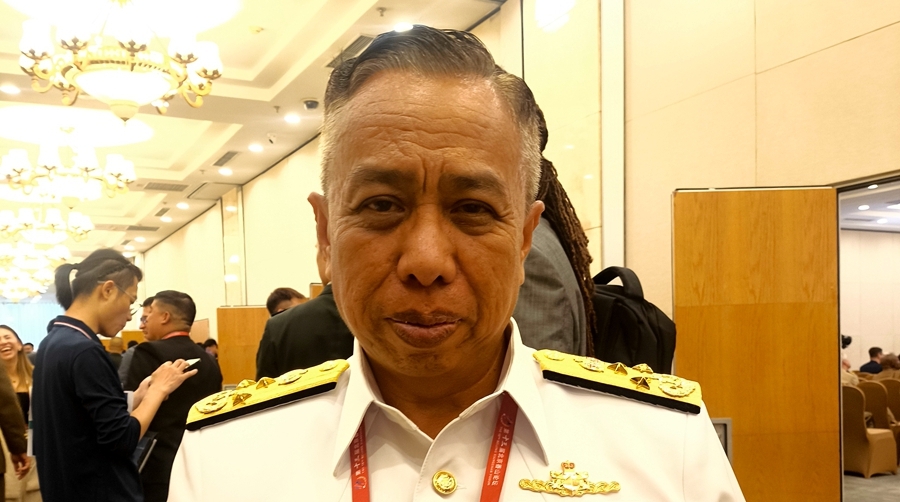
Vice Admiral Datuk Yusne bin Hj Mokhtar, chief executive of the Malaysian Institute of Defence and Security, poses for a photo in a conference venue hallway during the 13th Beijing Xiangshan Forum in Beijing, Sept. 15, 2026. [Photo by Xu Xiaoxuan/China.org.cn]
Speaking to China.org.cn at the forum, Vice Admiral Datuk Yusne bin Hj Mokhtar, chief executive of the Malaysian Institute of Defence and Security (MiDAS), said cybersecurity has become an increasingly complex dimension of warfare and is evolving rapidly.
"There is no one country that can address these cybersecurity issues alone, especially when you are lacking capacity and capabilities to do it," he said.
Yusne said he was particularly interested in multilateral mechanisms and saw the Association of Southeast Asian Nations (ASEAN) as a platform that could bring major powers as well as small and medium-sized countries together to discuss security issues and seek peaceful solutions to disputes.
Within ASEAN, countries could cooperate by sharing infrastructure and information, and strengthening human resources and other capabilities to better respond to cyberattacks, he said.
"If we share our resources, whether in the region or internationally, we can easily contain this threat within a certain threshold. Eventually, we may address this together," Yusne said.
However, with artificial intelligence (AI) increasingly being used in both cyber offense and defense, the issue is becoming more complicated, Yusne said, expressing particular concern about the potential use of AI in cognitive warfare and its ability to influence public perception.
He suggested that countries could work under the Global Governance Initiative toward general rules or international law governing the use of cyberspace. Such efforts, he said, could help establish a common understanding and shared interests in addressing cybersecurity challenges.

Imad Rizk, director of the Institute of Strategic and Communication Studies of Lebanon, poses for a photo in a conference venue during the 13th Beijing Xiangshan Forum in Beijing, Sept. 15, 2026. [Photo by Xu Xiaoxuan/China.org.cn]
Imad Rizk, director of the Institute of Strategic and Communication Studies in Lebanon, pointed to another dimension of the changing security landscape: the growing influence of major technology companies through their investments in big data and AI.
"We are talking about competition in big data and AI investment. Now big companies can influence state decisions," Rizk said.
He argued that major tech companies should therefore have a role in relevant negotiations and discussions on national and global security.
"These companies must be part of these negotiations, must be part of the national security of states and the world," he said.
Rizk also highlighted the need to address challenges involving data communications, cybersecurity, hacking and fraud, warning that the rapid development of technology requires a faster response.
"I think the problem, if we are not going fast, the problem is going faster," he said.
He added that the Global Security Initiative could also play a role in addressing these challenges.


 京公网安备 11010802027341号