 Share:

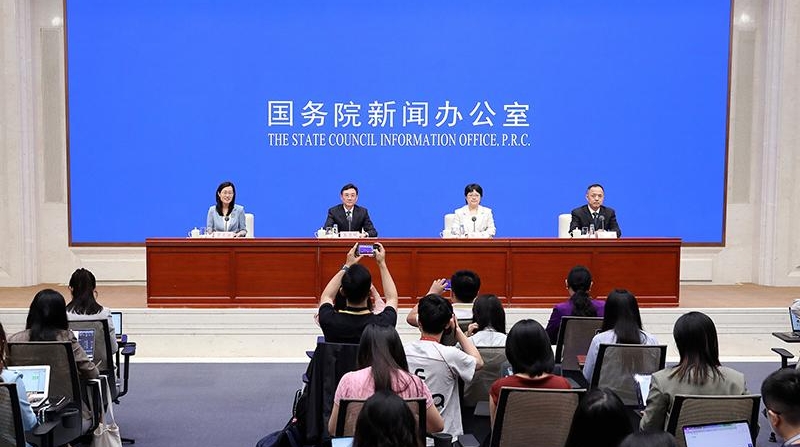
Speakers:
Mr. Wang Weiming, chief engineer of the Ministry of Industry and Information Technology (MIIT)
Ms. Tao Qing, spokesperson of the MIIT and director general of the Bureau of Operation Monitoring and Coordination of the MIIT
Mr. Xie Cun, spokesperson of the MIIT and director general of the Bureau of Information and Communications Management of the MIIT
Chairperson:
Ms. Jia Huili, deputy director general of the Press Bureau of the State Council Information Office (SCIO) and spokesperson of the SCIO
Date:
July 20, 2026
Jia Huili:
Ladies and gentlemen, good morning. Welcome to this press conference held by the State Council Information Office (SCIO). Today's conference is a routine release of economic data. We have invited Mr. Wang Weiming, chief engineer of the Ministry of Industry and Information Technology (MIIT), to brief you on China's development of industry and information technology in the first half of 2026 and take your questions. Also joining us today are Ms. Tao Qing, spokesperson of the MIIT and director general of the Bureau of Operation Monitoring and Coordination of the MIIT; and Mr. Xie Cun, spokesperson of the MIIT and director general of the Bureau of Information and Communications Management of the MIIT.
Now, I will give the floor to Mr. Wang for his introduction.
Wang Weiming:
Ladies and gentlemen,
Good morning. First, I would like to thank you for your continued interest in and support for the development of the industry and information technology sectors.
Since the beginning of this year, under the strong leadership of the Central Committee of the Communist Party of China (CPC) with Comrade Xi Jinping at its core, the MIIT has thoroughly implemented the arrangements of the Central Economic Work Conference and the Political Bureau of the CPC Central Committee, fully implemented the various tasks set forth in the Government Work Report, adhered to the general principle of seeking progress while maintaining stability, and actively implemented the requirements of "stabilizing employment, supporting enterprises, ensuring smooth market operations and strengthening expectations." In the first half of the year, the industry and information technology sectors continued to evolve toward innovation and higher quality.
First, the economic performance remained stable overall. We have accelerated the implementation of policies to boost consumption, advance major national strategies and key-area security capacity building, and promote large-scale equipment upgrades and consumer goods trade-ins. We have also implemented a new round of growth initiatives for 10 key industries, focusing on enriching the supply of high-quality products and services and improving supply-demand alignment. In the first half of the year, the value added of industrial enterprises above designated size increased by 5.4% year on year, and industry contributed more than 35% to overall economic growth. The profitability of industrial enterprises has improved significantly, with the total profits of industrial enterprises above designated size increasing by 18.8% year on year in the first five months. Industrial exports grew rapidly; in the first half of the year, China's total goods exports in yuan-denominated terms rose by 13.4% year on year. The digital industry is accelerating, with total revenue reaching 16.7 trillion yuan in the first five months, up 13% year on year, and profits up 19.3% year on year. Business expectations have remained generally stable, with the production index in the manufacturing purchasing managers' index (PMI) staying in expansion territory for four consecutive months.
Second, innovation capabilities have continued to strengthen. We have further scaled up the "AI Plus" initiative. AI adoption among manufacturing enterprises above designated size has exceeded 30%, and the global cumulative downloads of open-source large AI models have surpassed 10 billion. We have accelerated the formation of a closed-loop chain of "technology, services and industry," designated a second batch of 111 key pilot testing platforms for cultivation, and recognized 14 outstanding and 402 standard-level incubators for technology companies. We have given full play to the leading role of major national sci-tech projects, accelerating breakthroughs in key core and foundational technologies. The "Jiuzhang 4.0" quantum computing prototype has set a new world record in optical quantum information technology, and the world's first invasive brain-computer interface (BCI) medical device has been approved for marketing.
Third, the industrial structure has been constantly optimized. We have driven industrial optimization and upgrading through standards enhancements, formulating 114 new mandatory national standards and 1,403 industry standards. We have thoroughly implemented initiatives for high-quality development of key industrial chains in the manufacturing sector, major technological transformation and upgrading programs, as well as large-scale equipment renewal projects. We have accelerated the smooth transition from old to new growth drivers, and steadily enhanced the resilience and security of industrial and supply chains. We have fostered and strengthened emerging and future industries, launching an action plan to grow emerging industrial sectors and cultivate new growth drivers. The value added of equipment manufacturing and high-tech manufacturing enterprises above designated size increased by 9.3% and 13.3% year on year, respectively. Investment in emerging fields such as computer and office equipment manufacturing and aerospace equipment manufacturing achieved double-digit growth. In the first five months, the profits of "little giant" firms and high-tech enterprises above designated size increased by more than 20% year on year.
Fourth, we have made solid progress in benefiting enterprises and the public. We have further intensified comprehensive rectification of cutthroat internal competition, and released mandatory national standards covering sectors including photovoltaic power and intelligent connected vehicles. We have used a combination of measures to bring greater order to market competition, including production capacity early warnings, capacity replacement and regulatory talks with enterprises. As a result, the producer price index (PPI) for the battery manufacturing sector rose year on year for four consecutive months, and prices of products such as lithium carbonate have continued to stabilize. We have intensified efforts to clear overdue payments owed to enterprises and continued to implement special campaigns to reduce corporate burdens. We have rolled out 10 user-centric practical initiatives for the information and communications sector for 2026, directing enterprises to detail measures for telecom service handling and personal information protection to improve overall service quality. We have delivered robust emergency communications support for flood prevention and disaster relief. As of 5 p.m. on July 19, the information and communications sector had rushed to restore 46,600 base stations and mobilized 190,100 support personnel (person-times). We spared no effort to fortify the emergency communications lifeline, command line and support line for flood prevention and disaster relief.
The current international environment remains complex and severe. The structural imbalances between robust supply and weakening demand is still prominent. However, China has distinct strengths in its complete and resilient industrial system. In addition, with reform measures and supporting policies continuously playing an effective role, the overall performance of China's industrial sector remains stable and promising. Going forward, we will focus on high-quality development as our primary task, better ensure both development and security, and issue and implement industry-specific and thematic 15th five-year plans for the industrial and information technology sectors. We will move faster to build a modernized industrial system with advanced manufacturing as its backbone, further enhance the quality and effectiveness of performance in the industrial sector, and maintain the steady growth of the industrial and information technology sectors. All these efforts will contribute to a solid start to the 15th Five-Year Plan period (2026-2030).
That concludes my introduction. Next, my colleagues and I will be happy to take your questions. Thank you.
Jia Huili:
Thank you for your introduction, Mr. Wang. The floor is now open for questions. Please identify the media outlet you represent before asking your questions.


 京公网安备 11010802027341号