 Share:


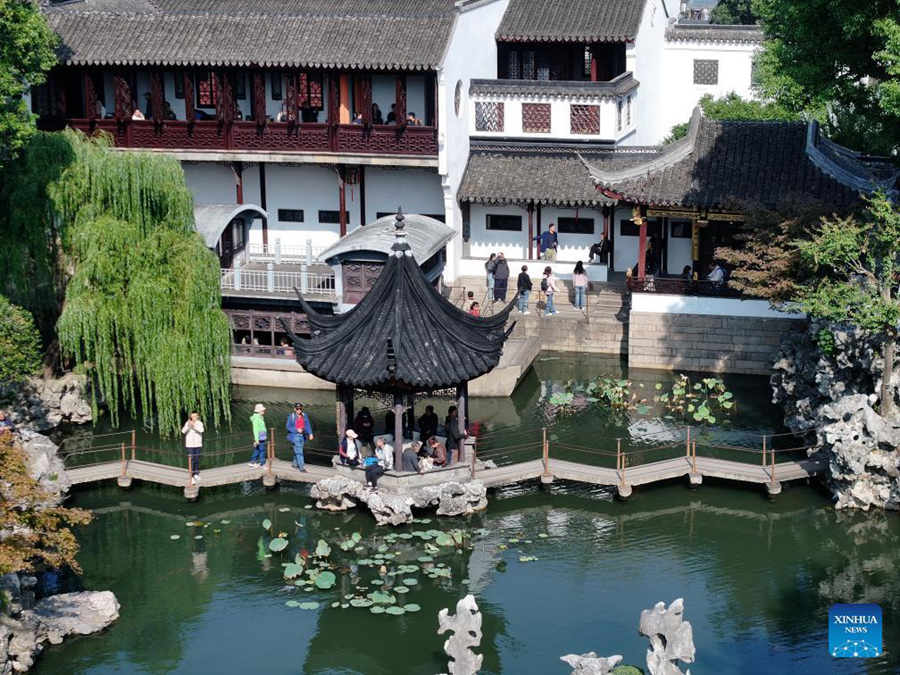
A drone photo shows people visiting Lion Grove Garden in Suzhou, east China's Jiangsu Province. [Photo/Xinhua]
For many international visitors to China, the name Jiangnan (江南) evokes a familiar collection of images: graceful gardens, elegant pavilions, stone bridges crossing quiet canals and mist drifting over lakes. There is something almost immediately recognizable about the Jiangnan aesthetic, even among those who may not know precisely where the region begins and ends. The name suggests refinement, delicacy, cultivated beauty and an appreciation for the finer things in life.
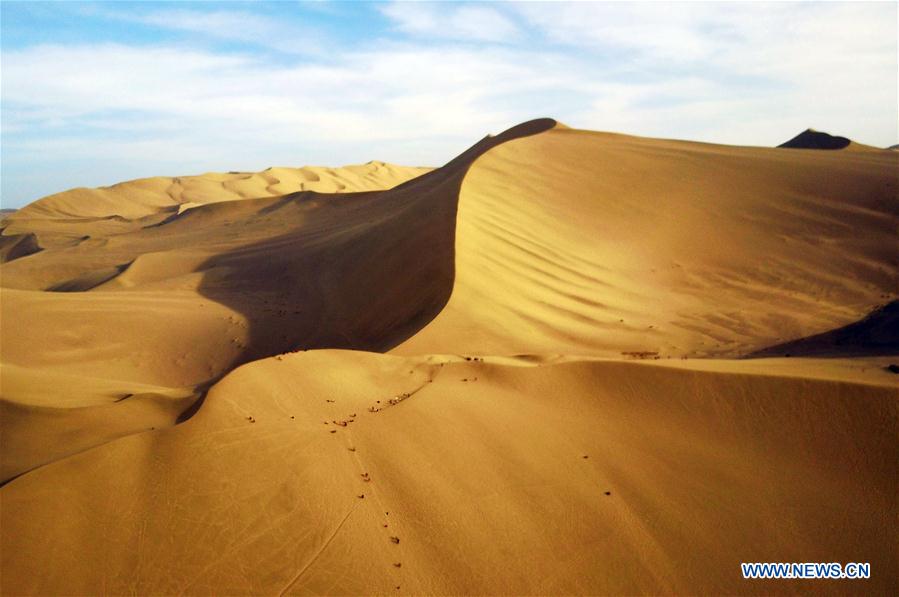
Photo shows the Mingsha Mountain (Singing Sand Dune) scenic site before sunset in Dunhuang, northwest China's Gansu Province. [Photo/Xinhua]
Yet within the Chinese cultural imagination, Jiangnan has a striking counterpart that may be less familiar to international audiences: Saibei (塞北). Literally meaning "north of the frontier passes," Saibei evokes an altogether different landscape. Where Jiangnan suggests gentle rain and intimate gardens, Saibei calls to mind sweeping grasslands, vast deserts, rugged mountains, galloping horses and windswept frontiers. Its imagery is one of immense distances, exposed horizons and the often-harsh conditions of life beyond the historical frontier.
It would be a mistake, however, to imagine these as a simple contrast between beauty and barrenness. Rather, Jiangnan and Saibei represent two different visions of beauty, each with its own aesthetic traditions and emotional associations.
Jiangnan's beauty is often intimate and carefully composed. A garden may reveal itself through a succession of framed views, with a pavilion appearing beyond a cluster of rocks or a flowering branch extending across a white wall. Water, vegetation and architecture combine to create an experience that rewards close attention. Even the weather participates in this aesthetic. Mist softens distant forms, while fine rain gives the landscape a sense of depth and atmosphere.
Saibei offers another kind of beauty, one that can be found in openness, scale and starkness. A solitary figure against an enormous sky, a line of horses crossing the grasslands or the setting sun illuminating an otherwise austere landscape can be every bit as compelling as the most carefully composed Jiangnan garden. Where one aesthetic may invite the viewer to look closely, the other encourages the eye to travel toward the horizon.
Yet the distinction is not absolute. Anyone who has visited a Jiangnan garden in winter knows that its beauty does not depend entirely upon lush greenery and flowering trees. When the leaves have fallen and flowers have disappeared, the garden's rocks, walls, bare branches and architectural lines become more prominent. The result can be strikingly austere, offering a quiet echo of the stark beauty more commonly associated with Saibei.
These contrasting associations did not emerge overnight. They have been shaped through centuries of Chinese poetry, painting and other artistic traditions. One familiar literary pairing captures the distinction with remarkable economy: "铁马秋风塞北,杏花春雨江南," or "iron-clad horses and autumn winds in Saibei, apricot blossoms and spring rain in Jiangnan." In just twelve Chinese characters, two entire landscapes emerge, complete with their characteristic seasons, movements and moods.
The Jiangnan of poetry is often a place of water, flowers, gentle weather and remembered pleasures. In his celebrated "Remembering Jiangnan," Tang poet Bai Juyi (772-846) recalls the region through the brilliant colors of sunrise over the river and the green waters of spring. The poem's beauty lies not merely in the scenery, but in the affection and longing attached to it.
The poetic traditions associated with China's northern and western frontiers offer a different register. In "On Mission to the Frontier," Wang Wei's (701-761) famous lines "大漠孤烟直,长河落日圆" describe a solitary column of smoke rising straight above the vast desert and the round setting sun over a long river. The imagery is spare, yet the sense of space is enormous.
Although frontier poetry encompasses landscapes beyond what is strictly called Saibei, it helped establish an enduring vocabulary of distance, grandeur, hardship, solitude and sometimes heroic ambition. Over time, these literary landscapes became cultural shorthand capable of evoking an entire atmosphere without the need for lengthy description.
That shorthand remains remarkably powerful in contemporary popular culture. In films, television dramas and historical fiction, Jiangnan settings frequently provide an atmosphere of elegance, romance, cultivated living or nostalgia. A waterside pavilion, a narrow stone lane, a boat moving beneath a bridge — each can immediately suggest a particular cultural world. Such settings may also carry sadness, separation or longing, recalling the emotional complexity of classical poetry.
The northern frontier offers a different visual vocabulary. Horses moving across open grasslands, distant mountains, military outposts and expansive skies can suggest freedom, adventure, endurance, martial courage or isolation. Martial arts fiction and its screen adaptations have helped keep these associations alive, often bringing characters from different geographical and cultural worlds into contact with one another.
These representations are not necessarily accurate portraits of everyday life in either region. They are inherited imaginative landscapes, shaped and reshaped by generations of storytellers. The same visual traditions now appear in commercial settings. Tourism campaigns promoting Jiangnan destinations often emphasize water towns, classical gardens, tea, traditional architecture and leisurely experiences. Hotels, restaurants and lifestyle brands draw upon similar imagery to suggest refinement, tranquility and cultural sophistication. By contrast, destinations associated with the northern frontier may be promoted through dramatic desert scenery, grasslands, horseback riding and the promise of adventure beneath immense open skies. The appeal lies not in delicacy, but in grandeur and the experience of space. In both cases, marketing draws upon associations that audiences have already learned to recognize. A few carefully chosen images can evoke centuries of cultural representation.
Interestingly, the two imaginative worlds can also be brought together. The expression 塞北江南 (Saibei Jiangnan), a traditional epithet for the fertile Ningxia Plain, draws its appeal from the apparent contrast between the two regions. The idea of finding Jiangnan's abundance and beauty north of the frontier becomes meaningful precisely because the two places carry such distinct associations.
Of course, neither Jiangnan nor Saibei can be reduced to the images that poetry and popular culture have given them. Both encompass complex histories, varied landscapes and living communities whose experiences extend far beyond these familiar representations. But that is part of what makes the contrast so revealing. Geography tells us where a place is. Literature, art and popular culture help shape what we imagine that place to be.
Jiangnan and Saibei have become two enduring ways of imagining beauty in China: one often associated with intimacy and refinement, the other with vastness and stark grandeur. Their landscapes are real, but the meanings they carry have been cultivated through centuries of imagination.
Shelly Bryant is a writer and culture & communication consultant living in Singapore and China's Shanghai.
Opinion articles reflect the views of their authors, not necessarily those of China.org.cn.


 京公网安备 11010802027341号