 Share:


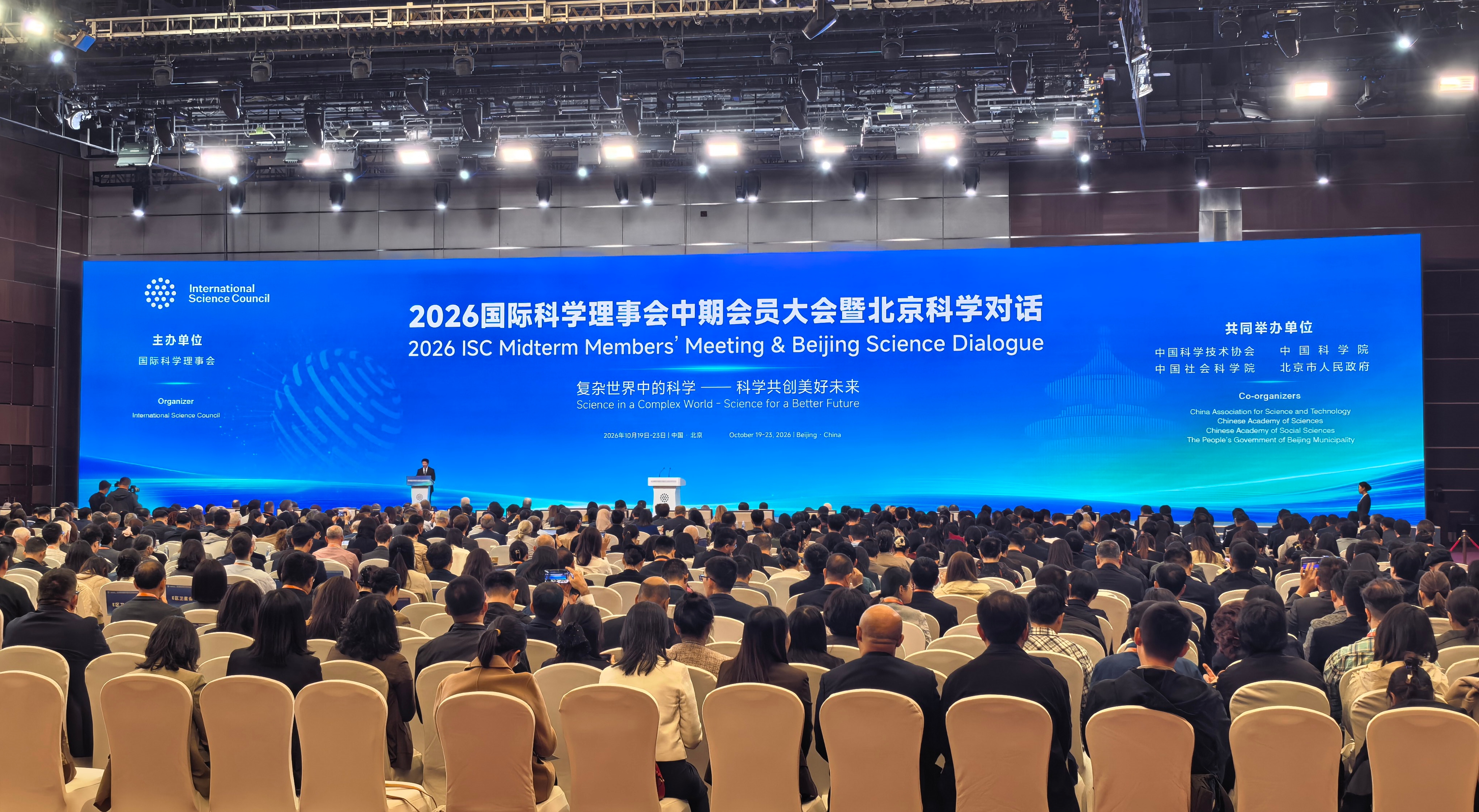
Scientists from around the world gathered in Beijing for the opening of the 2026 International Science Council (ISC) Midterm Members' Meeting and Beijing Science Dialogue on Oct. 19, with international scientific cooperation featuring prominently in discussions on how science can help address shared challenges and contribute to a better future.
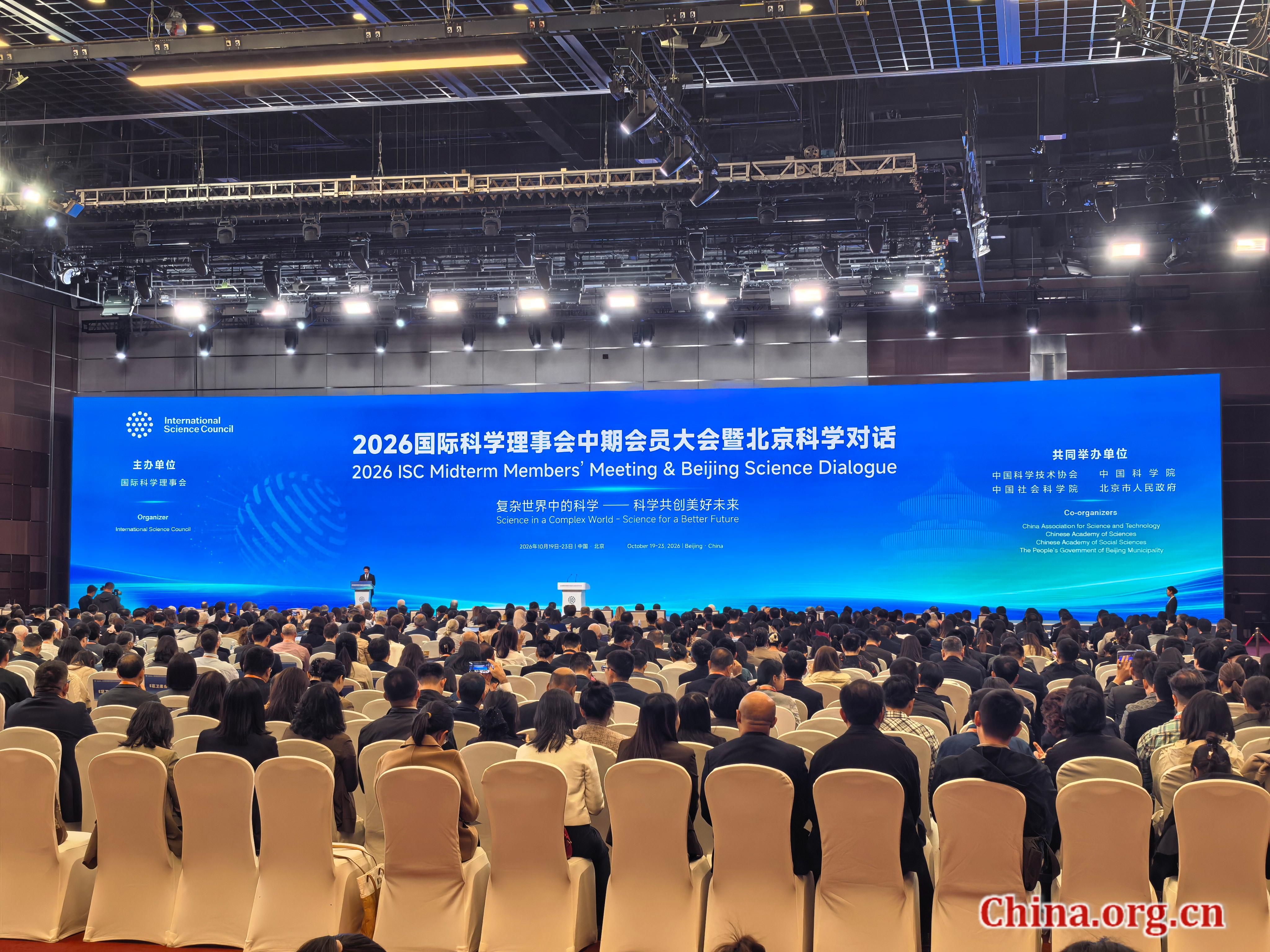
The 2026 ISC Midterm Members' Meeting and Beijing Science Dialogue opens in Beijing, Oct. 19, 2026. [Photo by Mi Xingang/China.org.cn]
Over 1,000 representatives of the global scientific community attended the event, held under the theme "Science in a Complex World — Science for a Better Future." Hosted by the ISC and co-organized by the China Association for Science and Technology (CAST), the Chinese Academy of Sciences, the Chinese Academy of Social Sciences and the Beijing Municipal People's Government, the gathering brought together voices from different disciplines to discuss how science and technology can contribute to addressing shared global challenges and delivering the United Nations Sustainable Development Goals (SDGs).
Speakers at the opening ceremony addressed a range of issues, including global science governance, responsible artificial intelligence (AI) and the role of science in advancing sustainable development.
Peter Gluckman, president of the ISC, said science can transcend political and cultural differences and help build common ground. He also stressed the importance of a collective scientific voice in addressing global challenges, including climate change, biodiversity and the governance of emerging technologies.
Robbert Dijkgraaf, ISC president-elect, noted that scientific collaborations build trust across borders and political divides, often over decades rather than electoral cycles. He emphasized that global challenges require worldwide cooperation, access to global data and expertise, and the integration of different disciplines, perspectives and forms of knowledge.
Dijkgraaf also spoke about science as a global public good, noting that knowledge is the only resource that grows when used and when shared. He called on the scientific community to actively defend international partnerships and uphold academic freedom, openness, integrity and international collaboration.
The value of sustained cooperation was echoed by Brian Schmidt, 2011 Nobel laureate in physics and former vice-chancellor of the Australian National University. Drawing on the history of scientific exchanges between China and Australia, he highlighted how research relationships can endure through challenging times and create lasting connections between people.
"Research partnerships come from the bottom up, not top down," Schmidt said in an interview ahead of the conference. Scientists can start small, get to know one another and learn from each other before gradually expanding their partnerships, he said. He also stressed the importance of researcher mobility, long-term funding and open data. Scientific research, he noted, requires a longer time horizon than a few months, often spanning five to 10 years.
Schmidt pointed to astronomy as an example of how international collaboration can advance discovery. He cited cooperation involving Chinese and Australian researchers and the use of new-generation facilities, including China's Einstein Probe (EP) and the Five-hundred-meter Aperture Spherical Telescope (FAST). Such partnerships, he said, can both improve research and build relationships that help countries respond to future crises.
Maria Jarquin, a member of the ISC governing board, emphasized in an interview that trust and equitable participation are essential to effective international research partnerships. All partners should have the opportunity to contribute equally to discussions and access resources, she said.
Jarquin also described science as a platform for easing tensions between countries, calling it a universal language that can bring people together to discuss shared challenges and aspirations. Scientific mobility, she added, is an essential part of international partnerships, enabling researchers to exchange ideas and address common challenges.
At the opening ceremony, Irina Bokova, patron of the ISC and former director-general of UNESCO, emphasized that science and the international scientific community are essential to renewing multilateralism, calling for equitable access to scientific knowledge and greater opportunities for researchers from all regions to shape global agendas.
Wang Guangqian, president of CAST, reaffirmed China's commitment to achieving greater strength and self-reliance in science and technology, while deepening open and inclusive international cooperation. He called for joint efforts to address major global scientific challenges, including climate change, energy transition and health, promote responsible AI, and facilitate the global sharing of scientific data and research outcomes.
The opening ceremony also showcased several scientific achievements, including the Global Data Products for Sustainable Development (2025), Exhibition of Major Achievements in Archaeological Sciences and Cultural Heritage Conservation, World Journal Clout Index (WJCI) of Scientific and Technological Periodicals, China Fundamental Research Report (2026), and Sci-Tech Organizations Gather in Beijing for Global Innovation.
The ISC Midterm Members' Meeting and Beijing Science Dialogue will continue in Beijing through Oct. 23, with participants exploring priorities and pathways for global scientific cooperation in the post-2030 era of the SDGs.


 京公网安备 11010802027341号