 Share:


China will strengthen its earthquake monitoring, forecasting and early warning capabilities during its 15th Five-Year Plan period (2026-2030), leveraging artificial intelligence and advanced sensing technologies to better guard against major earthquakes and mitigate disaster risks, an official said at a Wednesday briefing.

Zhang Qin, deputy administrator of the China Earthquake Administration, attends a press conference in Beijing, Oct. 21, 2026. [Photo by Xu Xiang/China SCIO]
Zhang Qin, deputy administrator of the China Earthquake Administration, said the country will focus its efforts on five priorities, including improving earthquake monitoring and forecasting, identifying major seismic risks, strengthening infrastructure resilience, leveraging technological innovation, and enhancing public preparedness.
China faces significant seismic risks due to the high frequency, wide geographical distribution, and intensity of earthquakes, Zhang said, adding that the administration aims to further consolidate the country's overall capacity to withstand magnitude-6 earthquakes. Earthquakes of magnitude 6 or above are generally classified as strong earthquakes.
A key priority will be identifying potential sources of major earthquakes along 28 large fault zones spanning multiple regions, with the aim of largely mapping out seismic sources capable of generating earthquakes of magnitude 7.5 or higher.
The administration also plans to investigate active faults in another 21 major cities facing risks from earthquakes occurring directly beneath urban areas, building on similar surveys already conducted in 44 cities.
To strengthen infrastructure resilience, China will revise its national seismic ground motion parameter zonation map and introduce seismic zoning for its maritime areas. It will also work with relevant authorities to assess earthquake risks and reinforce critical infrastructure, including energy and transportation facilities.
Zhang said China will develop an integrated earthquake monitoring network spanning space, air, land, and sea, supported by AI, advanced sensors, and high-precision observation technologies.
Dense geophysical observation networks will be established in key regions, while deep-well monitoring stations will be built in areas including the Beijing-Tianjin-Hebei region to improve the detection of potential earthquake precursors.
China will also build coastal seismic observation stations and increase monitoring density in southwestern and northwestern regions, and integrate various specialized seismic monitoring networks into the national network, with the goal of enabling the country to detect earthquakes of magnitude 1.0 to 2.5.
Emerging technologies, including distributed fiber-optic sensing, quantum precision measurement, and edge computing, will be incorporated into the monitoring system to enhance its capability and efficiency.
The country will also upgrade its national earthquake early warning network, which has attracted more than 500 million users and been deployed in more than 10 major sectors, including railways, water conservancy, and nuclear power.
During the 2026-2030 period, the administration will refine the system's core algorithms to improve the speed, accuracy, and reach of earthquake alerts.
Besides existing channels including mobile phones and televisions, additional warning terminals will be installed in densely populated locations, including schools, hospitals, transportation hubs, and major shopping centers.
The administration will further integrate early warning information into automated control systems for high-speed railways, nuclear power facilities, and precision manufacturing operations, enabling measures such as automatic train deceleration and production-line shutdowns immediately after an earthquake is detected.
Beyond technological upgrades, Zhang noted that public education and emergency preparedness will remain central to the country's disaster risk reduction strategy.
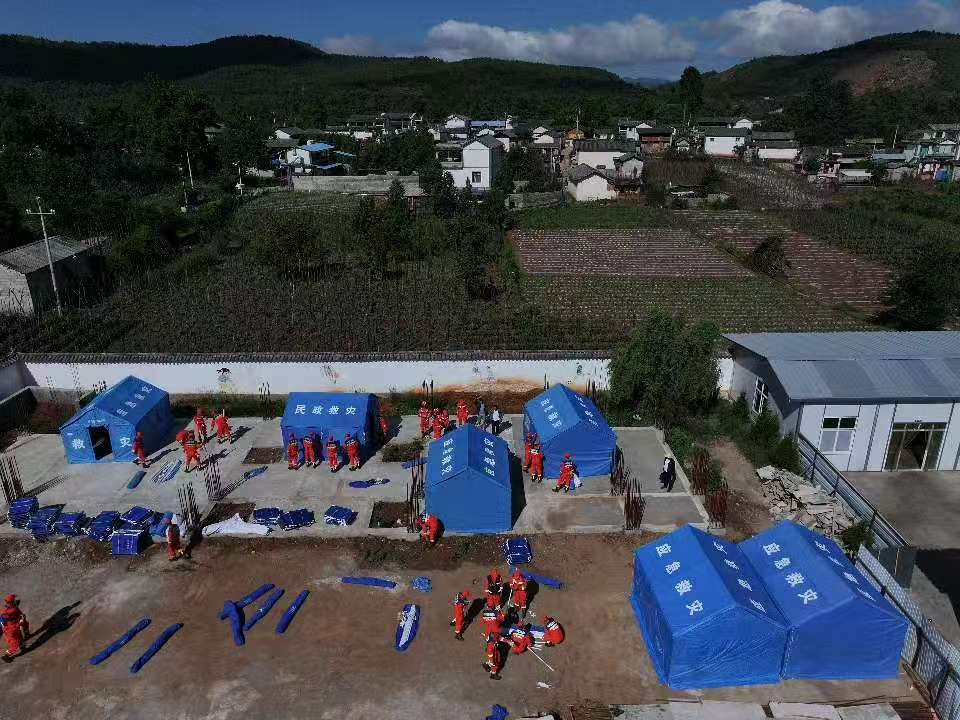
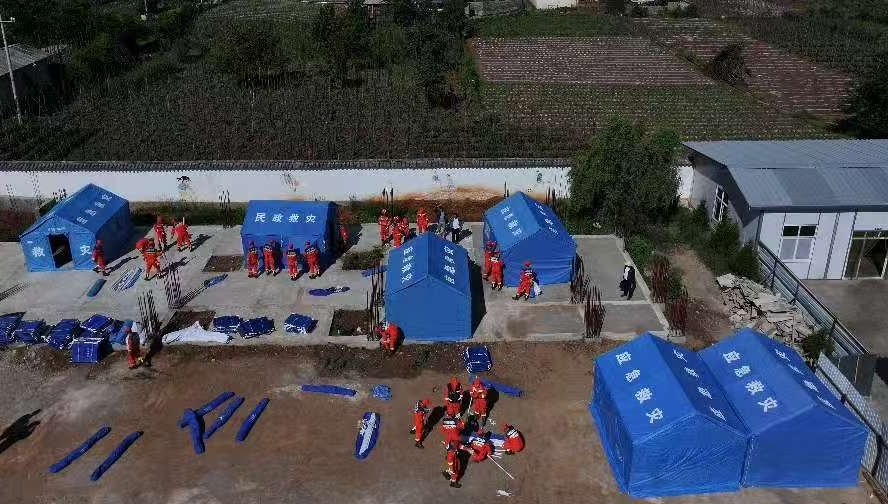
This drone photo shows rescuers setting up temporary shelters at Baicao village of Eryuan county in Dali Bai autonomous prefecture, southwestern China's Yunnan province, June 5, 2025. [Photo/Xinhua]
A new nationwide earthquake science education campaign will reach primary and secondary schools and villages. Authorities will also promote practical emergency drills and encourage the development of dedicated training facilities.
A separate initiative will support the creation of high-quality science communication works, incorporating information on earthquake preparedness and emergency response skills into literature, film, and television.


 京公网安备 11010802027341号